
Hell Under Earth
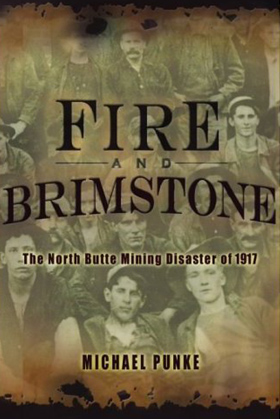
In June 1917, in a shaft in a copper mine in Butte, Montana, some miners were installing part of a new sprinkler system when one of them accidentally ignited a fire. An electrical cable insulated in oil-soaked rags caught flame, and the blaze spread up and down the mineshaft. Soon the mine began to fill with water and carbon monoxide. Within a few hours more than 160 miners were dead.
In Fire and Brimstone: The North Butte Mine Disaster of 1917, the historian Michael Punke tells the grim story, with attention to the personal tales of the men whose lives it claimed but also telling of those who managed to survive—and who lived to fight the unsafe practices of the mining industry.
Many of the miners were very brave indeed. Ernest Sullau, the German-born miner who first ignited the fire, quickly understood the consequences of his error and detected the flood of gas. Rather than save himself, “Sully” rushed deeper into the mine to warn his fellows of the danger they were in. Manus Duggan’s story is similarly heroic. With a small group of comrades far beneath the earth’s surface, he walled himself in for more than a day to avoid the spread of carbon monoxide. His group would eventually emerge from its hiding place and make its way toward rescue, but Duggan himself, perhaps disoriented by gas vapors, wandered back into the mine and to his death.
The Butte mines, Punke explains, began in 1856 after an encounter between white traders and Blackfeet Indians. The portion of the book that tells this wider story is certainly less action-packed, but it is just as absorbing as the account of the disaster itself. In it Punke illustrates the fundamentally Western nature of Butte’s mining culture. The figures behind the town’s rise are familiar types to followers of Western history. Marcus Daly and William Clark, for example, are perfect models of the freewheeling speculators who made their fortunes in the American West.
After the disaster, clashes between labor activists and mining-company strongmen also took on a distinctly Western tone. When a belligerent organizer named Frank Little was beaten and lynched, his masked assailants tagged his body with a note reading “3-7-77.” These numbers’ origins are unknown, Punke explains, but they “had been the calling card of vigilantes during Montana’s frontier days. Sometimes they were marked on a man’s door—a warning to leave the territory.” Butte in 1917 was far from being a frontier town, but traces of that life persisted.
The author brings together both milieu and individual in the figure of Burton K. Wheeler. Wheeler was a man who was intimately connected to the disaster at the North Butte mine and whose later career made him uniquely significant in the history of both Montana and the United States. He helps to meld local events with national history.
In the summer of 1917 Wheeler was the U.S. attorney for Montana. He angered mining-company officials when he refused to crack down on labor organizers in the wake of the disaster. Starting in 1922 he represented Montana in the U.S. Senate. There he would champion President Franklin Roosevelt’s New Deal reforms before becoming a leading opponent of FDR’s court-packing scheme and an ardent isolationist. Punke gives him an unabashedly sympathetic portrayal, saying that only Wheeler’s “fierce independence” kept him from attaining the White House himself. But the author is fair in his acknowledgement of Wheeler’s intellectual failings as well as his political accomplishments.
For a fairly slim book, Fire and Brimstone tackles a wide range of subjects, relating the history not only of the 1917 accident but also of Butte, of the mining industry in the West, and of the decline of modern American mining. The Chilean leader Salvador Allende even makes an appearance. As the story winds on past the events of 1917, its connection to the mine disaster sometimes seems tenuous, but Punke admits as much, telling the reader, “The unruly braids of Butte history defy those who search for tidy summation.”
He tells a fine story, alternately sad and exciting, and in so doing he sheds light on a part of American history too often overlooked in favor of events on Capitol Hill or Wall Street.