
A Honeymoon Cut Short: How One Couple Survived the Sinking of the Lusitania
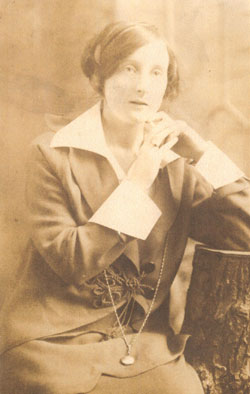
On May 1, 1915, newlyweds Lucy and Harold Taylor of Niagara Falls, New York, threaded their way through a knot of photographers and reporters gathered at New York City’s crowded Pier 54 on their way to board the R.M.S. Lusitania. A few photographers ribbed the Taylors about the “Last Voyage of the Lusitania, a macabre reference to recent newspaper coverage of the German Embassy’s warning that: “Vessels flying the flag of Great Britain, or of any of her allies, are liable to destruction in those waters and that travelers sailing in the war zone on ships of Great Britain or her allies do so at their own risk.”
The self-conscious, 19-year-old bride was far more concerned with the reporters knowing that she and Harold were newlyweds than the momentous world war raging across the ocean. She was certain that the confetti that still bespeckled their fancy clothes would announce their status to the whole ship. But it was Lucy’s hat, a fancy affair boasting a long, elegant peacock feather, that drew attention. As she reached the top of the gangplank, a young sailor plucked her hat off her head and threw it overboard. Peacock feathers on a ship, he explained among the din, were very bad luck indeed.
Germany’s warning deterred almost no one. For some, boarding a British vessel in 1915—a year into the Great War—was an act of patriotism and defiance against Germany. Most felt the expense of the ticket was too great to waste. (At a time when the average American worker earned only $687 in one year, the cheapest ticket for the Lusitania cost more than $30.) The Taylors, whose combined fortune totaled $100, had obtained their third-class passage solely by virtue of an aunt’s generosity, without which they would have spent their honeymoon trip on the less glamorous R.M.S. Mauretania. Refusing such magnanimity was unthinkable.
The Lusitania was impressive by any measure. “The Greatest Steamship Ever Built,” raved The New York Times after her 1907 maiden voyage. “If the Lusitania were stood on end she would almost equal the combined heights of the three great skyscrapers of New York: the Park Row Building, the St. Paul, and the Flat Iron.” The liner could hold 2,200 passengers, 850 crewmembers, and a full dance orchestra, which performed nightly in an opulent, two-tiered dining room in the first-class section. Even third-class passengers had common rooms to themselves; many other ships of the day did not provide this comfort to those in the cheapest cabins. “Just now,” claimed a writer for the Philadelphia Inquirer, “the man who came over in the Lusitania takes precedence of the one whose ancestors came over in the Mayflower.”
During the day, Lucy and Harold strolled the decks, sun bathed in deck chairs, conversed with fellow passengers, and played deck games. They dined well—not as decadently as the passengers in first class, where oysters, caviar and hard-cooked eggs were served with premium champagne—but better than on most other ships of the period. They ate four hearty meals a day in a pine-paneled dining room with long tables covered in pressed, white linen cloths.
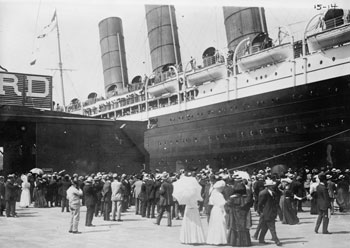
On May 7, 1915, the Lusitania was nearing the end of its journey as it entered the seas around Ireland and England. During the six days the ship had been at sea, German U-boats had torpedoed 23 merchant vessels in this area; only a day before, the German U-20, under the command of Walther Schweiger, attempted an unsuccessful attack on the Arabic, a White Star Line passenger ship. In the evening of May 6, a warning came from the Valentia wireless station: “Submarines active off south coast of Ireland.”
In the early afternoon of May 7, the Lusitania’s captain Turner ignored the British Admiralty’s directives for evading enemy submarines: he neither ordered the ship to go to full speed, nor did he have his pilot zig zag, probably convinced that his ship could easily outrun any trouble. At 1:20 p.m., the Lusitania was cruising at moderate speed just eight miles off the southern coast of Ireland when Schweiger’s U-20 sighted her. The Lusitania was too far out of range, and it was cruising at 18 knots, still too fast for a U-boat to give chase; but it was coming directly towards the U-20 and was not changing course.
At 2:00 p.m., Harold Taylor was strolling the deck alone while Lucy napped below in their cabin. The ocean was calm, and the day was clear, devoid of the fog that had foiled the attack on the Arabic the day before. Schweiger maneuvered for a clean shot. At 2:10 p.m, the U-20 fired a single torpedo.
The torpedo sliced through the ocean and found its mark, ripping into the starboard hull of the Lusitania and sending debris and plumes of water shooting into the air. The ship lost engine power, and began to list dangerously—within seconds it tipped 15 degrees to starboard. Harold sprinted below desk to find Lucy, who was in bed with sea sickness. “We’re hit,” he told her, wrapping her in his sealskin coat and strapping a lifebelt around her torso.
“Hit?” she asked.
“We’ve been torpedoed.”
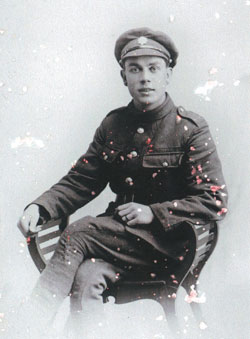
They rushed to the upper decks, Lucy forgetting her shoes in the commotion. The Lusitania carried enough lifeboats for all passengers and crew members, but the severely listing ship made it impossible for anyone to loosen and set the lifeboats afloat. Lucy and Harold fought their way to the starboard side of the ship where some boats were being launched. When a space on one became available for her but not him, Lucy clung to Harold, screaming, “I won’t go, I won’t!” But Harold pushed her into the boat. Lucy put up her hand as the little lifeboat moved away across the water, well aware that her husband did not know how to swim. “Long as I could see him,” she later remembered, “we waved.”
The Lusitania sank in 18 minutes. (By contrast, the ill-starred R.M.S. Titanictook nearly three hours.) Few passengers boarded any of the lifeboats. Only six of the ship’s 48 lifeboats made it to shore. Most people fell or jumped into the water; others, including Harold, remained with the ship as it sank.
Lucy watched the Lusitania’s remaining passengers thrash about in the 52°F water, begging for room on the lifeboats. Her boat mates pounded on the knuckles of those luckless souls, fearing that extra weight would capsize them. “Everyone was for themselves,” she later recalled. “But it seemed terrible to me to do that.” The ocean’s victims eventually succumbed to hypothermia and slipped under the waves.
After a few hours, Lucy’s boat put ashore in Queenstown (now Cobh), Ireland. Townspeople had begun to lay out bodies in rows on the town’s streets and in public buildings. Lucy stared into the faces of each one, even the ones battered beyond recognition by the sea. Lucy did not find Harold among the dead; even so, she considered herself a widow. She wired her family in Niagara Falls, “Harold had gone,” it stated simply.
On the afternoon of the second day after the sinking, still walking around in a daze, Lucy stopped short in the lobby of a Queenstown hotel when a sailor rushed up to her. Only it wasn’t a sailor, but Harold in seaman’s garb. “I think I was,” said Lucy, “the happiest person alive.”
Harold explained how he had been sucked into a vortex as the ship sank and found himself floating miraculously in open water, without a lifebelt, surrounded by the dead and dying. By clinging to pieces of the wreckage, Harold stayed afloat until a small boat trolling for survivors came by. The euphoric couple fired off a new wire to their loved ones at home: “Both saved.”
Their saga had not ended: Once on British soil, Harold, who had immigrated to the United States with his family as an adolescent, was immediately conscripted into the British Army. He fought throughout World War I while Lucy stayed in England, determined to stay as close to Harold as possible. When the Taylors finally returned home to Niagara Falls, in 1922—seven years after the sinking—they settled, raised four children, and lived a quiet life. Harold spent 40 years working for the local electric company. Lucy was known for her gardens, her cooking, and love of her family. Harold died in 1960, Lucy 16 years later.
Their children and grandchildren consider Lucy and Harold’s story one of the finest love stories of all time. “I never saw anything other than a devoted couple,” said Cynthia Kiebala, a granddaughter. In their front parlor stood an upright piano, purchased with Cunard settlement money. One of their daughters bore the middle name, “Lusitania.” Yet in the end, perhaps the most telling remnant of the Taylors’ honeymoon with history is something that their descendants observe to this day. Whether a sign of superstition or remembrance, the the peacock feather has become their family’s emblem of good fortune. “It’s lucky,” said Kiebala, the granddaughter. “We’re connected to history.”