
How Ayatollah Khomeini Changed the World
Twenty-eight years ago today, on February 1, 1979, four million people surged onto the streets of Tehran to celebrate a momentous homecoming. After 15 years in exile, Ayatollah Ruhollah Khomeini returned to Iran that day to lead a revolution that sent tremors around the globe.
The average Iranian had good reason to celebrate, despite what the subsequent decades have taught the world about the returning hero. Khomeini’s flight from Paris landed just days after Iran’s longtime head of state, Shah Muhammad Reza Pahlavi, fled his brutal monarchy. Life under the shah’s government, a police state with a Western veneer, had offered most Iranians little hope, and the exiled ayatollah had become the center of almost messianic expectations. Poets predicted, “When the Imam returns, Iran—this broken, wounded mother—will forever be liberated.” Of course, Khomeini hardly brought the people of Iran the liberation they so badly needed.
Ruhollah of Khomein, as his name literally means, was born in 1900 and spent the first half of his life in quiet study. He was a serious scholar in the Shiite clergy and attained the high-ranking clerical position of ayatollah—one of many, making references to the ayatollah not strictly correct—at a young age. It was not until after World War II that he began his shift from subdued theologian to Islamist firebrand.
Sudden changes in Iranian government and society sparked Khomeini’s political fire. During the 1950s the shah began to reform his decrepit regime along Western, secular lines, imagining himself as a kind of Persian Ataturk. But unlike his Turkish neighbor, the shah lacked popular support, and he increasingly relied on SAVAK, Iran’s brutal secret police, to enforce his reforms. Before long his mixture of autocracy and Western liberalism began to agitate religious leaders who opposed any changes to traditional Islamic society.
In 1963 the shah decided to let women and non-Muslims vote in local elections. Khomeini angrily spoke out against this, backed by a medieval alliance of clerics and merchant guilds. When threatened by SAVAK and begged by moderate clergy to soften his confrontational tone, he shot back that “pouring pure water into a cesspool would only be a waste of time.”
Ayatollah Khomeini’s cunning made him a major thorn in the shah’s side. He quickly learned how to make the regime appear anti-Islamic, and he played on the importance of martyrdom in Shiite Islam by planning major demonstrations on holy days. As SAVAK killed hundreds and tortured thousands, Khomeini made sure the shah’s victims looked like modern-day martyrs. Eventually the shah tired of Khomeini’s tricks and forcibly expelled him in 1964.
This could have been the end of Ruhollah Khomeini’s story. He spent the next decade living quietly in Turkey, Iraq, and France. But then the shah’s grip on Iranian society suddenly weakened. The post-1973 oil-boom held no benefit for ordinary Iranians, and many educated, young, urban men, especially ones who had studied abroad, began to agitate for genuine reform. Their goals, secular and liberal and Westernizing, were fundamentally different from the exiled ayatollah’s stark Islamist vision. However, Khomeini’s clever politics and the shah’s heavy-handed violence brought the two disparate movements together in the late 1970s.
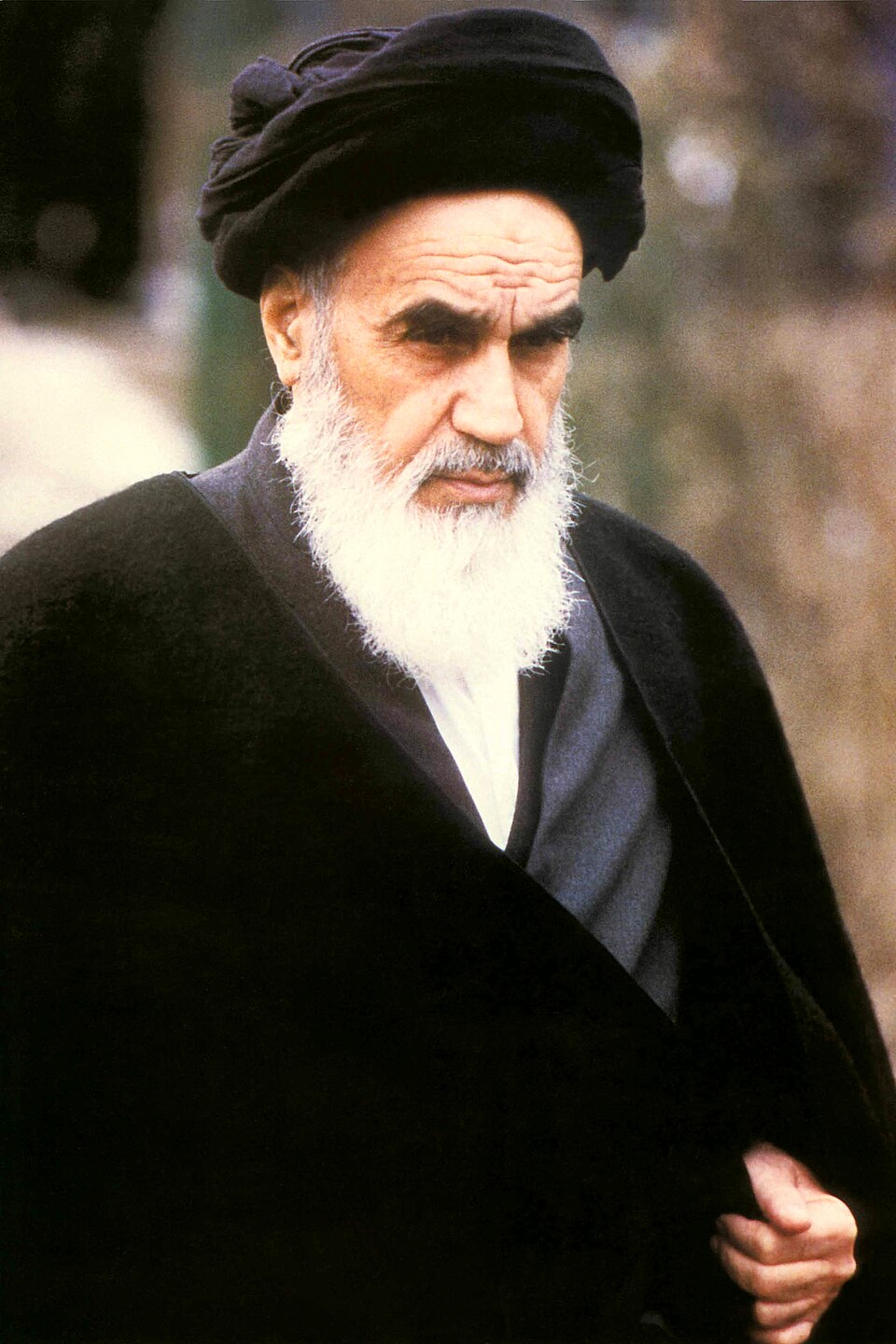
Exile actually strengthened Khomeini’s position. He used the West’s open media (which he often condemned) to craft his image as a Revolutionary leader. The beard, the black turban, the stark uncompromising gaze—all helped to establish his mystique. Even his lack of charisma won him supporters. His austere, antisocial nature came across as otherworldly, high above the pettiness of the shah’s very worldly regime.
His cult grew. Soon Persian peasants claimed to see his face in the moon at night. Most important, he deliberately played down the radicalism of his beliefs and simplified his scholarly language for a wider audience. Millions of Iranians who pined for a liberal republic, not an Islamic state, were conned into seeing Khomeini as their savior.
As the two revolutions fused, the shah’s regime stumbled. SAVAK’s torture chambers could not contain the combined efforts of the clerical and student movements, and in 1978 riots began to engulf the nation. The shah foolishly tried to both crush and mollify the movement, declaring martial law but also admitting his regime’s “corruption and cruelty.” This was a huge mistake, and Shah Muhammad Reza Pahlavi—hated, depressed, and secretly dying of cancer—fled his monarchy in January 1979.
Twenty-eight years ago today “the imam” returned, welcomed by Iranians of all political stripes. Soon the army declared neutrality, what was left of the shah’s government collapsed, and Khomeini began to consolidate his power. Slowly his true beliefs seeped out from behind the popular image. By April, show trials, executions, and attacks by gangs of thugs succeeded in killing and intimidating his main opponents. Iran’s liberal revolutionaries either joined his movement or disappeared.
Khomeini’s violent supporters presented a terrifying image of the new Iran, “riding in great armadas through the streets on their motorbikes, traditional Shi’ite black flags held aloft,” in the words of one observer. Within a year Iran was an “Islamic republic,” with an overseeing body of fundamentalist “guardians.” As in France in 1793 or Russia after 1917, the country’s much-needed revolution was devouring its children and all of its promise.
American blunders certainly aided Khomeini’s rise. Though many blamed President Jimmy Carter alone, decades of misguided U.S. policy had encouraged the Islamic republic’s creation. Several administrations had blindly backed the shah and trained SAVAK agents, who successfully crushed all moderate opposition. Carter followed a confusing policy, with Secretary of State Cyrus Vance and National Security Advisor Zbigniew Brzezinski pushing contradictory goals in Iran.
American policies between 1954 and 1979 gave Iranians cause to rebel but left them with no reasonable leadership. Only Khomeini stood out, and he cleverly profited from the subsequent anti-Americanism. In late 1979 he popularized his Islamic constitution by capitalizing on the U.S. embassy hostage crisis, painting those sensibly opposed to his fundamentalist government as American stooges.
The ugly, protracted hostage crisis of 1979 and ’80 cemented the ayatollah as Iran’s proud leader and America’s most bullying enemy. Through manipulative publicity and sheer defiant zeal he established himself as the most powerful man in the Middle East. His beliefs are still significant nearly three decades later. His legacy is present not only in the region’s violent factions—from Moqtada al-Sadr’s Baghdad death squads to Hezbollah’s Beirut rocket crews—but also in the sober media outlets, clever political parties, and populist humanitarian organizations that draw millions of moderates to a violent form of Shiite Islam.
Khomeini taught Shiite Islamists how to surpass their Sunni equivalents at winning popular support. Consider the massive political and cultural role of Hezbollah compared with that of a relatively small band of Sunni Islamists like Al Qaeda. It is all part of the tremors of an earthquake touched off when Ruhollah Khomeini’s jet landed in Tehran on this date in 1979, a seismic jolt along the most volatile fault-lines on the planet.