
How the Everglades Was Saved—At First
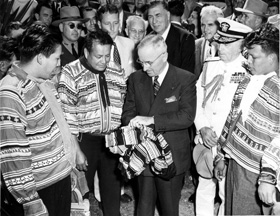
Harry Truman’s name does not usually appear at the top of lists of great conservationists. Sure, he ended World War II, guided America through the beginning of the Cold War, and led his country into the battle on the Korean peninsula. But he also was a leader in the struggle to protect the nation’s environmental birthright. On December 6, 1947—60 years ago today—the former Missouri senator stood in a small Florida town and dedicated America’s newest national park, a multimillion-acre marshland called the Everglades.
He delivered a speech trumpeting ecological preservation. Comparing his efforts at environmental protection to his achievements in international affairs, he said, “The battle for conservation cannot be limited to the winning of new conquests. Like liberty itself, conservation must be fought for unceasingly to protect earlier victories.”
We still hear today about the desperate plight of the Everglades. In the 2000 presidential election, the fight to preserve Florida’s subtropical wetlands became a national issue. The history of the struggle goes back a long way, though. In 1847, when Seminole Indians made their homes there and frequently clashed with American settlers, the federal government sent a researcher, Buckingham Smith, to investigate the possibility of developing the Everglades into commercially valuable land. By the 1870s, traders were hunting birds there and selling their plumes. At the start of the 1880s, a speculator named Hamilton Diston bought four million acres of the wetlands and began draining it to make room for farms.
But not until the 1920s did large-scale construction projects begin to threaten the wetlands’ very existence. Florida was becoming a popular vacation destination, and real estate developers were coming in to capitalize on the tourism. By the time Truman was elected Vice President, in 1944, Florida had a booming tourism industry that profited from the state’s beautiful natural environment, but that environment was in trouble as a result. In 1934, a concerned Congress had authorized the President to designate the Everglades as a national park, but not until the Truman administration was enough money appropriated to actually set the park up and run it.
A few Americans had always recognized the importance of the Everglades—John James Audubon had documented southern Florida’s many species of birds in 1832—but Truman was the first occupant of the White House to lend strong support to preservation efforts. When, in mid-October 1947, he announced his plan to visit Florida, it was welcome news to conservationists. It was also a breath of fresh air to Americans in general. For once, the President’s efforts were focused on a cause that Congress and the executive branch could agree about. After seemingly endless clashes over foreign affairs, here at last was something less divisive.
Truman arrived in the Sunshine State on December 3, several days before he was to open the park. The main purpose of his trip was to formally dedicate Everglades National Park, but he also visited the Key West Naval Base, where he decorated four submarine officers for their service in World War II. Standing aboard a captured German U-boat, he accepted a tongue-in-cheek commission as a “qualified submariner.” And he capped his visit to Key West by swapping his seersucker suit for a pair of bathing trunks and dipping into the ocean water.
When he finally arrived at the Everglades, more than four thousand people had flooded into Everglades City to hear him speak, and thousands more were gathering in nearby Florida City to celebrate the dedication. At the dedication ceremony itself, he delivered his carefully prepared remarks and then met with the tribal leader of the Seminole Nation, William McKinley Osceoia.
At the end of the day, it seemed that great good had been done both for the Everglades, with some two million acres of it placed under federal protection, and also for the state of Florida, which stood to reap millions in new tourism revenues. But in the long run, the gravest portions of Truman’s speech that day would prove the most prophetic. In the six decades since, conservationists have had to struggle harder and harder to protect the Everglades—not only to win “new conquests,” as Truman put it, but also “to protect earlier victories.” Everglades National Park saved millions of acres of wetlands from real estate development, but it couldn’t isolate them from all destructive human influence. By the 1970s, Florida’s continuing real estate boom had pumped a huge amount of pollution into the air and water, decimating the mangrove forests that have always been a crucial part of the coastal ecosystem. Non-native water hyacinth plants blocked rivers, and new damming projects disrupted the natural circulation of the fresh water that was the Everglades’ lifeblood. In the twenty-first century, conservationists have been locked in a fierce battle with Florida’s sugar industry, which has consistently diverted and polluted water that flows into the park. Truman’s move to protect the area was an important first step, but it was not sufficient to ensure the continuing health of the wetlands.
Fortunately, Truman has not been without his political heirs. In the 1980s Florida Gov. Bob Graham worked to put the Everglades back on the national agenda. He continued to fight for the Everglades after winning a seat in the U.S. Senate, where he, a Democrat, and Connie Mack, a Republican, formed a bipartisan partnership in defense of southern Florida’s environment. In 1989 President George H. W. Bush signed a law expanding the park and allocating money for maintenance projects. Then in the late 1990s President Clinton forged a political alliance to restore the park, even persuading sugar manufacturers to sign on with a multibillion-dollar Comprehensive Everglades Restoration Plan. This project has flagged in recent years, and conservationists have struggled to attract the attention of a government preoccupied by the Iraq War. Time may not be on the Everglades’ side, but Truman’s conservationist tradition is unlikely to fade quietly.