
How Good Was the Good War, Really?
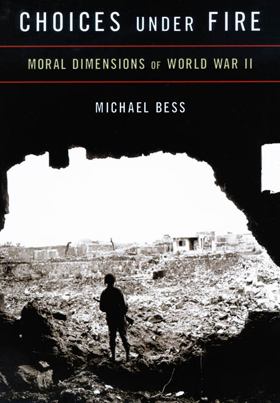
People used to call World War II the Good War, meaning that America’s role in it was morally unambiguous. They did so especially when contrasting it with Vietnam. But more recently, with the rise of what might be called the Howard Zinn school of American studies—stressing the darker elements of our history and casting doubt on any use of armed force—some people have looked at World War II less uncritically. It is certainly worth asking just how good the Good War really was, and the historian Michael Bess does just that with a sometimes splendid if occasionally mildly exasperating new book, Choices Under Fire: Moral Dimensions of World War II (Knopf, 395 pages, $27.50).
It’s an ambitious book, and not a simple one. Bess, a history professor at Vanderbilt University, sees World War II as the event that created the present world and gave birth to a moral order that transcends what he thinks are now old-fashioned ideals of nationalism and military heroism. But he is also sympathetic to the charge that it wasn’t a pure war for democracy and couldn’t be, with the United States allied to both Stalin and the British and French empires. He is painfully aware that Allied strategic bombing killed roughly 600,000 civilians, some of them more or less the direct targets of the attacks, and that the war ended with the use of nuclear weapons against largely civilian populations. He notes that the Allies fighting racist Germany and Japan were themselves racist, with the British and French empires built on racial domination and most of the United States strictly segregated. We fought the war in alliance with a vicious tyranny, the Soviet Union, in many ways as ugly as Hitler’s, and the war ended with that tyranny expanding across Eastern and Central Europe. And he also makes the case that the United States was to some extent a passive bystander to the Holocaust, and that the Nuremberg trials were victors’ justice.
On balance, Bess finds these charges to be largely true, but outweighed both by the vast evil the war averted and by the positive good it in the long run created. He points out that American racism was of a different order of magnitude from that of the Third Reich, with its Final Solution, or of imperial Japan, with its Rape of Nanking. Acknowledging the horrors of Stalin’s Russia does not mean there was any alternative to fighting alongside it; the Red Army killed four of every five German soldiers who died in the war. The moral purity of fighting both Hitler and Stalin would have been insane (which didn’t stop a few people from contemplating it). As for conventional strategic bombing, Bess finds that it made an indispensable contribution to victory, though some of the late-war attacks were unnecessary and should have been avoided. He frequently engages in meticulous and subtle military and moral analysis, often combining the two, and his chapter on the nuclear attacks on Hiroshima and Nagasaki is long, well-informed and deeply impressive. By his most conservative estimate, between 850,000 and 1.8 million lives were spared by the decision to drop the bombs.
He points out what most people who compare Auschwitz and Hiroshima ignore: that in 1945 between 100,000 and 250,000 Asian noncombatants were dying every month, and that a blockade of Japan that lasted through 1946, one of the most likely alternatives to Hiroshima and Nagasaki, could have killed as many as 10 million Japanese (the inhabitants of Tokyo were down to 800 calories a day in early 1946, and MacArthur brought in 800,000 tons of food to avert famine). Thus, ending the war as quickly as possible was morally compulsory, and Bess explains why the odds of Japan’s surrendering without one or two nuclear attacks were slim. He does think the United States should have tried a nuclear demonstration shot first, but he is almost certain it wouldn’t have brought surrender.
Since he believes that both the nuclear bombs and most conventional air attacks, including ones that killed many civilians, on balance saved vast numbers of lives, most of them civilian lives, it is puzzling that he repeatedly calls these events “atrocities.” In general usage an atrocity is the same thing as a war crime, and to imply that acts are war crimes while celebrating both their consequences and the courage of those who committed them, probably confuses more than it clarifies.
It may be that he is unwilling to fully accept some of what he himself says so clearly, that appalling means are sometimes required to prevent even more appalling outcomes.
If so, this would explain his chapter recounting the Battle of Midway. He observes that at Midway American torpedo-plane pilots threw away their lives in attacks that were wholly fruitless but happened to create the opportunity for dive-bombers to destroy the Japanese aircraft carriers. For Bess, the “moral character”—the bravery—of those men carried the day. Well, yes and no; Japanese pilots were every bit as brave. But Midway illuminates none of the moral-military agonies Bess so skillfully assesses, and it may attract him precisely because it requires none of that balancing. No civilians were present, and no necessary “atrocities” were committed by the victors. Midway is probably war the way Bess thinks it should be fought—in a just cause, by just means, and with the just prevailing, against all odds. It seems as if he is subliminally comparing the rest of the war with Midway and finding it wanting. But as the British general Lord Kitchener observed, “We must make war as we must, not as we would like.”
One place where Bess’s analysis is not fully convincing is in his condemnation of kamikaze pilots. For him, an ethical man can bear a weapon but cannot be a weapon without devaluing life itself. But he is aware that the kamikaze attacks were conceived as part of a desperation strategy of making any invasion of Japan too costly for the Allies to pursue, and he knows that the attacks were very effective as the only way Japanese pilots could hope to sink or seriously damage American ships. The Japanese didn’t know that such a strategy was already hopeless against American B-29s and the coming atom bombs, and they sincerely believed the attacks were their only chance to avert an orgy of rape and murder at the hands of victorious and vengeful Americans. In that light, the courage and patriotism of kamikaze pilots seems admirable.
Japan’s systematic use of torture and mass murder give sufficient grounds for condemning that country’s World War II military; it seems odd to damn them for their virtues too. Bess may see the logic of the kamikazes—that of using suicidal courage to frighten enemies into concessions—echoed in some contemporary Islamist thinking, and if he does he is right, although Islamic suicide attackers don’t restrict themselves to military targets, and kamikazes did. The kamikazes were indeed frightening, and the conclusion to draw from the comparison may be that when people sufficiently frighten their enemies, they risk provoking not concessions but a devastating response. The struggle against Islamic terrorists, and their sponsors, is one in which Westerners have so far refused to employ the ferocity we used against the Germans and Japanese. If terror continues long enough or greatly increases, that might change.
There are other odd conclusions in Bess’s book. He greatly admires the courage and patriotism of Allied soldiers in the war, but feels we needn’t emulate their virtues; total war (and to some degree fully sovereign states) are things of the past, he argues, so those virtues are largely obsolete. He thinks not only that nuclear weapons make total war impossible, but also that we have outgrown it, and that military force has very little role in the modern world. While finding fault with the justice dealt at Nuremberg, he also claims that it made international criminal courts legitimate and increasingly effective. He thinks that post-nationalistic enlightened self-interest now informs the foreign policies of progressive European countries like France and Germany, and one senses that he thinks we in the United States have a little catching up to do. To the extent that we need to celebrate living soldiers, he holds up as a modern hero the Canadian Lt. Gen. Roméo Dallaire, who tried to save Tutsi lives in Rwanda. This is odd, because Dallaire failed, and he failed because he didn’t have the means to inflict enough violence on the genocidal Hutus in Rwanda, just as no one is today providing the means to stop genocide in Darfur.
As for European moral evolution, it was François Mitterrand who said that a genocide in Africa was not a matter of great importance, and France and Britain that tried to keep American military power from stopping Serbian terror against Bosnian Muslims. One can oversell the moral acuity of those Europeans who insist that after World War II war is a thing of the past. Odder yet, Bess claims that the professed values of the most pacific and internationalist Europeans are on the rise everywhere. This seems doubtful. Is multicultural tolerance and abomination of war really sweeping the Islamic world? Is disdain for nationalist thinking really sweeping China?
Despite these questionable conclusions, Choices Under Fire is a book with great strengths. It is an all-too-rare example of good generalist history built on a solid grasp of the specialist literature that most of us never read. And in making his own arguments about what we ought to remember about the Second World War, Bess acknowledges that historical memory is always selective, and that there are consequences in what you select to focus on. If we overstate our own country’s crimes we risk weakening our will to use force when it’s really necessary, but if we understate them we risk repeating them. Bess has sought to achieve as just a balance in that regard as is humanly possible. He seems to think that most Americans weight their interpretations in a way that unduly flatters our own past behavior, but he also struggles to avoid the opposite error. He does know that to defeat vast evil it is sometimes necessary to commit some evil—even if he seems to have consigned that lesson to history.