
The Invisible Man Man
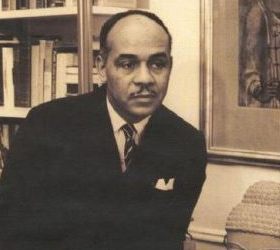
Ralph Ellison, who wrote one of the most profound of all novels about race in America, also lived through the most radical transformation of racial relations in the nation’s history. Arnold Rampersad, in his thorough and insightful new book, Ralph Ellison, A Biography (Knopf, 657 pages, $35), sheds light on Ellison the artist, the turbulence of his time, and the complex relationship between the two.
The future author was born in Oklahoma City in 1913. His father died when Ellison was three. His mother instilled a strong sense of self-worth in her son, but like all African-Americans of the time, he suffered the cruelties of Jim Crow. “Our aspirations were . . . bound by the restricted range of possibilities enforced by Southern tradition,” he later wrote, with stoical understatement.
After studying at Alabama’s Tuskegee Institute, Ellison settled in New York City in 1936. He was briefly attracted to black cultural nationalism and Marxist radicalism, but he soon turned his back on both. Following a wartime stint in the Merchant Marine, he set to work on the novel that was to make his career. He published the book in the spring of 1952. It began, “I am an invisible man.”
“The initial responses . . . to Invisible Man were like the first tremors of a major earthquake,” Rampersad says. Critics recognized that Ellison had written one of the greatest of American novels. “An intensity rare in the fiction of any time or place,” one reviewer noted. “A resolutely honest, tormented, profoundly American book,” said another. With it, Ellison achieved a position he had long coveted among the top ranks of American writers and intellectuals.
Acutely sensitive to every nuance of race in America, he was lukewarm about the burgeoning civil rights movement. He did not join the National Association for the Advancement of Colored People, but he did help raise money for its Legal Defense Fund. He was deeply moved when he heard of the 1954 Supreme Court decision overturning legal segregation. “It made for a heightening of emotion and a telescoping of perspective,” he observed.
As the pace of civil rights agitation accelerated with the sit-ins, bombings, and arrests of the early 1960s, “the scale and speed of the resistance stunned and confused Ralph.” The vicious reaction of Southern whites “rocked his idealistic notions about the likelihood of voluntary change in the South as well as his faith in the white aristocrats of the South.”
Yet he always affirmed “the proud loneliness of the artist and his exception from political definition.” Rather than join the ranks of militant blacks, he steered a distinctly conservative course. “His rhetoric reached new heights of patriotic fervor in response to what he saw as deepening cynicism about America.” In lectures and interviews, he maintained an Olympian distance from the events of the day and “gave no thought to join the March on Washington” in 1963.
Ellison maintained warm friendships with African-American artists and writers of his generation. But, “while black youths hungered for leadership,” Rampersad notes, “the most honored living black American novelist had no young black disciples, students or friends.” He scorned the fiery writer LeRoi Jones, later called Amiri Baraka, who in turn considered him “a snob, an elitist.”
During the mid-1960s, Rampersad relates, “almost uncannily, certain dramatic features of Invisible Man . . . the rioting near the climax of the action; the imminent threat of total chaos—now seemed to be not so much a fictional world created by Ralph as his inspired prophecy.”
Yet the unfolding developments also made Ellison oddly unsure of his writing. “Why did I have to be a writer during a time when events sneer openly at your efforts?” he asked. As the years passed after the publication of Invisible Man, he continued to work on his second novel, which had at its core a political assassination attempt. He found the book impossible to finish. “One reason Ralph was having so much trouble with his novel was that history was interfering with him,” commented his friend the poet Richard Wilbur. “The succession of assassinations in the real world made it necessary for him to revise and keep revising so as to keep his novel from portraying some particular historical event.”
Rampersad lets the air out of the notion that Ellison’s inability to finish his novel-in-progress was connected to a house fire that destroyed much of the manuscript. At the time of the 1967 fire, Ellison acknowledged that he had lost only a few months’ revisions and some notebooks. Later, increasingly embarrassed by his writer’s block, he inflated the loss to hundreds of crucial pages. His failure to finish the book before his death in 1994 had numerous causes, starting with the daunting challenge of matching the success of Invisible Man.
Ellison had long since become a pillar of the nation’s intellectual establishment. President Johnson made him a founding member of the National Council on the Arts, and he repaid the favor with lavish praise for the embattled President and staunch support for the war in Vietnam.
His political stance put him into direct conflict with younger African-Americans who had embraced the black-power movement. After a conference in Ann Arbor in 1967, a Newsday reporter wrote that “this past week I have heard angry young Negroes here call Ellison ‘an Uncle Tom’ and ‘a house nigger’ and, in rare moments of comparative civility, ‘a man 10 years behind the times.’”
Ellison felt that his conservatism was rooted in a Negro culture that went back to the time of slavery. He spoke of recognizing the fierceness of the white will to violence and the need for accommodation. “It’s one thing to use violent rhetoric,” he said, “and it’s another to deal with the violence which is released by the rhetoric.” He had a dark view of the society in which he lived. “Americans, when they get panicky, will kill you,” he warned.
Yet he was largely dismissive of the nonviolent approach to civil rights championed by Martin Luther King, Jr. “At times he expressed himself in a satirical, even sardonic way that mixed pride with cynicism,” Rampersad says. He mocked the efforts of “wrinkle headed bible pounders” and later said of King, “His morality was too simplistic.”
As Rampersad’s book amply documents, Ellison was a complex, acutely sensitive, and deeply thoughtful man who raised himself from poverty to produce one of the towering literary works of his century. In the final analysis, he was not a politician or an activist or a spokesman. He was an artist. He warned Americans not to “allow the single tree of race to obscure our view of the magic forest of art.” As an artist, he left the world with the question that ends his great masterpiece: “Who knows but that, on the lower frequencies, I speak for you?”