
Murder, Adultery, and Abraham Lincoln
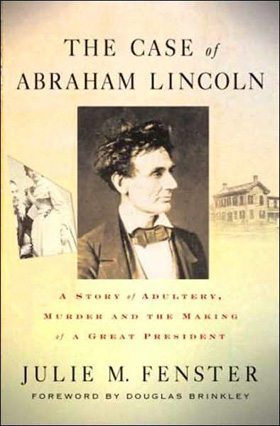
Until the year 2000, when a three-DVD set became available and anyone could examine the surviving records of his every case, the details of Abraham Lincoln’s law practice were hard to find. Unless you were prepared to spend a lot of time in Illinois archives, a fair chunk of the professional life of the greatest American was simply unknowable. This is no longer true, and in The Case of Abraham Lincoln: A Story of Adultery, Murder, and the Making of a Great President(Palgrave Macmillan, 255 pages, $24.95), Julie M. Fenster (an occasional contributor to this website) has taken advantage of the new possibilities to very skillfully interweave two simultaneous stories with several overlapping characters.
Both of the stories are in a sense mysteries, the first being a relatively small and, until now, obscure one. On May 15, 1856, George Anderson, a blacksmith in Springfield, Illinois, was on the mend. He had been troubled by agonizing stomach cramps for weeks, and doctors had been treating Anderson almost daily from the 22nd of April. Anderson’s wife, Jane, had nursed him through these miseries with conspicuous devotion, and things were looking up, at least until nine o’clock that evening, when Anderson, again wracked with pain, went into his yard to the privy. He never made it. Around ten o’clock his wife sent one of Anderson’s apprentices, John Morgan, out to look for her husband, who she said had disappeared from their bedroom while she was sleeping. Morgan found Anderson stone dead on the ground. When the body was subsequently examined by a physician, it turned out that Anderson’s skull had been fractured, as if by a violent blow from a heavy club.
It soon came out that Anderson’s symptoms were compatible with strychnine poisoning. In fact, his doctors had suspected strychnine for some time, going so far as to covertly poison a dog to see if it reacted the same way. When Anderson died by apparent violence, suspicion fell on his nephew Theodore, a mason by trade, who since arriving in Springfield in November had chosen to remain unemployed, spending most of his time hanging around his uncle’s house (where he had been a boarder for his first few months) and his uncle’s wife.
An autopsy seemed to confirm the suspicions about poisoning, and a search of Theodore Anderson’s room produced both a bottle of strychnine and a daguerreotype picture of Jane Anderson, who turned out to have visited a daguerreotype parlor twice with her nephew. A search of George Anderson’s property turned up bloody sheets and pillowcases, at which point it seemed likely that the dead man had been murdered in his home and then dragged outside. Most of Springfield promptly decided that Theodore and Jane Anderson had committed first adultery and then murder. A prosecutor agreed and indicted both. Passions were running high, and soon they outran the evidence, much of which was circumstantial. Early in December, after a number of trials, both Jane and Theodore Anderson were acquitted; Abraham Lincoln, who had eventually agreed to join the team of lawyers defending them, prevailed against a famous opponent and some very high emotions.
The year 1856 also saw a second mystery that puzzled a lot of people in Springfield, in Illinois, and in the North generally: If you hated slavery but feared civil war, what should you do? That was the general question; in the first half of 1856, the narrower mystery of what Abraham Lincoln would do about those divided passions might not have seemed worth solving, because Lincoln, who had been unable to make up his mind about the question, was at the age of 47 drifting into political obscurity. The resolution of that second mystery is Julie Fenster’s real concern in this book. She charts it in detail, and the story is in no way less fascinating because we know how it will come out.
Ever since 1854, when Congress repealed the Missouri Compromise with the Kansas-Nebraska Act (allowing settlers in those two territories to decide whether to permit slavery), anti-slavery men had been leaving the Whig party. In 1856 these ex-Whigs formed a new party, struggling at first to find a name for it. They began by calling themselves “Anti-Nebraska” Whigs; to be “Anti-Nebraska” was to be anti-slavery, and there were also Anti-Nebraska Democrats. Illinois was also contestable ground for the American Party, better known to posterity as the Know-Nothings, an anti-Catholic party that two years before had elected 9 governors and 43 congressmen. Many Know-Nothings detested both slavery and Catholicism, but the former passion was generally weaker than the latter, and much weaker than the fear of disunion. People who detested slavery enough to risk civil war—an outcome most of them were nonetheless very eager to avoid--eventually settled on the name Republican Party. The choice between peace and slavery was a painful one from which many still recoiled. One man from Galena, Illinois, Ulysses Grant, was unwilling to run that awful risk, and in the 1856 presidential election he voted for the Democrat James Buchanan. Abraham Lincoln, who at the beginning of 1856 was paralyzed by similar concerns, suddenly went the other way.
Lincoln made up his mind while the Anderson case was being decided, and as Fenster traces the progressive unfolding of both mysteries, the most thrilling event is the night of May 29, when Lincoln gave a famous speech in Bloomington, Illinois. That night, in the wake of recent news of pro-slavery violence in Kansas and on the floor of the U.S. Senate, Illinois’s Anti-Nebraskans held a political convention, and Lincoln made what is known to posterity as “the Lost Speech”.
We do not know precisely what he said; there were reporters in the room, but none of them wrote the speech down. The most romantic explanation for that failure is that what Lincoln said was so mesmerizing that the newspapermen could only listen, awestruck, too spellbound to even take notes. We have paraphrases from some of the people present, who later tried to explain what had so hypnotized everyone in the room. There is plenty of evidence that the speaker made a tremendous impression: Going into the convention hall, Lincoln himself may well have doubted that he was destined to be a great man, for Fenster quotes a self-assessment from sometime in 1856 in which Lincoln, contrasting himself with Douglas, wrote that “with me, the race of ambition has been a failure—a flat failure; with him, it has been one of splendid success.” When Lincoln finished speaking at the Bloomington convention, most of those present were exhilarated, and at least some of them were talking about him as a possible presidential nominee.
The Case of Abraham Lincoln traces the story to the result of the 1856 election, in which the new Republican Party lost its first presidential race; it would not lose another until 1884. It simultaneously traces the legal history of what remains a mystery: to this day, no one knows who killed George Anderson. On the other hand, we do know who killed off slavery in the United States. So in this quiet little book, we learn how Abraham Lincoln averted one looming if by comparison rather small injustice, and also how he began the business of ending a much vaster and more terrible one.