
Photographs Offer New Look at Lincoln’s Second Inauguration
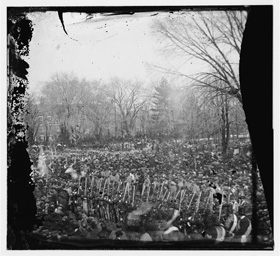
This past December, Civil War enthusiast, Carl Jennings of Berthoud, CO, was online gathering photographic material for his “American Civil War Library,” when he discovered three miscataloged photographs taken at the scene of Lincoln’s second inaugural address.
“My first thought was ‘No way!’” said Jennings, a former high-tech executive from South Carolina, who is not a professional scholar of American history, but has made Civil War collecting his life’s work. While many images of the Lincoln presidency exist, it is extremely rare to find a “new” image.
Jennings was sifting through the Library of Congress’ one million archival photographs in its online Prints and Photographs catalogue when he encountered the picture captioned ‘Wash. D.C. Grand Review of Army,’ which was ostensibly of the two-day military parade in May 1865. A distinct line of soldiers with shouldered rifles stood amidst a crowd of hundreds of civilians. But, said Jennings, “the identification given didn't jive with what I was seeing.” After viewing the photograph at a higher resolution, he saw civilians pressed closely around the soldiers, not something that would occur in a military parade.
A day later, Jennings returned to the online archives and discovered two more photographs, each entitled “Inauguration of President Grant.” Both showed the same trees, townhouses, and soldiers as the first photograph.
“The idea that I had discovered previously unknown photographs from this event seemed too good to be true,” said Jennings, “especially since it was on the Library of Congress website, and had been there for years.”
Jennings fired off a letter to Carol Johnson, Curator of Photography for the Library of Congress Prints and Photographs Division, who compared the images and immediately saw the similarities. She also noticed that in the margins of the log for one of the negatives labeled as Grant’s 1869 inauguration, a researcher had scribbled “Lincoln?” Johnson pulled out the only existing picture of Lincoln’s second inaugural in the archives, which showed the same details as in the three mislabeled photographs: the steps of Capitol building, wandering civilians, carriages, trees, buildings, and line of soldiers. Moreover, the existing inaugural photograph and the three new prints were part of the same collection, all taken by photographer Alexander Gardner.
An elated Johnson contacted Bob Zeller, the President of the Center for Civil War Photography, and asked him to confirm her findings. Zeller and his colleague quickly ruled out that the prints illustrated the Grand Review of the Army. The leafless trees in the three new prints suggested winter not spring. Zeller also noted the absence of the platform, which was added for Grant’s inauguration. The presence of hundreds of soldiers by the Capitol building was another giveaway: lines of uniformed soldiers would have been present at Lincoln’s second inaugural right after the war, but not when the nation was at peace during Grant’s inauguration in 1869.
Several days later, Jennings was eating breakfast when he saw the CNN report on the second inauguration images. “I am very excited to have been part of this major historical discovery,” he said. Bob Zeller shared Jennings’ enthusiasm. “A real scholar could glean a fair amount of information from those photos about the second inauguration of Lincoln,” he said. “We have three new windows into history...The images are almost like frames of a movie.”
If their discovery wasn’t exciting enough, in November, John Richter of the Center for Civil War Photography, made headlines after identifying the figure of Abraham Lincoln in two photographs. In them, Lincoln wore a top hat and white gloves, and rode through the crowd gathered to hear him deliver what would become known as the Gettysburg Address. Because the faces of the people in the photograph are indistinguishable, and much of the figure thought to be Lincoln is obscured by the surrounding crowd, some remain skeptical of Richter’s discovery.
Zeller argues, however, that Alexander Gardner would not have wasted time by taking two photographs of a crowd without an important reason. “It took about as much time to get a new plate into the wet plate camera as it did to load a musket,” he explains. He finds it understandable that Gardner would not have sold the prints to the public. “I can see him arriving at the Gettysburg Address scene and being extremely disappointed,” says Zeller, “and probably irritated that the platform was too far away.”
Though much of Lincoln’s second inauguration is only within the reach of our imaginations, these new images allow us to see more of that event as it truly happened. The photographs also serve as a reminder that there are still undiscovered primary sources, and we can never know what we may find.