
A Revolution in the Funnies
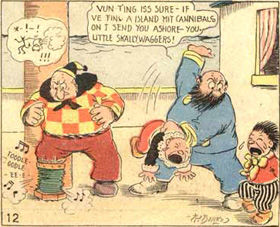
Around the turn of the twentieth century, two popular art forms began parallel transformations. Up until that point, photography and cartooning had each been used primarily to depict isolated scenes. But in the last years of the 1800s, static photographs evolved into movies; at the same time, stand-alone cartoons began to multiply across the panels of a newly emerging phenomenon, the comic strip. Both developments allowed artists tell stories rather than just capture vignettes: Just as film could now record motion, the comics had harnessed time. On December 12, 1897, a comic strip debuted that would set the standard for the new medium. The Katzenjammer Kids, now the world’s longest-running strip, made its first appearance in the New York Journal 110 years ago today.
In that single decade astride the turn of the twentieth century, the format of the comic strip crystallized. All its pieces locked into place between 1895 and 1905, buttressing a structure both durable and flexible enough to survive all the fleeting trends of the century to come. With multiple panels, the comics began to render time as well as space; by integrating text into drawings in thought and word balloons, cartoonists allowed us to read their characters’ minds. Permanent casts encouraged ongoing storylines, which brought readers back week after week. When all these elements finally combined, it represented the final step in the long evolution of the comic strip. None of the ingredients was new; in fact most had been in use for centuries. But they had awaited the perfect nexus of technology, commerce, and culture to bring them together.
The comic strip’s ancestry can be traced back to the stone-age cave paintings of Lascaux, and its forebears would crop up again and again across centuries and continents. Scenes sculpted on ancient Mayan temple walls occasionally included word balloons. Classical Greek and Roman artists arranged images in sequence to convey the passage of time. For example, the friezes along the gables of the Parthenon, showing the exploits of the gods and the Trojan War, may be the oldest prototype of the superhero comic. The stained-glass windows, triptychs, and tapestries of the Middle Ages also portrayed progressions of events over several images; perhaps the most famous example is the Bayeux Tapestry, which commemorates the Battle of Hastings in hundreds of scenes embroidered on 76 yards of linen.
The invention of the printing press in the fifteenth century allowed drawings to be mass-produced, and by the 1800s cartoons dominated commercial art. Before the rise of photography, stylized illustrations were the norm for magazine covers, advertisements, and posters. Authors no less luminary than Charles Dickens and Mark Twain worked closely with illustrators, aware that vibrant images helped bring their characters to life. Magazines like Punch in England and Puck and Judge in America emerged mostly to run cartoons. Stand-alone drawings evolved into multi-panel series, and wordless pantomimes were soon accompanied by text captions. Picture magazines enjoyed immense popularity, and their art inched tantalizingly close to the comic-strip format. But the artists failed to develop continuing characters and rarely if ever integrated words into their pictures.
In the last decades of the 1800s, cartoon art fell out of favor with publishers, who now filled novels and magazines with dense, hyper-realistic charcoal drawings. Cartoonists scrambled for work, but soon enough another set of employers—with much deeper pockets—would come calling. America’s cities had become the setting for a battle for readership among the nation’s newspapers. Noting what illustrations had done for book sales, Joseph Pulitzer, publisher of the New York World, bought a four-color rotary press in 1893, intending to reprint famous paintings in the Sunday paper. His Sunday editor persuaded him to use the press for humorous cartoons instead. The World, like many American papers, had been running single-panel, black-and-white gag drawings to fill space at the bottom of its pages. In a manner of weeks, these bloomed into lavish, full-color, four- and eight-page sequences.
Still, the Sunday cartoons were not comic strips as we know them today. The stories did not continue from week to week, and the characters spoke no dialogue. In fact, the question of which series can be called the first comic is still up for debate. Some historians argue for Jimmy Swinnerton’s Little Bears, which appeared in the San Francisco Examiner in 1892; others contend that Ally Sloper’s Half Holiday, a weekly British tabloid drawn by Gilbert Dalziel in 1884, should win the title. In any case, the feature that paved the way for a century of comics was not a strip at all. Richard Outcault’s Hogan’s Alley, which debuted in the World in May 1895, depicted the adventures of a horde of unruly children in New York’s Irish slums. Whether racing a pack of dogs down the street or mounting a backlot circus, the gang included a bald, gap-toothed toddler whose lemon-colored nightshirt earned him the moniker “the Yellow Kid.”
Within a few months, the Kid was New York’s newest sensation. Outcault’s detailed, single-panel tableaux—with the Kid’s Irish-inflected dialogue written on his nightshirt—found a following among the city’s thousands of recent immigrants. Many of them may have been unable to read the rest of the paper, but they recognized the world of Hogan’s Alley from their own lives. Pulitzer’s circulation soared. Soon New Yorkers were clamoring to spend their nickels not only on the newest Sunday World but also on Yellow Kid cigarettes, fans, and crackers, and on tickets to a Yellow Kid musical on Broadway. Once Hogan’s Alley demonstrated that cartoons could sell papers, publishers across the country began putting out their own color supplements.
William Randolph Hearst, owner of the New York Morning Journal, wanted to top Pulitzer’s numbers. The Journal’s comic section premiered October 18, 1896, headlined by none other than Richard Outcault, whom Hearst had lured from the World. (Pulitzer retained the rights to Hogan’s Alley, so Outcault drew a new strip for the Journal.) Within a year, Outcault had left for the New York Herald; meanwhile, the popularity of the World’s Yellow Kid, now drawn by another artist, was waning. As Hearst searched for the next big success, he remembered a picture book he had picked up on a childhood trip to Germany. Max und Moritz, written and illustrated by Wilhelm Busch in 1865, was a collection of stories about two young pranksters who were, in the end, ground up and fed to geese. Shorn of its gruesome finale, might it not be a promising inspiration for a comic strip? Hearst and his comics editor tapped a 20-year-old staff artist, Rudolph Dirks, to give the idea a try.
The result, titled “Ach Those Katzenjammer Kids!” appeared in the Journal in full color on December 12, 1897. The action unfolded in six unframed drawings: After a gardener shoos away three boys with a blast from his hose, they find him sleeping in an outbuilding. The boys pen in the gardener with a piece of latticework across the door and then open the full force of the hose into his bed. This first outing contained no word balloons and carried no caption. By the next week, Dirks had decided to eliminate one of the boys; from then on, there would be only two Katzenjammers.
The strip was a hit almost immediately. The new stars of the color supplement, the mischievous brothers—now named Hans and Fritz—perpetrated their slapstick devilry week after week on whatever authority figure bumbled within range. Behind a camouflage of chubby cheeks, skinny legs, and bristly hair, the boys personified unbridled anarchy. (“Mit dose kids, society is nix!” was their targets’ refrain.) The strip’s adults responded with occasional spasms of justice, administered via cathartic spankings. Readers relished the broad gags, and the Katzenjammer Kids embarked on a run unmatched in comics history.
In the first five years, Dirks created the blueprint for all future comic strips. He did not invent word balloons or sequential panels, but he was the first cartoonist to use them both regularly; he also made standard the recurring cast of characters and ongoing narrative. “Because of him,” wrote the cultural historian Richard Marschall, “the comics told tales, not just jokes.” His design sense was perfectly suited for the crowded newspaper page. He quickly scrapped excess detail and clutter in favor of simple lines and bold fields of black that guided the reader through his panels. In Dirks’s strips, Americans first encountered the symbols that now form an unquestioned part of comics syntax: Straight lines indicate motion, beads of sweat mean fear or exertion, footprints show movement, stars equal pain.
With the Katzenjammer Kids, finally, an artist fused together all of the centuries-old ingredients that make up the modern comic. Dirks would be joined by hundreds of competitors in the next few years. Most of the early comics appeared in city papers and depicted urban life, particularly the immigrant experience. Many of the cartoonists were themselves immigrants, including Dirks, who moved to Chicago from Germany when he was seven. His characters were unabashedly German; they spoke in pidgin English (even the title, literally translated as “cats’ howling,” is German slang for a hangover) and wore European dress. Dirks was trying to charm, rather than mock, the immigrants who composed a healthy chunk of his paper’s demographic. (Unfortunately, the same cannot be said for the derogatory portrayals of blacks in early comics.)
Dirks left the Journal for Pulitzer’s World in 1912; in the year-long suit that followed, Dirks won the rights to the characters but Hearst got to keep the title. Dirks called his new strip Hans und Fritz (retitled The Captain and the Kids during the anti-German fervor of World War I, when Dirks also went to great pains to establish that the characters were Dutch). Dirks drew the strip, notwithstanding several multi-year sabbaticals, until 1958, when his son John took over. The Captain and the Kids ran until 1979; it is survived to this day by the original Katzenjammer Kids, now on its seventh artist.