
Sherman Reaches Savannah—Leaving a Swath of Destruction Behind Him
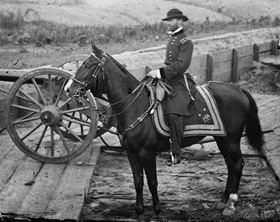
“War is cruelty, and you cannot refine it,” Union Gen. William T. Sherman wrote Confederate Gen. John Bell Hood in early September 1864. “You might as well appeal against the thunder storm as against these terrible hardships of war.” Sherman, who had just taken Atlanta in a brutal four-month campaign, had asked Hood for a ten-day truce to evacuate civilians from the city. Hood agreed, grudgingly, complaining that “the unprecedented measure you propose transcends, in studied and ingenious cruelty, all acts ever before brought to my attention in the dark history of war.” Over the next three months, Hood would no doubt revise that opinion. On December 10, 1864, 143 years ago today, Sherman’s army reached the outskirts of Savannah, having visited the full force of its thunder on the state of Georgia. Barreling across the countryside in a 60-mile-wide front of fire and destruction, the army moved with one purpose, as summed up by its commander: to “make Georgia howl.”
Sherman’s army teemed with healthy soldiers, and back in September they had seemed to be preparing for a nice long stay in the richest, most populous state of the Deep South. Hood wanted Sherman out of the Confederacy. But with only about 30,000 men to Sherman’s more than 80,000, he couldn’t risk a direct attack. Instead he headed northwest, to sabotage the 120-mile Federal supply line from Chattanooga. On October 4 the Rebels ripped up nine miles of the Western & Atlantic Railroad before Sherman, marching north from Atlanta, could catch up. For the next several weeks, the Yankees chased the Confederates around northern Georgia. Hood never did manage to sever Sherman’s supply line, and Sherman never cornered Hood for a decisive blow.
By the end of October, Sherman was fed up. He had just spent a month fighting over a region he had won in May, and for what? His army was wasted guarding this railroad, just to supply a city whose greatest value to the Union lay in keeping it from the Confederacy. “Damn him,” he fumed of Hood. “If he will go to the Ohio River I will give him rations. . . . Let him go north. My business is down South.”
Sherman had always planned to end the campaign at “salt water,” as he put it, though his original objective had been Rebel troops along the Gulf of Mexico. Now that he had injected his army straight into the heart of the Confederacy, though, the stakes had changed. He had a huge, flexible force apparently free to tear through the South at will. Perhaps its best use came not in chasing Hood but in striking at a bigger target: Confederate morale. Instead of battling an army, Sherman would wage war on the South itself.
Since the middle of September, he had been trying to persuade Gen. Ulysses Grant to let him march through Georgia to the Atlantic. In a message sent September 20, he proposed that the navy provision a base on the coast, where he and his men would arrive after a “sweep through the whole state.” The Confederates “may stand the fall of Richmond,” he argued, “but not of all Georgia.”
Grant had serious doubts, as did President Lincoln. Diverting the ships necessary to capture a Southern port would require months of effort with no guarantee of victory. Worse, the Confederate President, Jefferson Davis, had hinted during a recent speaking tour that Hood would soon take the fight north, toward Gen. George Thomas’s Union forces in Tennessee. Without Sherman to block him, Hood might defeat Thomas and seize Federal territory as far north as Cincinnati. Grant wanted Sherman to obliterate Hood’s army.
“We cannot remain on the defensive,” Sherman countered. He was confident Thomas could handle Hood, especially with the 30,000 reinforcements Sherman would send up from Atlanta. Meanwhile, he had expanded on his plan. “By attempting to hold the roads, we will lose a thousand men each month and will gain no result,” he wrote to Grant. He expected “plenty of forage in the interior of the state.” So why not abandon the precarious supply line and move forward, untethered, to feast on the abundant countryside?
The new strategy dovetailed perfectly with Sherman’s larger goals. Of course, as he told Grant, “the utter destruction of [Georgia’s] roads, houses, and people will cripple their military resources.” But, more important, the marchers would deliver a much-needed shock to the Southern people. If the war in all its horror were brought to their doorsteps, perhaps they would not be so fervent in its support. And if the Union army could rampage throughout the state unmolested—if the Confederacy could not even protect its citizens’ homes—perhaps the young proclaimed nation would finally be exposed as too powerless to survive.
In a sense, this was a negative image of future “hearts and minds” campaigns: an attempt not to win Southerners to the Union’s way of thinking but to kill their faith in their own. By mid-October, Grant informed Sherman he was starting to “think better of your proposition,” and on November 2 the general-in-chief wired his full consent. Sherman had begun to prepare weeks in advance, assembling supplies and ferrying trash and unfit men north to Chattanooga. Now the commissary stockpiled 20 days’ rations, including 3,000 beef cattle. The Western & Atlantic ran its final trains November 12; the last cars had not chugged out of sight before Yankee crews tore up the tracks, torched the ties and trestles, and made curlicues of the rails.
The final task was to dispose of anything in Atlanta the Confederates might find useful. As the leading elements set out for the coast on November 15, the remaining soldiers got some practice with what would, in the coming weeks, become one of their favorite tools: fire. Sherman’s orders were to destroy only public buildings and military assets, but a Union chaplain noticed that the prevailing spirit proclaimed, “Leave not one stone upon another.” Blazes spread from neighborhood to neighborhood, consuming entire blocks. A party of staff officers capped a feast in an abandoned home with a bonfire: “The furniture was piled up in the center of the dining room,” wrote one of the officers, “a match applied and soon that stately mansion, once the shelter of wealth, beauty and refinement, had paid the penalty of its owner’s disloyalty.” As the sun set over the flames of Atlanta, the band began playing “John Brown’s Body.” Come sunrise, more than a third of the city had been reduced to cinder.
By then, the bulk of the army was on its way south. Sherman paused that morning to look back on “Atlanta, smouldering and in ruins, the black smoke rising high in air and hanging like a pall over the ruined city. Away off in the distance . . . was the rear of [Union Gen. Oliver] Howard’s column, the gun barrels glistening in the sun, the white-topped wagons stretching away to the south.” Within hours Sherman’s entire army was on the road: 62,000 of the fittest men in the Union, most of them three-year veterans. “What they did not know about campaigning was not worth inquiring into,” one marcher wrote of his fellow soldiers. “Such was the ratio of casualties that [each] may be said to be the sole survivor of four men who had set out . . . in 1861.”
As the soldiers left Atlanta, they tried not to dwell on the risks they faced. With winter looming, rain or snow could block the roads. The army’s supply and communication lines had been severed; not even Grant and Lincoln would know where they were until they reached the Atlantic. Sherman was betting on what the historian (and late American Heritage editor) Bruce Catton called “a move to sweep the chips.” If a concentrated dose of bloodless violence could end the war’s wholesale slaughter, Sherman had to attempt it. So, without a lifeline, the general and his men plunged deeper into enemy territory.
He divided the troops into two equal columns, each of which stretched along some 12 miles of Georgia’s rural roads. The columns traveled separate routes about 20 miles apart, to ease traffic, confound the enemy, and widen the area of destruction. His was an army built for speed—he planned to make about 15 miles a day—and it traveled light. The artillery brought only 65 cannon, and the commissary kept just five days’ grain for the eight horses that hauled each gun. With so little ordnance, the force could not endure sustained fighting, which speaks volumes about Sherman’s intentions. This army’s casualties would be bricks and mortar and tracks and acres, not enemy soldiers.
Sherman chose his route to follow Georgia’s railroad lines, which his men shredded as they marched. Hood had turned toward Nashville in a vain effort to lure Sherman north, and now a meager 13,000 Confederate soldiers remained in the state. The Rebels tried to predict where the tidal wave of bluecoats would strike, only to be fooled by feints on Augusta and Macon. In the early weeks of the march, Union cavalry along the outside of each column traded bursts of rifle fire with Rebel horsemen and militia; just once would one of these hit-and-run skirmishes develop into full-blown battle.
Meanwhile, the marchers were eating better than they had for the past three years. Sherman’s orders, released November 9, directed the army to “forage liberally on the country,” although soldiers “must not enter the dwellings of inhabitants or commit any trespass.” Specially appointed foraging parties from each brigade were to fan out and collect food each day; if civilians hindered their efforts, “then army commanders should order and enforce a devastation more or less relentless, according to the measure of such hostility.”
In practice, the fine nuances of Sherman’s instructions dissolved before the lure of looting. Although the official foraging parties did bring back cartloads of freshly harvested corn, sweet potatoes, and ham, they were soon joined by unappointed hordes of soldiers and civilian hangers-on, whose haul rarely ended up in brigade coffers. As homeowners watched, bands of barefoot, raggedly clothed marchers ransacked parlors and stabbed at flowerbeds in search of buried treasure. More often then not, they found it. In stolen wagons and silver-topped carriages, a typical expedition brought back, according to one source, ”a looking glass, an Italian harp, sweetmeats, a peacock, a rocking chair, a gourd, a bass viol, sweet potatoes, a cradle, dried peaches, honey, a baby carriage, peach brandy, and every other imaginable thing a lot of foot soldiers could take in their heads to bring away.”
Presumably Sherman’s quartermasters had little use for cradles, string basses, or peacocks. And the soldiers usually abandoned most of their swag within the first few miles of the next day’s march. So why take it in the first place? Some foragers wanted revenge against the Southern women thought to be urging their husbands and sons into war; others took a liberal interpretation of Sherman’s vaguely worded orders. Many just felt entitled to grab what they wanted. But the overriding motivation seems to have been, simply, that plundering was fun. “This is probably the most gigantic pleasure expedition ever planned,” one soldier wrote. The troops were, for the most part, in their late teens and very early twenties; even the commanders averaged only 40 years old. A century and a half later, their heirs might be caught smashing suburban mailboxes or torching cars at fraternity parties; fueled by the same youthful appetites (and, often, confiscated liquor), Sherman’s men tore through central Georgia.
“The destruction could hardly have been worse if Atlanta had been a volcano in eruption and the molten lava had flowed in a stream sixty miles wide and five times as long,” one veteran boasted. Of course, devastation was Sherman’s primary objective, and his men fulfilled it with relish. Western & Atlantic rails were heated and twisted around tree trunks to form “Sherman neckties.” In each town, men dumped courthouse files from high windows into the streets. In private homes, as their comrades cheered and residents cried, soldiers hurled china against kitchen walls and sent the contents of feather beds avalanching down stairwells; the rear guard denuded the gardens of Madison, Georgia, and marched out of town with roses in their hats and musket barrels. Although the arsonists spared most of the private homes along their route, enough factories, trestles, and granaries were set ablaze that the two columns no longer had to send up flares to announce their position; the commanders just looked for the trail of smoke. “We had a gay old campaign,” a New Yorker enthused. “Destroyed all we could not eat, stole their niggers, burned their cotton & gins, spilled their sorghum, burned & twisted the R. Roads and raised Hell generally.”
For an army to forage in the surrounding country was nothing novel; the strategy had been a staple of recent campaigns. However, this was despoilment on a brand-new scale. Traveling virtually unopposed, the army could afford to direct all of its energy toward sacking Georgia. What’s more, Sherman’s foraging system brought the army into close contact with civilians, presenting soldiers with more than the usual temptations. “The nature of the march,” remarked Union Gen. Alpheus Williams, “was calculated to remove discipline.” (Mercifully, rape appears to have been rare; only two cases were reported during the army’s time in central Georgia.) The judge advocate Henry Hitchcock accused Sherman of turning a blind eye to the sins of his men, and many historians have since agreed. Sherman was never a disciplinarian, and he seemed loath to punish his troops for doing, ultimately, what he wanted. “This may be a hard species of warfare, he wrote, “but it brings the sad realities of war home to those who have been directly or indirectly instrumental in involving us in its attendant calamities.” Or, as he put it 20 years later, the rebels “deserved all they got and more.”
On November 22, the Yankees reached the state capital, Milledgeville. A group of officers took over the abandoned Hall of Representatives and, in a marathon session, repealed the ordinance of secession and sentenced Davis and Gov. Joseph Brown to kicks in the behind. That same day in nearby Griswoldville, a brigade of Federal infantrymen fought the only real battle of the campaign (up until that day, the majority of their ammunition had been fired at chickens). Fifteen hundred of the rear guard had taken a defensive position on a hill just outside town, protected by swamps on either side. Suddenly Georgia militiamen stormed forward in a frontal assault, barreling straight into a cloud of Yankee rifle fire. The Rebels quickly fell back, reformed, and charged a second time. “With more courage than discretion,” as one Federal soldier remembered, the Confederates continued to attack head-on, again and again, for hours. When sunset finally ended the battle, the Northerners counted just 62 dead. They swarmed jubilantly from the hill, only to find the field below strewn with the bodies of more than 600 preadolescent boys and old men; this was the force Georgia had mustered to oppose them. “I was never so affected at the sight of dead and wounded before,” an Illinoisan wrote. “I hope we will never have to shoot at such men again. They knew nothing at all about fighting and I think their officers knew as little.”
As Sherman’s columns filed out of Griswoldville and Milledgeville, the soil underfoot changed from clay to sand, a reminder that every day they were drawing closer to the sea. The bountiful harvests dwindled in swamp country, though, and the foragers began to have trouble finding food. Sherman complained about the hordes of stragglers trailing behind his columns, particularly the thousands of slaves who had fled their plantations to follow him to freedom. Although he believed blacks should be free, he deemed them “not fit to marry, to associate, or vote with me, or mine.” Now, with forage growing scarce, he wished to rid himself of what he called “useless mouths.” As it happened, one of his generals accomplished that for him. After the corps under Gen. Jefferson C. Davis (no relation to the Confederate president) finished crossing 100-foot-wide Ebenezer Creek, 35 miles west of Savannah, they hastily took up the pontoon bridge, stranding 500 black refugees on the opposite bank. Terrified of the approaching Confederate horsemen, they plunged en masse into the frigid stream. Most could not swim. Astonished Federals waded in to help, and some slaves made it safely across. Many more drowned; the rest were rounded up by Rebel soldiers and returned to their owners.
On December 10, Sherman’s army plodded through the flooded rice fields around Savannah, where they confronted the city’s outermost defenses. A few miles down the coast, Yankee cavalrymen set fire to a church on St. Catherine’s Sound as a signal to waiting gunboats. This was the first communication with the Union the army had had since leaving Atlanta four weeks earlier. On December 13, Sherman climbed onto the roof of a rice mill to survey Fort McAllister, which guarded the Ogeechee River at Ossabaw Sound. A Union steamer plied the sea on the horizon, and Sherman’s lookouts noticed a signalman sending a wigwag message from the deck. “Who are you?” the sailor asked. “General Sherman,” a flagman responded. “Is Fort McAllister taken?” wondered the ship’s signalman. “Not yet,” came the reply, “but it will be in a minute.”
It actually took 15 minutes, but Sherman’s troops captured the fort with only 134 Union casualties; the 250-man Confederate garrison lost 48 killed or wounded. That night, Yankee ships began steaming up the Ogeechee River, bringing rations and weeks’ worth of mail for the soldiers. Rather than storm the city and its 15,000 regulars and militia, Sherman took position for a siege. But on the night of December 20, while he was in Hilton Head asking Maj. Gen. John Foster for reinforcements, the Rebel force slipped out of the city and into South Carolina. The next morning, the Federal columns marched into Savannah without their leader. A windstorm had waylaid Sherman on his return trip from Hilton Head, forcing him to miss the denouement of his historic march.
When he entered Savannah on December 22, it was to a hero’s welcome, from both his men and the Northern press. That day he cabled Lincoln the good news: “I beg to present you as a Christmas gift the City of Savannah with 150 heavy guns & plenty of ammunition & also about 25,000 bales of cotton.” With the loss of only 381 killed or missing, Sherman had covered 300 miles in 24 days, seized 13,000 cattle, 9,000 horses and mules, and 9.5 million pounds of corn. The columns destroyed 320 miles of railway and ravaged about 12 percent of Georgia’s total area. “There was hardly a fence left standing all the way from Sparta to Gordon,” a visitor noted just before Christmas. “The fields were trampled down and the road was lined with the carcasses of horses, hogs, and cattle that the invaders, unable either to consume or to carry away with them, had wantonly shot down to starve out the people.” Above all, central Georgia was quiet, the winter silence unbroken by lowing cattle or clucking chickens. There weren’t any left.
As for Sherman, history has yet to reach full agreement on whether he was an ingenious hero or a shameless sadist. Either way, his campaign had the intended effect. Georgians fell into despair, and people across the South began to lose hope. He had ended a year-long stalemate, and by January 1865 he was preparing to take his army into South Carolina, the birthplace of a Confederacy that—thanks in large part to him—had just four more months to live.