
Travel: Fort Worth—A Cowtown with Class
Dallas and Fort Worth sizzle like a double-yolked egg on the Texas plain, shaped by a history of vast open spaces, of cattle and oil and the fortunes they spawned. But the differences between the two are big, and they can be defined by Fort Worth’s claim to be “where the West begins.” That leaves a demarcation that would seem to float between the yolks, somewhere around the Dallas–Fort Worth airport, which the two share.
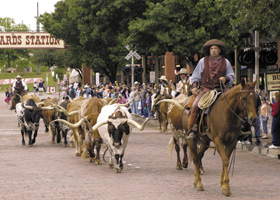
Fort Worth likes to call itself Cowtown, and it revels in its history. Witness its Texas Cowboy Hall of Fame, Cowgirl Hall of Fame, and Cowboys of Color Hall of Fame. Witness also the small herd of longhorn cattle the city keeps on hand to perform twice-daily cattle drives for the benefit of tourists, not a few of them Wild West fans from Europe raised on spaghetti Westerns, who come in search of the real thing.
Fort Worth aims to oblige, while at the same time serving up some first-rate culture. The point is perfectly made by three of the best fine-art museums in the country, each designed by a famous architect and housing a collection considered to be world-class. The city flaunts its eclectic taste, from a masterpiece by Caravaggio hanging in the Kimbell Art Museum to the signs that advise that your gun must remain outside.
Once a stop on the Chisholm Trail, when the great cattle drives moved up throughTexas, Fort Worth sprawls around the looping Trinity River and its tributaries. A master plan for the 88 miles of waterways that wind through the city will one day create large swaths of green space and speed up urban renewal. Changes are already underway; right now three separate districts offer a kaleidoscopic view of a city struggling to hang onto its colorful past while racing into the future: Downtown, the Stockyards, and the Cultural District.
I live in the San Francisco Bay area; my sister moved from Manhattan to Fort Worth several years ago, and when I visit we always start with the museums, clustered together in the Cultural District, a sumptuously landscaped open space about five miles from Downtown. My last visit was at the very end of September; the midday temperatures were still in the 90s, so the air-conditioned museums beckoned.
We had Sunday brunch at the Kimbell, where we shared a table with a couple from Belgium and a young architect from New York; all had come to admire the building itself, a pristine masterpiece by the architect Louis Kahn. Another day we lunched at the Modern Art Museum, opened in 2002 and designed by Tadao Ando, and we divided our time between admiring the building, which seems to float around a reflecting pool, and wandering through its galleries. Then on to the Amon Carter Museum, where a recent Philip Johnson renovation plays with light and shadow, and which holds some of the best Western art anywhere, especially works of Frederic Remington and Charles Russell. Thanks to several local families with oil money, vast pools of it, these three museums have collections that do their architecture proud. One enormous added attraction: The galleries are almost never so crowded that you need to jostle for a view.
On my last day we squeezed in the new National Cowgirl Museum and Hall of Fame, which honors, among others, Annie Oakley and Dale Evans but also Georgia O’Keeffe and Sandra Day O’Connor. In a small upstairs gallery we donned earphones and plugged into a jukebox where we could rock with singers like Patsy Cline and Reba McEntire. Cowhand culture reigns on this side of the Cultural District; next door is the Will Rogers Memorial Center, home to the city’s big Stock Show and Rodeo, which has stalls for 2,000 horses.
It was a day of ricocheting between Goyas and Cezannes at the Kimbell and the opportunity to take part in an “interactive bronc riding experience” at the Cowgirl Hall of Fame, where I had the chance to be videotaped in slow motion on a mechanical “bronc.” The film would then be sped up and pasted into old rodeo footage, conveying instant cowgirldom. I demurred, in deference to the women the museum honors, “who have distinguished themselves while exemplifying the pioneer spirit of the American West.”
Across town, the Stockyards District is heavy on the tourist experience; the great packing plants that once were the hub of the cattle trade have been washed down, spruced up, slathered with faux Old West décor, and turned into shops and restaurants.
There the great cattle herds of the nineteenth century have been replaced with the city’s own little herd of longhorns, who star in a twice-daily reenactments of a trail drive for the benefit of tourists. Costumed cowboys and cowgirls on horseback nudge the cattle from their holding pens and herd them a few blocks along Exchange Avenue by the Cowtown Coliseum, and then back again.
Nearby in a sprawling old cattle barn is Billy Bob’s Texas, billed as the biggest honky-tonk in the world. As many as 6,000 people at a time can check the action at a live bull-riding ring, chow down on slabs of barbecue, belly up to one of 32 “bar stations,” two-step, line dance, or take in a show. Willie Nelson performs there, along with countless other mostly country and western acts.
When the billionaire Bass family decided to invest in its hometown, it started the Downtown revitalization, bankrolling Sundance Square (named after the infamous Kid, made famous by Robert Redford, who turned up in Fort Worth in the days of the Hole in the Wall Gang). The family also built the fine new Bass Performance Hall, now home to everything from the symphony and touring Broadway shows to an international piano competition named after the city’s own Van Cliburn. Old warehouses have blossomed into condos and apartments, and upscale hotels and shops have moved in. You won’t have trouble finding a pair of Texan Dave Little’s “Peanut Brittle Glazed Crocodile” boots for $4,825.
The Downtown area has expanded to cover 35 acres; its center is marked by thousands of twinkling lights illuminating pubs, restaurants, and fountains. The sidewalks around Sundance Square are alive with flowers and people, music, and clubs. Downtown suddenly has a real uptown night life and a mood that is the twenty-first-century Fort Worth version of cool.
Combined, the three districts offer an interesting view of a Texas town in transition, determined to hang onto its real-West past while at the same time moving out to help itself to what the rest of the world has to offer.
Where to eat: Fort Worth has plenty of eating places, mostly offering steak and Tex-Mex (which someone has described as the worst of both cuisines). It also has one of the eight incredible Central Markets scattered around Texas; Fort Worth’s version of the gourmet store is in the Chapel Hill Shopping Center at Interstate 30W and Hulen. It’s a mind-blowing market by any measure, filled with almost any imaginable foodstuff and an amazing takeout department. Worth the stop: The Paris Coffee Shop, at 704 West Magnolia Avenue, has been around since the 1920s, long enough to become an institution, with the kind of eclectic décor (and menu) that makes it more than worth a breakfast or a lunch. Open from 6 a.m. to 2:30 p.m. on weekdays and 6 a.m. to 11 a.m. on Saturdays.
Currently at the museums: At the Kimbell through March 30, 2008, “Picturing the Bible: The Earliest Christian Art,” a collection gathered from, among other places, the Vatican, the British Museum, the Louvre, and the Metropolitan Museum of Art in New York. At the Amon Carter, through January 6, “Accommodating Nature: The Photographs of Frank Gohlke,” which explores the complexities of man’s relationships with the natural world. At the Modern Art Museum, through January 6, “Declaring Space,” featuring works that shifted the role of space and color in abstract painting after World War II, including the artists Mark Rothko, Lucio Fontana, Barnett Newman, and Yves Klein.