
Travel: With Lewis and Clark at the Pacific
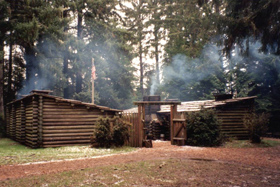
On October 3, 2005, communities at the mouth of the Columbia River, near Astoria, Oregon, were getting ready to mark the bicentennial of Lewis and Clark’s 1805 arrival at the Pacific Ocean, with the festivities just weeks away, when an accidental fire destroyed the 1955 replica of the expedition’s encampment, Fort Clatsop.
Hours after the fire, hundreds of people were volunteering to help rebuild the landmark. Work got under way within two months, with about 700 people pitching in; a new replica was ready for visitors by the peak of the 2006 summer season; and on December 9, 2006—201 years to the day after the Lewis and Clark expedition had begun making its winter quarters—the people of Clatsop County, Oregon, dedicated the new fort. It was the second time in a half a century they’d rallied to construct that reminder of the Corps of Discovery’s visit.
The fire may have been the second force of nature that spurred Astorians to preserve Fort Clatsop’s legacy; Bernard DeVoto was the first. The historian was newly famed for his 1953 abridged edition of the expedition’s journals when he “came out and looked at the site, and it was a mess,” says Bob Lovell, an Astoria octogenarian who remembers the spot when it was marked by little more than a flag pole and a lot of trash. “He wrote a scathing letter to The Oregonian saying we’d neglected this treasure. He got everyone excited about it.” U.S. Sen. Richard Neuberger of Oregon was another early proponent.
Before long, the local Jaycees and Lions Club had agreed to clean up the site, and while doing that they decided to build a replica of the historic fort, which measured 50 feet square, with two rows of small adjoining huts on either side of a gated parade ground. Ruth Shaner, of Astoria, remembers hearing her husband Wesley on the phone half a century ago, agreeing to lead the effort. “He hung up and asked me to go to the library and take out the journals,” she says. “We’d lie in bed at night and read them.”
The first replica, based on descriptions and drawings in those journals, was completed in time for Astoria’s sesquicentennial commemoration of the expedition in 1955. When the 2005 fire forced reconstruction, the National Park Service called in archaeologists, architects, and historians to take the latest in Lewis and Clark scholarship and make the new structure more faithful to the original. For example, the new replica isn’t nearly as finished looking as its predecessor. The timbers, although treated to withstand the coastal climate, are more rough-hewn to better recall the look of the “huts” that Lewis and Clark’s crew hastily constructed in December 1805. The fort also includes a new fire detection system to enhance the chances of this replica’s lasting more than 50 years.
Fort Clatsop gets most of its visitors in summer. But winter is the time to experience a taste of what the expedition actually endured. “Basically, you get the mixed bag of weather,” says Ron Tyson, the park’s chief of maintenance (and a local volunteer firefighter who was called to the 2005 blaze). “It’s wet, cold—that’s one of the things they talk about most in their journals.”
Hardy winter visitors can hike in the footsteps of the expedition on the 6.5-mile Fort to Sea Trail, which follows the trek taken by Joseph Field, William Bratton, and George Gibson, the “salt makers,” who camped at the ocean to replenish the expedition’s supply of salt for the return trip home and for use at the fort. Another more moderate hike, the 2.5-mile Clatsop Loop Trail, leads from Ecola State Park near Cannon Beach to Tillamook Head. Clark and a small party including Sacagawea passed that way in January 1806 to see a beached whale.
The northwest Oregon coast offers plenty of other wintertime attractions. Frequent dramatic storms can produce waves as high as 40 feet. Ask locally for safe viewing locations. The Columbia River Maritime Museum in Astoria is a great place to spend an inclement afternoon, with exhibits on Coast Guard rescue teams and Astoria’s days as a top salmon fishery. For many visitors, the literal high point of a trip is a stop at the Astoria Column, a 125-foot-high tower displaying 14 spiraling murals about local history. The historic 1926 monument, on top of 600-foot Coxcomb Hill, is a splendid place for a sunrise or sunset.
Before leaving the area, cross the four-mile-long Astoria-Megler Bridge and explore the southwest Washington coast too. Cape Disappointment State Park, in Ilwaco, is home to a Lewis and Clark interpretive center that focuses on the expedition’s difficult last weeks reaching the ocean and the explorers’ interactions with local Native Americans. Long Beach boasts miles of sand and the World Kite Museum, celebrating a favorite local pastime.
Astoria and the Long Beach Peninsula have abundant choices in lodging and dining. The Hotel Elliott, in downtown Astoria, is a recently renovated boutique-style inn with heated stone floors in the guest bathrooms and local art on the walls. Astoria also has many Victorian bed-and-breakfast inns and Northwest-style restaurants. On the Washington side, good choices include the Shelburne Inn and its Shoalwater Restaurant, in Seaview, and the Ark Restaurant, on Willapa Bay.
In late winter, February 23 to 25 in 2007, Astoria holds its annual Fisher Poets Gathering, a sort of cowboy poetry festival with seafaring types instead of buckaroos. In late April look for the Astoria-Warrenton Crab and Seafood Festival.
Fort Clatsop is open daily except Christmas. Get the details at www.nps.gov/lewi. For more information on other sights and accommodations, visit the Astoria-Warrenton Area Chamber of Commerce at www.oldoregon.com or the Long Beach Peninsula Visitors Bureau at www.funbeach.com.