
Travel: Provincetown—The Long Journey from Puritanism
The Pilgrims they never were. That word came in long after they all were dead. They were instead Separatists, who took issue with England’s prevailing religious doctrines, and then, after migrating, Holland’s. They decided to get away to the New World. There were some 50 of them. With insufficient resources to finance an ocean trip, they took on a similar number of people with passage money who for one reason or another wanted to leave Europe. They called themselves the “saints,” their fellow travelers “strangers.”
One of the first to spot land after 65 days may have been a 14-year-old girl, Constance Hopkins, a saint of unremarkable first name when contrasted with the voyagers christened Humility, Love, Wrestling, Damaris, Degory, Resolved, and the aptly designated Oceanus, her little half-brother born at sea. (Such means of address have been infrequently replicated in those who over the years since 1620 have gloried in the never decreasing cachet of being descended from those who came over on the Mayflower. Of course there were also Richards, Johns, Marys, and Priscillas.)
What met their eyes was what their leader, William Bradford, termed a “hideous and desolate wilderness”: endless low-tide sand flats, and the dunes and scrub pine of a thin strip of land arching around a vastly empty harbor. The morrow would commence their new lives in the place that today we call Provincetown, at the tip of Cape Cod, in Massachusetts. How would they comport themselves, here? They signed the Mayflower Compact, establishing a “civil body politic” to enact “just and equal laws” to which all would offer “due submission and obedience.” It is seen as a precursor of the Declaration of Independence and the Constitution.
They rowed and then waded ashore to find a cache of Nauset Indian corn to which they helped themselves, feeling guilty for doing so. Women boiled ocean water to cleanse bedding and clothes fouled after the long voyage. It was Monday, and so began America’s centuries-long tradition of that being washday.
They stayed five weeks, found little arable land, left, and went across the bay to Plymouth and its legendary Rock. Nearly three centuries on, in 1910, William Howard Taft, arriving on the presidential yacht Mayflower, dedicated a 252-foot-tall Pilgrim Monument. By then Provincetown was a fishing village with 60 wharves for great schooners, with sail and rope makers, riggers, ironmongers, coopers, ship chandler stores. The shore was dotted with windmills for salt production. Salt cod went out in stupendous amount. So entirely involved with fishing was the isolated community that once when a clergyman imported a horse and carriage a child asked how the contraption was steered: There was no rudder.
This thin extension between ocean and bay consisted of two unpaved sandy streets three miles long: Bradford, for the Separatist leader, and Front, later Commercial. Houses sat jowl by jowl. Tiny flower patches grew in soil from somewhere else, brought in as ballast from incoming ships. After the Civil War a trickle of tourists came in on the desultory one-track railroad running the Cape’s length, to take the sea air and the waters. Provincetown needed them, for inexorable decline had begun. Fishing was giving out—depletion of catches, demand for fresh, not salt, introduction of new techniques elsewhere. The four thousand residents saw ruin ahead.
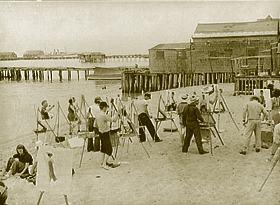
Then there arrived the most important tourist of all. The artist Charles Hawthorne perceived that the quality of light from the sea’s glitter, patterns, and movement combined with that of the sun on the dunes to produce an effect replicated almost nowhere else, the South of France offering the only competition. He established his Cape Cod School of Art. Within a few years, the summer months found students coming in droves. With easel and brush they thronged the beaches where once scavengers had salvaged goods floating ashore from wrecked craft of the graveyard of the Atlantic, the Cape’s ocean side—1,500 ships at least. (Sometimes things were helped along, with lanterns hung where shoals meant disaster for trusting captains. Deepest darkness was required, and so the entrepreneurs were called the Mooncussers.)
The First World War was a great boon, for American artists gave up study abroad, instead coming to what became and remained the country’s largest summer art colony. Following them came others divorced from routine occupations, writers and poets and the people of the Provincetown Players, who gave birth to the American theater. (Eugene O’Neill, wandering the dunes, was arrested as a suspected German spy.)
Prohibition was also good for P’town, rumrunners bringing in liquor from offshore. Lights flickering from the high bluffs outside of town told when the coast was clear for delivery to shore. But summer tourism was now the place’s lifeblood. There was a category of guest much sought after for the hundreds and hundreds of rooms for rent. They were originally termed “bachelors” and “maiden ladies.” They were uniformly quiet and self-effacing—taught to be so in their hometowns all over the country which, unlike Greenwich Village North, were not populated by artistic and Bohemian types of tolerant nature. Yet beating up the queers, fairies, fags was a recognized sport for locals for decades, until the LGBT, a designation so familiarly used in P’town today as not to require explanation that it means lesbian-gay-bisexual-transgender, gained complete political power.
The process took 30 or 40 years. Perhaps the last stand of the old Yankee-cum-Portuguese, the last being fisherfolk immigrants, took place in the spring of 1939. The city fathers expressed concern for U.S. Navy sailors coming in for shore leave from the warships docked in harbor for big-gun firing practice, which rattled windows, as did the dive-bombers screaming overhead. These fine lads should be protected from untoward sights when on land. It was improper that they be exposed to the sight of women in shorts “and other horrors,” recorded the author Mary Heaton Vorse. Word of the no-shorts ruling garnered nationwide newspaper attention, and laughs. It was rescinded. The walls came tumbling down, and Provincetown became, and remains, what its longtime resident Norman Mailer terms the Wild West of the East, America’s “freest town.”
No traffic lights downtown. Walk in the middle of the street. See the six-foot drag queen in stiletto heels and mesh stockings and high wig heading for a cabaret performance you might enjoy, “cling-ons” though you may be—which according to local terminology means an opposite-sex couple clutching one another wide-eyed as they pass the legions of men looking to hook up and the shop of incredible devices for women only. Need you feel uncomfortable? Absolutely not. There is no drunkenness, no fights, no crime, unless you count the real estate prices.
If you go, you might think about renting a bike to go along wondrous trails through sand hills reminiscent of the Sahara, which dip down into almost jungle-like forest. There are old schooners sailing in late afternoon for cocktails, and boats that go out to see whales. Your kids will go nuts when the friendly monsters spout geysers and then shoot up to flop down with colossal splash effect, and the sunset as seen when heading back to harbor is beyond description. Then there’s the view from the Pilgrim Monument peak: Boston can be seen. Getting up the endless stairs—well, you do after all want to work off the calories picked up in Provincetown’s brilliant eating places too numerous to name.
Provincetown is a very popular destination. It’s never too soon to start planning for next summer, and in fall and winter the place feels almost bleakly peaceful and remote.