
Travel: Revisiting Sixty Years of Sex
In 1938 the biologist Alfred Kinsey offered to teach a class on marriage at Indiana University—and stepped into a scientific vacuum. With human sexuality a subject never really discussed either inside or outside the academy, people knew next to nothing about actual sexual behavior. He spent the rest of his life trying to fill that void. The Kinsey Institute for Research in Sex, Gender, and Reproduction, now in its sixtieth year, continues his legacy by supporting pioneering research and sheltering a vast collection of materials related to sex. Nestled in Morrison Hall, an elegant brick and limestone building at the university, it also shows off its collections to the public, both in its gallery and on monthly tours.
Kinsey, until then known as an entomologist, had been raised to distrust and fear his own sexuality. As a child, he had been told that masturbation could cause blindness and even insanity. His sexual ignorance led to a disastrous wedding night and a rocky beginning to his marriage. But the Kinseys sought out better information and experimented, and they learned to lead a fulfilling sex life. He believed that “prudish ideas . . . undermined the home,” and he wanted save his students the pain and embarrassment he had suffered.
Crewcut and bowtied, he taught his students about sex from a biologist’s perspective, free from bias and relying on scientific fact. The course demolished many of the myths they had learned in previous “social hygiene” classes, such as that women have no sexual response and that oral sex causes infertility. The most persistent question they had for their professor was whether what they felt, thought about, and did was “normal.” In an effort answer them, he surveyed his 100 or so students.
To his surprise, many reported homosexual acts, premarital affairs, extramarital affairs, and masturbation—all behavior that social hygiene courses taught was perverse and abnormal. Wanting to know how aberrant this result was, he started to collect sex histories from the general public. To protect his project’s independence from nervous faculty members, the university’s president, Herman B. Wells, created the Institute for Sex Research in 1947.
This gave Kinsey the freedom to assemble a small staff to help him collect tens of thousands of sexual histories from people in all walks of life. John Gagnon, one of the sex researchers, described his boss’s zeal: “He was a man who felt that truth was better than ignorance, that inquiry was better than dogma, and that if people knew more things they would make better decisions. And if they made better decisions they would make a better society.”
In 1948 Kinsey published Sexual Behavior in the Human Male, an instant bestseller and a cultural sensation. In a time when adultery, premarital sex, and homosexuality were crimes in many states, Kinsey found that more than 50 percent of his subjects had had premarital affairs and 37 percent had had at least one homosexual experience. He also discovered that 98 percent of men masturbated frequently.
His 1953 volume about women reported that more than half of women masturbated or had had a homosexual experience. This time people reacted with moral indignation and disbelief. The American public was evidently ready to accept the variousness of male sexuality, but not of female. Rev. Billy Graham called the work “an indictment against American womanhood.” The Rockefeller Foundation, which had been funding Kinsey, withdrew its support. Questions were raised about his statistical methods. His work floundered. Three years later he died of a heart attack, deeply disappointed. He missed seeing public acceptance of sexuality grow the 1960s, and the decriminalization of homosexuality that resulted in part from his work. His biographer Jonathan Gathorn-Hardy credits him with “lifting a huge weight of guilt, anxiety, and worry. . . . Suddenly people thought, ‘I’m alright!’”
The Institute was renamed in his honor in 1981, and it continues to build on his work. The tours, run by volunteer docents, cover the fascinating, sometimes controversial history of the Institute and give an overview of the projects it’s currently supporting. Kinsey’s painstaking collection of data about what people did sexually exploded the idea of what was “normal” sexual behavior; the Kinsey Institute today takes his research to the next level, looking at why people do what they do. For instance, why do many people informed of the risks of unprotected sex still not use condoms?
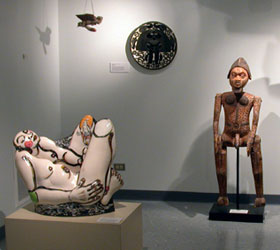
The highlight of the tour is seeing some of the vast collections of artworks, films, and ephemera that Kinsey amassed. He had an unquenchable curiosity about how sex was portrayed in everything from high art and literature to pornography. He preserved materials that others would have destroyed, thus providing invaluable resources for researchers in many disciplines. The halls of the Institute are decorated with a rotating display of some of the 7,000 pieces in the collection. You can see paintings by Pablo Picasso, Marc Chagall, and Henri Matisse, dramatic photographs by the pioneering fashion photographer George Platt Lynes, and erotically charged lithographs by the Hungarian artist Mihlay von Zichy.
The library displays notable pieces from its vast archive of four centuries of materials. These include a rare Chinese “pillow book” from the 1600s and a letter handwritten by Sigmund Freud. It also houses Kinsey’s own voluminous correspondence, such as exchanges with the playwright Tennessee Williams about A Streetcar Named Desire.
The Institute runs a modest gallery on the first floor of Morrison Hall. It is currently showing “Queer Projects,” a look at gay, lesbian, and transgender individuals on film, with farcical posters from campy lesbian biker flicks of the 1950s and stills from the heartbreaking 1999 movie Boys Don’t Cry. The Institute is also preparing for its annual juried erotic art show, with sculptures, photographs, and paintings that invariably illustrate how very diverse people’s ideas about sexuality are.
While the focus of the Institute’s research has changed and its methodology has been refined, it still upholds Kinsey’s commitment the belief that the more people know about human behavior—including sexual behavior—the better off they and society are. In the words of Jennifer Bass, the head of information services, “Sex research remains important because sex is the fundamental reason for our being. All of us are connected by the fact that we were created or we procreate.”
Tours of the Kinsey Institute are offered monthly. Call 812-855-7686 or email kinsey@indiana.edu for information and reservations. For gallery hours and a complete listing of shows visit www.kinseyinstitue.org.