
Travel: See How Photography Was Born and Grew
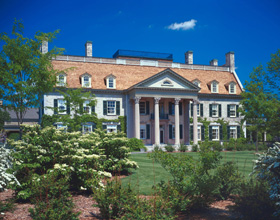
The day is fast approaching when a camera that records pictures on film seems as strange to young people as a wind-up Victrola. Someone who has grown up snapping images on a cell phone can hardly relate to sending film away for processing. Show them how this dated technology came about, how it evolved, and how it changed our world, with a visit to George Eastman House, in Rochester, New York.
It’s the world’s premier photography museum, and its curators have amassed a detailed and fascinating record of the history of photography. They continue to track developments even as pixels replace grains of silver iodide.
George Eastman, born in 1854, did not invent photography any more than Henry Ford invented the automobile. The earliest paper negatives date to 1816, and photography became practical in 1839, when Louis Daguerre devised the direct positive method, which used mercury vapor to develop an image on polished metal. By the 1850s, glass plates coated with a paste of collodion were yielding negatives that allowed multiple prints. The process was cheaper and more versatile than the daguerreotype, and it dominated photography for two decades.
But taking pictures during this period remained an exacting activity pursued mainly by professionals. Eastman was a 23-year-old bank clerk when he took up photography as a hobby in 1878. He found the process awkward, the equipment cumbersome. Three years of experimenting with gelatin emulsions in his mother’s kitchen resulted in a patent for a machine for coating plates with dry gel. Next, he made the glass negative obsolete by putting his emulsion onto flexible film. He founded the Eastman Kodak Company in 1892. His first Kodak camera held a 100-photo roll; the consumer sent the entire apparatus back for developing. “You press the button, we do the rest,” was the company’s motto. At the turn of the century, Kodak began selling the Brownie camera, which let the owner send in only the film.
The original Brownie, which sold for just a dollar, sparked a boom in amateur photography. A million Brownies were sold in the first five years, and the model remained on the market, in constantly evolving forms, for 80 years.
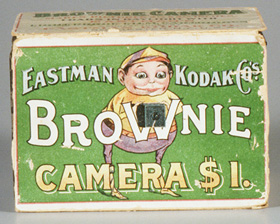
The Brownie is well represented among the museum’s 25,000 pieces of technology. You can see the earliest little black box of 1900, a 1905 stereo version that sold for $12, and on down through the Starmite III model from the 1960s with built-in flash, which retailed for $11.95. Also prominent in the collection are examples of Daguerre’s more complicated apparatus; the classic Speed Graphic camera made famous by 1940s news photographers; and the 1972 Polaroid SX-70, which allowed the photographer to watch an image emerge on the film in broad daylight.
The museum is directly adjacent to Eastman’s own house on Rochester’s posh East Avenue. The 50-room Colonial Revival mansion is, according to museum’s curators, a “three-dimensional biography” of the inventor. It is shaded by a 150-year-old copper beech and surrounded by formal gardens. Eastman, who never married, built the opulent home in 1905 and lived there with his mother. Exhibits highlight his life and extensive philanthropy—he gave away $100 million altogether. Everywhere you turn in Rochester you encounter evidence of his largess, for instance the Eastman School of Music, Eastman Theatre, and Eastman Dental Center.
Afflicted by an intensely painful degenerative spinal disease, he shot himself to death in 1932. He willed his home to the University of Rochester as a residence for the school’s president; it opened as a museum in 1949.
The Museum includes the George Eastman Archive and Study Center, where you can, by appointment, peruse one of the greatest photo collections in the country. The holdings, especially heavy on nineteenth-century work, span the entire history of photography. Turning from a grim Mathew Brady image of the slaughter at Gettysburg to a scene of the aftermath of the 1889 Johnstown flood and then Weegee’s portrait of tenement children asleep on a fire escape in 1941, you’re reminded of how photography has made history palpable during the century and a half since it came into wide use.
Motion picture film was another invention of Eastman’s, and his company became a leader in the nascent movie industry. The museum owns not only the earliest movie cameras but also 23,000 films that span the history of cinema, plus five million movie stills. George Eastman House also runs the first film preservation school in the country, and the 525-seat Dryden Theatre, right on the grounds, shows a wide variety of movies, from gems of the silent era to much more recent classics.
Eastman House is open Tuesday through Saturday, 10 a.m. to 5 p.m., Sunday 1 to 5, and until 8 Thursday. Guided tours, included with admission, are given twice daily and once on Sunday. The current photography exhibits include “Lucha Libre!,” a glimpse into the strange world of masked Mexican wrestlers, with images from the 1940s through today. Holiday specials feature a gingerbread house exhibit, musical events, and a Muppets retrospective at the Dryden. For more information, visit www.eastmanhouse.org or call (585) 271-3361.
Eastman Kodak never lost its preeminence in the production and processing of photographic film, and only ten years ago the 1,600-acre Kodak Park, a few miles north of downtown Rochester, was the largest industrial site in the Northeast. But the rush to digital photography has decimated the film business. After years of downsizing, the Rochester plant now covers 700 acres and employs fewer than 10,000 people, one sixth as many as at its peak.
But if George Eastman were alive, he would probably applaud the new technology. Today’s little digital point-and-shoots are the Brownies of their time, and like Eastman’s own invention, they’ve brought a whole new level of convenience to photography.