
Tunnel to the Future
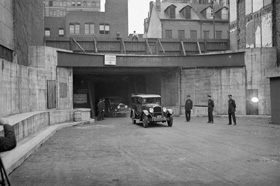
One Saturday in the autumn of 1927, 20,000 pedestrians walked through the brand-new Holland Tunnel shouting and singing and listening to their voices echo off the glistening white-tile walls. President Calvin Coolidge and a throng of dignitaries had that day dedicated one of the engineering marvels of the age. Then, just past midnight on Sunday, November 13—80 years ago today—the tunnel opened for traffic. A delivery truck bound for Bloomingdale’s, the department store, was the first paying vehicle to pass through the longest underwater vehicular tunnel in the world.
Twenty-one years had passed since officials had begun to grapple with the problem of getting automobile traffic across the Hudson River. So many ferries and barges plied the mile-wide waterway that they threatened to disrupt the passage of large ships. A bridge had been talked about for decades, but a seven-year study begun in 1906 found the idea impractical. Manhattan lay too low; a huge tower with a long approach would have been needed. (The George Washington Bridge would open in 1931 ten miles north of the downtown hub, where the river carved through high land.)
Thoughts turned to tunnels. Engineers had bored a railroad tunnel under the river in 1910, but a tunnel to accommodate cars and trucks would need to be much larger. Even more daunting was the problem of clearing the tube of exhaust fumes. Studies on volunteers showed that extended breathing of as little as four parts of carbon monoxide in 10,000 of air could be harmful.
A design submitted by Clifford M. Holland, a young engineer who had worked on the New York City subway system, was chosen in 1919. The project would require digging two tunnels, one carrying cars in each direction.
The work, which got underway the next year, began with the sinking of four large shafts, two on shore and two into the river bottom. Workmen constructed caissons, boxes with walls five feet thick, towed them into the river, and sank them onto the silt below the water. They descended into these boxes while operators kept the inside air pressure high enough to keep them from flooding. Then they began to dig.
When they had dug down to tunnel level, about a hundred feet below the river surface, the sandhogs (as the workers in the caissons were called) began using powerful jacks to push huge iron shields into the silt. Again, compressed air kept the mud and water from seeping in. All people and materials had to enter the work area through air locks.
Some days the progress was measured in feet, and some days it slowed to inches, as the men hammered and blasted through solid rock. The work was dangerous—13 men died during the seven years of construction. Holland kept obsessively close watch on every detail. “When Clifford M. Holland talks tunnels,” the Brooklyn Daily Eagle wrote, “his listener is in danger of being convinced that tunnels are the only refuge for mankind.”
By the autumn of 1924, workers were on the verge of joining the 29-1/2-foot-wide cast-iron tubes reaching out from either side of the river. But Holland had put too much of himself into the project. He suffered a nervous breakdown and died of a heart attack less than two days before the “hole through.” He was 41. The tunnel was given his name a few weeks later.
Once the tubes were completed, workmen lined them with concrete and installed a granite roadbed. But the real innovation was the ventilation system. Shorter highway tunnels relied on air flowing through each end. Holland had determined that to keep his tunnel supplied with fresh air that way would require a wind of 75 miles an hour. Instead, he planned to bring fresh air in through ducts under the roadway and take away exhaust fumes through a passage above the ceiling, changing all the air in the tunnels every 90 seconds.
Four ventilation buildings housing 84 huge fans accomplished the task. The fans could be regulated according to the traffic level. Monitors were installed to check the carbon monoxide concentration. In the early years of operation, lights along the way signaled drivers to turn off their engines during any long delays.
Today, this project that required a heroic vision to undertake and impressive ingenuity to complete seems decidedly mundane. A hundred thousand vehicles roll through the Holland Tunnel every day. Drivers either take the great engineering achievement for granted or curse it as a bottleneck.
But as the collapse of the Interstate 35 bridge in Minneapolis in August graphically illustrated, such an attitude can be dangerously shortsighted. Americans have too often neglected one of the critical functions of any government, maintaining and improving the nation’s infrastructure.
“The fact is that Americans have been squandering the infrastructure legacy bequeathed to us by earlier generations,” wrote Stephen Flynn, a senior fellow at the Council on Foreign Relations, in a recent issue of Popular Mechanics. “Like the spoiled offspring of well-off parents, we behave as though we have no idea what is required to sustain the quality of our daily lives.”
Officials in 1913, when the tunnel was first authorized, recognized that steadily increasing motor traffic would require a serious expenditure of money—the tunnel cost around $50 million, the equivalent of $600 million today—and effort. Eighty years later, we continue to profit from their vision and their investment. The Holland Tunnel is a model of investment in infrastructure that works and can last.