
Understanding Lincoln’s Genius with Words
On November 26, 1863, the Centralia, Illinois Sentinelreported on a speech President Abraham Lincoln had made at the dedication of the Gettysburg National Cemetery the previous week. According to the paper, Lincoln’s address began: “Ninety years ago our fathers formed a Government consecrated to freedom.”
Sound familiar? Not really? Yes, the Sentinel got the words wrong, but at least it made space for Lincoln’s speech; most papers didn’t. The Gettysburg Address was largely ignored in 1863. But the next 140 years would turn it, along with the rest of Lincoln’s writing, into American gospel. In two new books out this week (Sunday is the 143rd anniversary of the Gettysburg Address), eminent Lincoln scholars take a closer look at Lincoln’s words and their enduring power.
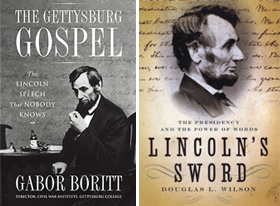
When Lincoln entered office, no one expected the lightly educated farm boy to craft phrases that would resonate for centuries. But in Lincoln’s Sword: The Presidency and the Power of Words (Knopf, 352 pages, $26.95), a painstaking analysis of Lincoln’s speeches and published letters, the historian Douglas Wilson shows just how meticulous the sixteenth President was with words, and how he achieved, through tireless rewriting, a perfectly calibrated ratio of force and reassurance. Time and again we see him use pet devices—pointed questions, antitheses, strategic acquiescence to an opposing view—to convince, or soothe, or attack.
But as obvious as Lincoln’s literary talents seem today, they went unsung in his lifetime. His writing lacked the long, florid phases standard in nineteenth-century prose, and his critics couldn’t see that he was creating a revolutionary new style. Wilson argues that Lincoln, as much as his contemporaries Walt Whitman and Ralph Waldo Emerson, established the first wholly American idiom, based on the dignity of common speech.
Wilson’s most fascinating achievement in his new book is the glimpse he offers into Lincoln’s mind. In one of the most hectic administrations in American history, Lincoln made time to write, and not just to improve his speeches but to keep his sanity. For the beleaguered President, writing was refuge, safety valve, and therapy. When an editorial or political opponent attacked him, he didn’t punch a hole in the wall; he poured his anger onto the page. In many cases, the result was a prickly letter he never actually sent. Sometimes, however, he purged his heart with a little comedy, like an imagined dialogue between his prospective presidential opponents, Stephen Douglas and John Breckenridge, or this bit of verse, titled “Gen. Lee’s invasion of the North written by himself—“: “In eighteen sixty three, with pomp and mighty swell,/ Me and Jeff’s Confederacy, went forth to sack Phil-del,/ The Yankees they got arter us, and giv us particular hell,/ And we skededdled back again, and didn’t sack Phil-del.”
Writing also gave Lincoln the opportunity to crystallize his thoughts. “Writing was a form of refuge for Lincoln,” Wilson notes, “a place of intellectual retreat where he could sort through conflicting options and order his thoughts with words.” Wilson provides example after example of Lincoln developing an idea over several drafts, even several documents, and jotting down phrases on scraps of paper for future use.
His ideas, particularly on emancipation, frequently clashed with popular opinion, and the speeches that middle-schoolers memorize today raised hackles in their time. “What does it say that those spirited phrases that could not induce the public to embrace the rest of Lincoln’s emancipation package are still remembered and still resonate with modern readers?” Wilson asks. “Perhaps this: that well-crafted language, particularly if flexible and adaptable, can outlive the ideas it was created to promote and can even take on a life of its own.”
But when modern readers give old language a new life, the words can lose their original meaning. In The Gettysburg Gospel: The Lincoln Speech That Nobody Knows (Simon & Schuster, 432 pages, $28), Gabor Boritt traces America’s evolving relationship with the Gettysburg Address. Boritt’s thesis is that each generation has adapted Lincoln’s words to suit its own needs, to the point where we have forgotten or deliberately obscured what he originally meant.
Two years into a war most Northerners thought would be won in a few months, Lincoln had to persuade the Union to see the conflict through to victory, even in the face of massive death tolls. In the Gettysburg Address, he warned that freedom itself was at stake. Two decades later, though, North and South would rewrite his lines in the service of reunion. The address “could be made into a tool for reconciliation between the whites of the North and the South,” Boritt writes. “First, the meaning of Lincoln’s words had to be sanitized, however, or at least given the understanding that some people had in 1863, those for whom ‘all men are created equal’ and the ‘new birth of freedom’ applied only to whites.” Progressives, New Dealers, anti-isolationists, and Cold Warriors would eventually all have their way with Lincoln’s words. But to highlight one aspect of the speech—its nationalistic message, for example, popular during both World Wars—obscures the others, like its themes of sacrificial redemption for slavery. Boritt, by putting the words back in their original context, strips them of the patina of a century and a half of misinterpretation.
The Gettysburg Gospel is both more specific and broader than Lincoln’s Sword. Wilson focuses on Lincoln’s writing, and four years of war filter through that lens. Boritt concentrates on a single speech and a single battle. But his subtitle is misleading: The Gettysburg Gospel spends as much time with soldiers, nurses, gravediggers, and townspeople as with the President or his address. Boritt squeezes an academic’s census of primary sources into taut, telegraphic sentences, often in second person and present tense, that convey the drama of their subject. In one passage he describes the work of black men contracted to move Federal bodies from their original graves to the new cemetery on the Gettysburg battlefield: “Who is this dead man? Many graves were never marked. Men barely buried. . . . When you open a grave, you first look to see if the uniform is blue or gray. But often you can’t tell what you have found.”
Boritt and Wilson both note that Lincoln was too disappointed in the aftermath of the Battle of Gettysburg, when Gen. George Meade failed to pursue the retreating, vulnerable Confederates, to see it as the turning point in the war. That we remember it as such, Boritt argues, is largely due to the legend born at the cemetery dedication. After the war, Americans imbued democracy with quasi-religious overtones; Gettysburg and Lincoln’s address came to be, and remain, central to its gospel. “Late in the century, Americans would rediscover Lincoln’s remarks in their own right, call them by the name we still know, begin to turn the text into a revered document, and find the meaning of their country there.” Boritt writes. “In the twenty-first century, Americans are still saying this is who we are.”