
The U.S. Constitution That Failed
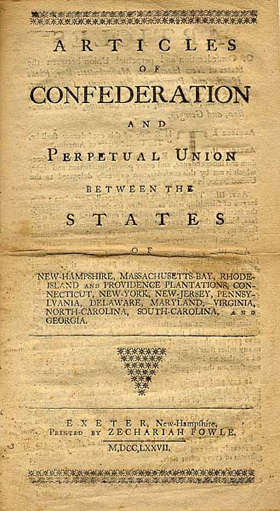
In June 1776, while Thomas Jefferson was writing the Declaration of Independence, a committee of the Continental Congress began work on another document. Thirteen delegates, most of whom had just two years’ experience in continental politics, were charged with an unprecedented task: They had to invent a brand-new government for a brand-new nation. On November 15, 1777—230 years ago today—Congress approved the finished product and sent it to the states for ratification. Called the Articles of Confederation and Perpetual Union, the charter was the brainchild of many of the same minds that would go on to author the Constitution, but it is rarely mentioned in the same breath. After its ratification, the weak, inefficient system it created would last only seven and a half years before the nation’s fathers scrapped it and started over. Derided when it is remembered at all, the Articles was nevertheless an important, if halting, step toward an enduring republic. The earliest formal bond of “perpetual union” between the erstwhile colonies, it announced from its first lines that “The name of this Confederacy shall be the United States of America.”
The American Revolution took the opposite of the usual pattern of rebellion. “In Europe, in Asia, in Africa, we have seen it stir one people after another: they grow proud of their traditions, of their language, of their identity, and they strike for independence,” wrote the historian Edmund Morgan. “In our case it was the other way round: we struck for independence and were thereby stirred into nationality; our nation was the child, not the father, of our revolution.” American society in the early years of the war was largely provincial, defined by family ties and local industries. Distinct customs, religions, industries, and heritage divided the residents of different colonies. One South Carolina militia leader believed that from Massachusetts to Georgia, “manners and modes of thinking of the inhabitants differ . . . nearly as much as in different nations of Europe.” Years of struggle against the crown had begun to weld the colonies together, though, and their shared political beliefs and outrage evolved, slowly, into a sense of union.
After Lexington and Concord, they knew they must join forces to defeat Britain. But what would their partnership be? A new nation, or merely a defensive alliance of 13 sovereign states? The question survived eight years of war unanswered. The Declaration of Independence called the colonists “one people,” but it also defined the colonies as “Free and Independent States.” Even after the Articles of Confederation was ratified, Congress was not an authentic national government in any conventional sense—it couldn’t make laws or compel the states to carry out its resolutions—but America’s instincts towards federalism whispered from each draft of the document.
They finally found full voice in 1787. But whereas the Constitution would be woven from ingenious compromises, the Articles seemed more like a tissue of evasions, sidestepping controversial issues with limp circumlocutions or shortsighted deferral to the status quo. As often as the two documents are compared, though (and as unflattering as the comparison is to the Articles), they sprang from radically different atmospheres and were intended for different ends. Ten years after the Articles was signed, the framers of the Constitution—who could draw upon a decade of experience in American government—had time to debate ideology, to consider every alternative.
In 1776, on the other hand, wartime demanded speed rather than lapidary perfection. The pressing need for a legitimating government overwhelmed quibbles over structural niceties. “An imperfect & somewhat unequal Confederacy is better than none,” wrote the Maryland delegate Charles Carroll. Any issue that might prevent a legislature from ratifying had to be smoothed over, any state’s apprehensions about confederating had to be soothed. Declaring independence had been divisive enough; all the allied states needed now was some agreed-upon communal overseer to coordinate the war effort.
Of course, the country already had such a body. In 1774, after Britain had expanded the boundaries of Quebec into the American interior and protected the Catholic Church in Canada, several state assemblies had called for a congress of representatives from the colonies. The first Continental Congress met in Philadelphia in September 1774; new sessions would convene every year until 1789. The historian Herman Belz called it “a kind of continuing emergency meeting of . . . ambassadors from independent states.”
The Continental Congress’s authority was amorphous, not executive but not exactly legislative either. Conceived as an advisory body, Congress digested colonial consensus into policy but left it to the individual governors and legislatures to execute its plans. The states imposed taxes, raised troops, regulated trade, and performed every other task that required coercive power. Congress couldn’t force the colonies to enact its recommendations, but it commanded enough respect from state legislatures that they uniformly followed its direction—at least at first.
In the early years of the rebellion, political thinkers, including Benjamin Franklin, drew up a few plans to formalize the relationship between Congress and the colonies. The delegates balked at the idea. Forming an official union sent a strong signal to Great Britain, perhaps too strong for a people still hoping for reconciliation. As the war ignited, Congress took over supervision of the growing army, a job that required money and the power to move men and resources. When it became clear that Americans were fighting not for home rule or expanded colonial rights but for independence, the delegates decided to compose a formal set of rules that would legitimize their assembly. On June 12, 1776, Congress appointed a 13-man committee—one delegate from each state—to draw up a blueprint for confederation.
As they debated over the next month, the committee members used as their template a draft by the Pennsylvania delegate John Dickinson. Dickinson doubted the states’ ability to act for the good of the whole union. His plan gave the central government preeminence over the states: Congress had sole power to manage war and peace, conduct diplomacy, and administer the sparsely settled lands west of the Appalachians. The states could execute their existing laws, but only as long as they didn’t “interfere with the Articles of this Confederation.” The committee toned down Dickinson’s original plan, deleting provisions that would have prohibited the states from establishing churches and allowed Congress to create a subordinate executive branch and regulate fees from interstate commerce. The committee also forbade Congress to levy taxes or duties, and it called for the consent of nine delegations for major decisions. The draft the committee members presented to the full assembly on July 12 still vested extensive powers in Congress, but these were merely the responsibilities Congress had already assumed, virtually unopposed, during the past two years.
Over the summer, Congress slashed away at the committee’s work. The clauses giving Congress control over Western lands, as well as articles that banned states from discriminating against residents of other states, were rejected. Conditioned by the past decade to distrust central government, the delegates worried that a strong Congress could become a tool that one region could use to dominate the rest. They also realized that state legislatures would dismiss any document that leached their power.
Debate dragged into August, with three particularly thorny issues bedeviling the delegates. The first was how to share the expenses of war. The Dickinson committee draft required states to contribute funds proportional to their populations. The majority in Congress approved, although other proposals had suggested area or total wealth as a better measure. The question of expense, in turn, brought up the puzzle of how to apportion votes in Congress. The 1774 assembly had agreed to give each delegation one vote, because there was no way to determine the area, population, or property of any colony. But if larger states like Massachusetts or Virginia were contributing more money to the army, didn’t they deserve more votes? “It is strange that annexing the name of ‘State’ to ten thousand men, should give them an equal right of forty thousand,” said the Pennsylvania delegate James Wilson. “This must be the effect of magic, not of reason.” But the small states stubbornly refused to give up their equal voice.
The lands to the west proved an obstacle, too. States like Virginia and Connecticut, whose colonial charters gave them territory extending to the Pacific coast, could profit from the sale of plots to settlers. The small states, like Maryland, Delaware, and New Jersey, would have to defray their costs through taxation. The Dickinson committee had hoped to quell their jealousies by giving the union control of the western land, but the states with large claims agitated successfully to strike that provision.
Underlying all of the disagreements were clashing, if never explicitly examined, ideas about sovereignty. From the very earliest drafts of the Articles, American lawmakers had been “groping toward modern theories of federalism,” in the words of the historian Jack Rakove, but “the notion that sovereignty ultimately had to reside in some one discernible place was still orthodox.” Would that place be Congress or the states? The delegates had not yet explicitly addressed the question. The Dickinson committee’s plan seemed to put Congress in authority, while the subsequent revisions divided sovereignty between the central government and the states.
Still at an impasse in August, some in Congress began to wonder if the Confederation could ever be signed or ratified. “We have made such a Devil of it already,” wrote the South Carolina delegate Edward Rutledge, “that the Colonies can never agree to it.” Other, more urgent problems demanded their attention, such as the hundreds of British and Hessian ships massing on the shores of Staten Island. Rather than press one another on matters that could lead to disunion, the delegates postponed further discussion of the Articles.
So Congress continued to lead the colonies as it had for two years, a government born but not yet truly conceived. Formally it lacked the sovereignty to do much of anything, but as problems arose, it took what power it needed. (Congressmen had to strike a fine balance, however; if they seized too much control, they might inflame a people already leery of central government.) The delegates picked up the discussion of the Articles in April 1777, only to drop it again when they realized that their disputes had not solved themselves in the interim.
Thomas Burke, a delegate from North Carolina, did manage to tip the balance of power toward the states during the brief resurgence of the debate. Believing that the document as written would enable Congress to “explain away every right belonging to the States and to make their own power as unlimited as they please,” he introduced an amendment: “Each state retains its sovereignty, freedom and independence, and every Power, Jurisdiction, and right, which is not by this confederation expressly delegated to the United States, in Congress assembled.” All but Virginia and New Hampshire voted in favor. Burke was the first delegate to subject the issue of sovereignty to close scrutiny, and once they thought about it, most delegates agreed the states—more intimately connected to the people—should hold sway.
In October 1777, the American army’s recent victory at Saratoga finally motivated Congress to finish the Articles. The need to confederate to negotiate an alliance with France had finally outweighed the risk of alienating the individual states. Once they buckled down, the delegates needed only ten days to complete their work. Quarrels that had stagnated for a year were resolved in hours. Each delegation would get one vote, the states would retain control of the Western territories, and expenses would be apportioned according to the value of a state’s granted lands. Burke’s amendment stood, with the added, if somewhat toothless, provision that “Every state shall abide by the determinations [of Congress] . . . on all questions which by this Confederation are submitted to them.”
Congress approved the Articles on November 15. In a letter to the states, the assembly warned of “the difficulty of combining in one general system the various sentiments and interests of a continent divided into so many sovereign and independent communities,” but hoped that Confederation would “confound our foreign enemies.” The letter cited March 10, 1778, as the deadline for ratification.
However, just like the Congressional debates, the ratification process would drag on much longer than expected. Maryland refused to sign as long as Virginia held its vast tracts in the West. Congress refused to amend the document, so it moldered, unratified, for more than three years. Only after Virginia relinquished its land claims did Maryland finally approve the Articles, in February 1781. Eight months later, British troops surrendered at Yorktown, and the two nations began the long process of negotiating a peace.
A product of haste, the Articles was meant as a stopgap, a short-term defensive alliance, and it took effect at almost the moment it became obsolete. The conditions of 1776 and 1777 had hardly been conducive to a systematic political ideology—and it showed. The central government lacked an executive and a judiciary. As Morgan wrote, “Congress had been safeguarded into impotency.” Unable to levy taxes, it depended on funds from the states, which increasingly ignored its pleas. States issued their own paper money without any specie to back it, negotiated their own foreign policy, raised their own navies, and taxed shipments from neighboring states. The new nation’s commerce and economy fell into chaos, and Britain declined to trade with American merchants. Congress was powerless to respond or even recommend a course of action; the states rarely sent enough delegates to reach a quorum. George Washington called the Confederation “a half-starved, limping Government that appears to be always moving upon crutches, and tottering at every step.”
After six years, Americans were ready to discard the Articles and form a real nation. The framers of the Constitution, now with a decade of experience in state and central government, finally constructed a system that worked. Their predecessors in the Continental Congress in 1776 and 1777 had had scant practice governing at the continental level; what’s more, they had never even lived under a national government. “When the Articles of Confederation were drafted, Americans had had little experience of what a national government could do for them and bitter experience of what an arbitrary government could do for them,” Morgan wrote. “In creating a central government they were therefore more concerned with keeping it under control than with giving it the means to do its job.”
Their job was certainly unprecedented. In the 1770s conjuring an entire government from scratch was all but unheard of. And as Britain does not have a constitution as such, little in the British historical tradition prepared the delegates for the job. “In no age before, and in no other country, did man ever posses an election of the kind of government under which he would choose to live . . .” wrote the South Carolina legislator David Ramsay in 1789. “In America alone, reason and liberty concurred in the formation of constitutions.”