
What Did the Summer of Love Leave Behind?
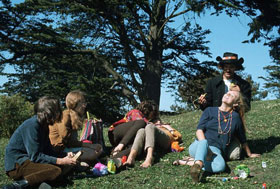
They came by the thousands from all over the country to Haight-Ashbury in San Francisco—college students, teenage runaways, political dreamers, “flower children”—seeking free love, radical change, communal living, drugs, and perhaps a piece of history. By some accounts, it was the largest migration of young people ever. Some estimate that as many as 100,000 flocked to the city, urged on by word of mouth and media reports of a “hippie invasion.” This summer San Francisco observes the fortieth anniversary of the “Summer of Love,” the famous few months of countercultural experimentation that came to define the 1960s for many people. Part spontaneous social phenomenon, part media-sponsored (and -manipulated) news event, just what the Summer of Love was and what it accomplished politically is still debated. But no one questions that it left a mark on the American consciousness.
If ever a time was ripe for social upheaval, the spring and summer of 1967 was. With race riots erupting in Detroit and Newark and anti–Vietnam War protests rocking college campuses around the country, the national mood was turbulent. Also, there were more Americans under the age of 25 than ever before. The people who would be called baby boomers totaled almost half the population of the country, so they had enormous power (or at least visibility) as a political entity. The generation brought up in the Eisenhower 1950s was eager for change and excitement, burning draft cards and trying drugs like LSD. And the heart of it all was San Francisco.
The Summer of Love actually began in January 1967 with the Human Be-In, a Haight-Ashbury community event that the San Francisco Oracle, an alternative newspaper, called “the gathering of the tribes.” Some 20,000 showed up in Golden Gate Park for a day of political discussion, music, dancing, and drug experimentation. Allen Ginsberg, the Grateful Dead, and Baba Ram Dass (né Richard Alpert) were there, and Timothy Leary used the occasion to coin the phrase “Turn on, tune in, drop out.”
But as with most too-good-to-be-true events, the party was over by the time the hordes arrived, and by the end of the summer, the dream had turned into a nightmare, the utopian vision disintegrating into homelessness, drug addiction, and violence. A “Death of the Hippie” funeral was even staged in October to mark the end of an era, when local activists—mainly just hippies who’d gotten there first—became disgusted with the influx of newcomers and exhorted them to go home. The city, and certainly a small neighborhood, wasn’t equipped to handle a flood of cash-poor young people. Social services got stretched to their limits, and health problems, including sexually transmitted diseases, spread.
The colorful Haight-Ashbury district, bordering Golden Gate Park, was a former working-class neighborhood (originally a summer retreat from downtown San Francisco) thrown suddenly and reluctantly, for many, into the national spotlight. The Haight’s pastel Victorian homes—many of them empty from a period of “white flight” a few years earlier—could be rented for a song, and many were taken over by young people and set up as communes. Others became crash pads for members of rock bands, including Janis Joplin’s Big Brother and the Holding Company, the Jefferson Airplane, and the Grateful Dead. LSD’s hallucinogenic, mind-altering properties had been heralded in none other than Life magazine in March 1966, and the drug was legal in much of the nation until October 1967. By then it had become ubiquitous on the San Francisco underground scene. Thousands showed up for free acid-fueled concerts and dances.
Haight Street, the main artery of the neighborhood, became an ongoing carnival of rainbow colors and marijuana smoke, so thronged with revelers that it was closed to traffic every weekend. The owner of one local business, the Haight Street Psychedelic Shop, is credited with originating the term “summer of love.” As the spectacle intensified, tour buses began plying Haight Street to provide a look at the hippies. The hippies in turn held up mirrors to the buses.
Though it is all pretty much dismissed today as so much drug-induced lunacy, some very real attempts at social change were taking place, and it can be argued that American society has never been the same since. From the mainstreaming of spiritual pursuits like yoga and Buddhism to the relaxation of attitudes about sex, much that has changed in America sparked at that moment. On a practical level, groups like the Diggers and the Haight-Ashbury Free Clinic (which is still in operation) came together to provide free food, free medical care, and even a free “store” where the denizens of Haight Street, at first footloose and by the end of the summer destitute, could get what they needed.
In the end, it is probably the music of that year that left the biggest mark. The Beatles’ Sgt. Pepper’s Lonely Hearts Club Band and Jimi Hendrix’s Are You Experienced?were released that year, smashing the paradigm of what rock ’n’ roll could be. San Francisco had its own home-grown music scene that flowered famously. Shows at the Fillmore and the Avalon Ballroom featured bands with quirky names like Country Joe and the Fish, Big Brother and the Holding Company, the Jefferson Airplane, and of course the Grateful Dead.
Haight Street, far less crowded than 40 years ago, still retains a whiff of that long-ago summer, with shops selling Eastern esoterica, drug paraphernalia, and tie-dyed T-shirts depicting the two streets’ intersection. And homeless young people still hang out on the corner and congregate on Hippie Hill, the spot in Golden Gate Park where George Harrison once borrowed a guitar and strummed along with the crowd for a few moments, wearing heart-shaped sunglasses.