
What Happened to the Kyoto Protocol?
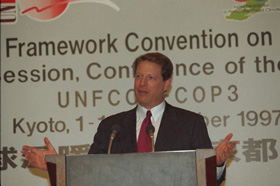
As the United nations wraps up its conference on climate change in Indonesia this week, the participating nations will be discussing how best to reduce atmospheric pollution and halt the process of global warming. They will also be marking an important anniversary. On December 11, 1997, ten years ago today, one of the most famous treaties of our time was completed. The Kyoto Protocol was the product of more than a week of intensive negotiations, and its supporters hoped it would mark a turning point on the issue of global warming. When President Bill Clinton signed the agreement on behalf of the United States, in November 1998, Vice President Al Gore hailed it as “a strong and realistic agreement . . . that couples ambitious environmental targets with flexible market mechanisms.” But ten years later, none of the treaty’s “ambitious environmental targets” have been met, and the United States government has distanced itself from it. What happened?
The causes of Kyoto’s failure were present from the very beginning. When President Clinton and Vice President Gore took office, in 1993, environmental protection appeared to be an issue ready for government action. The two men had made it a part of their campaign, and Gore had won acclaim as the author of the book Earth in the Balance: Ecology and the Human Spirit. It appeared that they should have the political capital to win legislative victories. And the new administration had international political momentum on its side too. Just the year before, the United Nations had held a landmark conference in Rio de Janeiro and produced several important environmental pacts, including the Framework Convention on Climate Change. Under that agreement, which the U.S. Senate ratified in 1993, countries pledged to cut their greenhouse gas emissions by 5.5 percent before the year 2000.
During the new administration’s first year, it learned the hard way that environmental victories would not come easily. After proposing a new tax on energy consumption, the White House met with fierce resistance from members of Congress, including leading Democrats such as Oklahoma Sen. David Boren. The measure had to be withdrawn. Recovering from that setback, the President and his allies attempted to work toward lower emissions by promoting voluntary conservation programs, like one that encouraged big businesses to use more energy-efficient lighting. But in spite of these efforts, the United States was pumping out almost 100 million more tons of carbon a year in 1995 than in 1992. As the Clinton-Gore team approached the end of its first term, the administration still hadn’t achieved any historic environmental breakthrough.
For a while, Kyoto looked like it could be just such a breakthrough. After their resounding reelection victory, in a campaign where the environment was again a prominent issue, Clinton and Gore helped organize the 1997 environmental summit in Japan. A preliminary meeting in Bonn, Germany, left hopes high for the December event.
Even before the American delegation reached Kyoto, however, the odds of diplomatic success dropped considerably. When it became clear that the administration hoped to reach a mandatory agreement on emissions reduction, domestic opposition sprang up. Coal, automobile, and utilities companies advertised harsh criticisms of limits on greenhouse gas production, and Clinton’s critics in Congress joined in. The newly elected senator from Nebraska, Chuck Hagel, won national attention as an outspoken opponent of caps on carbon emissions, and Republican Rep. Dana Rohrabacher decried the push to stop global warming as “liberal claptrap.” Some of the rhetoric got extremely caustic; the conservative activist Phyllis Schlafly suggested that plans to forcibly reduce American energy consumption were socialist schemes to redistribute wealth to the Third World. On July 25, little more than four months before the summit, the U.S. Senate unanimously passed a resolution declaring that it would not approve any treaty aimed at restricting carbon emissions unless it placed similar limits on developing countries like China. If congressional opinion was any guide, the White House was already losing the battle.
Even more troublesome for supporters of the Kyoto summit, the Clinton administration itself seemed increasingly ambivalent about the need for international action on global warming. Though Gore and Tim Wirth, the undersecretary of state for global affairs, were working hard to prepare for the December conference, they were receiving little support from the rest of the executive branch. Looking back on the run-up to Kyoto, Wirth later explained, “I could not get a single White House official to come to any of these meetings. They would not identify themselves with Kyoto.” Echoing Wirth’s criticism, Gore told The New York Times in 2007 that global warming had been “seen as an arcane, hobbyhorse issue” inside the Clinton White House. The attitude of most policymakers, he said, had been “We’ll indulge Vice President Gore, and let him do his thing . . . and then we’ll get back to what we know is the serious stuff.” With anti-environmentalist sentiment mounting and little return fire coming out of the West Wing, Kyoto looked doomed for the United States.
Unfortunately for the summit’s organizers, that trend was never reversed. The meeting took place in December, and a treaty emerged, but the United States ultimately gave it only lukewarm support. President Clinton signed the Kyoto Protocol, but he never even submitted it to the Senate for ratification. When George W. Bush moved into the White House, in 2001, he made it very clear that he would not support the deal. Citing concerns about the effect it would have on American business, and objecting to the exceptionally stringent requirements it placed on the United States, his administration left the treaty for dead. Today, more than 170 countries and governmental bodies have signed and ratified the Kyoto Protocol, but without the cooperation of the world’s largest carbon emitter, the treaty’s effect is extremely limited.
In the ten years since the Protocol was completed, environmentalism has gained stature as an international issue and has become a more potent subject in American domestic politics. Global warming in particular has gained much broader recognition as a genuine, serious challenge, and it is one that the next President will likely have to address. Any leader who claims to care about the global environment may be hard-pressed to pass up an agreement like the Kyoto treaty. But because the world has gone so long without an international pact on carbon emissions, the provisions of the Kyoto Protocol, which mandated fairly mild cuts in emissions (to between 5 and 7 percent below 1990 levels) would, according to most scientists, no longer be sufficient to halt climate change. Therefore if the American government wants to lead on this issue, it will need to set even more ambitious goals than the ones Al Gore supported a decade ago. And at this month’s Bali summit, the United States has given no sign that it is yet prepared for such a difficult undertaking.