
William Faulkner’s Struggle for Greatness
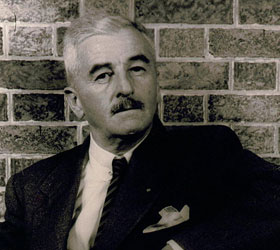
William Faulkner was born in New Albany, Mississippi, on September 25, 1897; he would die in 1962 just 50 miles away. He had lived in New York, New Orleans, Hollywood, and Virginia, but he always returned—in body and in his work—to his home state. In a career that made him one of America’s most revered modern authors, he wrote 17 novels, 13 of which are set in Mississippi. The setting served as a prism, through which he could examine themes—racism, poverty, war, alienation—that transcend region and time. For Faulkner, the most important geography mapped not place but past, the deeply etched tracks of ancient sins on living souls, the inescapable rush of ancestral blood in modern veins. Born 110 years ago today in the rural South, Faulkner left a body of work that confronted the past as it summoned a new era in storytelling.
Faulkner was born William Cuthbert Falkner in a Mississippi that had been an untamed frontier within living memory. It had packed an epic span of history into 80 years of statehood. During Faulkner’s youth, the region’s past was an enduring, palpable presence, festering like an open sore on the present. The shame of a 40-year-old defeat and the loss of a way of life based on the mores of a bygone English gentry weighed heavily on turn-of-the-century Southerners. So, too, did the adventure-filled legends of Faulkner’s ancestors—prominent players in Mississippi’s saga—echo as rebukes to their less-colorful sons. Faulkner’s great-grandfather, William Clark Falkner, moved south from Missouri in 1842 at age 17. In one of the many legends that surround him, it is said that he fled Missouri after nearly killing his own brother in a fight. In his 47 years in Mississippi, he built a railroad, led a company of Confederate volunteers in the Civil War, amassed a small fortune, fatally stabbed a man over membership in a social club, published a best-selling novel (The White Rose of Memphis), and, finally, was shot to death in the town square by a former business partner.
He also fathered at least nine children. The oldest, John Wesley Thompson Falkner, served as deputy U.S. attorney, state senator, president of the First National Bank of Oxford, and trustee of the University of Mississippi, but he still failed to live up to the popular memory of his dad. John’s son Murry positively wilted under the weight of his ancestry; his own son, William, called him “a dull man.” For his part, William was fascinated by the family legends. Some of his future characters, such as Col. John Sartoris, would bear a strong resemblance to his great-grandfather.
When Faulkner was five, the family moved to nearby Oxford. He enjoyed an active childhood there, playing in the woods and swamps with his three younger brothers. From his mother, Maud, he inherited a love of literature, and as he approached adolescence, he retreated behind a shy, silent reserve, preferring to read or draw rather than socialize or study. He frequently skipped school and dropped out altogether when he was in the eleventh grade, in 1915.
Around that time, he began three relationships that would each, in its own way, steer his future. The first was with Estelle Oldham, his neighbor and future wife. In his teen years he spent countless hours reading to her from his sheaves of original poetry. When she left for Virginia in 1915, to attend Mary Baldwin College, he had even more time to focus on writing, an interest encouraged by his friend Phil Stone, an Oxford native who had graduated from Ole Miss and now attended Yale Law School. During his vacations, Stone took it upon himself to tutor Faulkner in grammar and the works of the great poets. All the while, Faulkner was plunging into a lifelong dependence on alcohol. He later summed up his activities of 1916: “Quit school and went to work in grandfather’s bank. Learned the medicinal value of his liquor. Grandfather thought it was the janitor. Hard on the janitor.”
Over the next two years, he ambled through a string of dead-end jobs, filling his free time with writing, drinking, and golf. In 1918, Oldham—who Faulkner had always assumed would marry him—announced her engagement to Cornell Franklin, an Ole Miss law graduate. Devastated, Faulkner turned to what seemed like a chance for both escape and glory: the military. When the U.S. Army rejected him as underweight, he faked a British accent and background and joined the Royal Canadian Air Force. (This was when he introduced the u into his last name, thinking it looked more English.) The war ended before he finished training in Toronto, but he wouldn’t admit it; he returned to Oxford with a fake limp and a limitless stock of battlefront stories. The young Faulkner knew he was important, and until his true status matched his self-regard, he would manufacture his own reality.
Back home, he enrolled at Ole Miss as a returning veteran. He dropped out after a year, but not before publishing his first short story in the student paper and his first poem in The New Republic. He moved to New York and then back in 1921; published his first collection of poetry, with Stone’s financial support, in 1924; moved to New Orleans to live with the writer Sherwood Anderson and his wife for the first half of 1925; toured Europe; and returned home again.
Sometime during his travels, he gave up poetry to concentrate on fiction. Anderson had recommended him to the New York publishers Boni & Liveright, and in February 1926 they published his first novel, Soldiers’ Pay. An unremarkable story of a wounded war hero, Soldiers’ Pay shows promise if only in its intriguing minor characters, harbingers of the vivid casts that would populate his future work.
In the next three years, he published two more novels—Mosquitoes, about artists in New Orleans, and Sartoris, the first book set in what would later become his fictional Yoknapatawpha County, Mississippi—and wrote several short stories. None brought commercial success or rave reviews. So, after years of anxiety, he decided to stop guessing what publishers or the public would like. “One day I seemed to shut a door between me and all publishers’ addresses and book lists,” he later remembered. “I said to myself, Now I can write.”
The book he produced next—the work he later said he had “written my guts” into—was The Sound and the Fury. The story of Caddy Compson (of the once-prominent, now-disintegrating Compson family of Yoknapatawpha County), told by each of her brothers, the book experiments with unreliable narrators, multiple points of view, and stream-of-consciousness monologues. Faulkner had always been willing to try new literary techniques, which tended to make his early writing inconsistent. But now his unerring ear and sense of place produced a book, according to one review, “worthy of the attention of a Euripides.”
With The Sound and the Fury—often recognized as one of the great novels of the twentieth century—Faulkner embarked on what he would later call that “one matchless time,” the era, a little more than a decade long, when the major works of his career poured from his pen with little struggle. But although the literary world saluted his achievement, the public was slow to notice. The first 1,789 copies of The Sound and the Fury didn’t sell out for a year and a half. Meanwhile the stock market collapsed, and Faulkner had taken on a host of new financial responsibilities. He would describe his role in the mid-1930s as “the sole, principal and partial support—food, shelter, heat, clothes, medicine, kotex, school fees, toilet paper, and picture shows, of my mother, an inept brother and his wife and two sons, another brother’s widow and child, a wife of my own and two step children, [and] my own child.” (Estelle Franklin, now divorced and mother of two, had married him in 1929; they had a daughter, Jill, in 1933.)
To pay the bills, he churned out more than 40 short stories between 1929 and 1932. He also started work on a potboiler, “the most horrific tale I could imagine.” But his editors recoiled from the early manuscripts for Sanctuary, the story of a gangland rape trial. (“Good God, I can’t publish this,” his publisher told him. “We’d both be in jail.”) So Faulkner took a job as a night watchman at the university power plant. It was there, to the steady drone of the generator, that he wrote his next novel, As I Lay Dying. “Before I ever put pen to paper and set down the first word,” he recalled, “I knew what the last word would be and almost where the last period would fall.”
In 59 monologues from 15 characters, As I Lay Dying tells the story of the Bundren family’s disastrous journey through Yoknapatawpha County to inter their matriarch in her family plot. Published in 1930, the novel ignored most of the conventions of traditional storytelling, such as chronological plotting and an authoritative point of view. It earned favorable reviews but mediocre sales, so Faulkner agreed to revise Sanctuary into publishable form. When it arrived in bookstores in February 1931, Sanctuary finally won him public acclaim. Although reviewers scorned its transparently salacious plot, readers bought 7,000 copies in two months.
His next novel, Light in August, was a return to more traditional form. It chronicles the short, violent life of Joe Christmas, a possibly biracial orphan who kills and is killed in Yoknapatawpha County. (The critic Alfred Kazin chose it as “the Novel of the Century” in the pages of American Heritage.) But Light in August didn’t earn Faulkner the money he needed, so in 1932 he headed to Hollywood, where he worked as a screenwriter and script doctor for MGM. In the next decade and a half—in between writing four more novels, including Absalom, Absalom!, and three short-story collections, most notably Go Down, Moses—he would put in several stints in Hollywood. The money was good, but he detested the work.
By the mid-1940s, his career seemed to be waning. He toiled on unproduced screenplay after unproduced screenplay, and six years separated Go Down, Mosesfrom his next novel, Intruder in the Dust. Meanwhile, most of his books fell out of print. After the ferocious intensity—and sheer volume—of his output in the 1930s, he had stumbled into a prolonged fallow period. “Silence followed, a huge gap unlike anything else in his career,” wrote the biographer Jay Parini. “He had written so hard, so well, for so long, that his mind could not continue to generate work on such a scale.” By that point, his drinking binges had begun to disrupt his work, regularly landing him in hospitals and drying-out clinics.
The publication of The Portable Faulkner in 1946, coinciding with the university enrollment of thousands of World War II veterans, brought him renewed attention. Then came the announcement, in 1950, that he had won the 1949 Nobel Prize in Literature. At first, many critics were outraged. They considered his subjects prurient, his intentions immoral; one Mississippi reviewer assigned him to “the privy school of literature.” But in his acceptance speech (delivered in such soft tones that people at the ceremony didn’t understand it until they read it in print), he reminded young writers that “the problems of the human heart in conflict with itself . . . alone can make good writing because only that is worth writing about, worth the agony and the sweat. . . . The poet’s, the writer’s, duty is to write about these things. It is his privilege to help man endure by lifting his heart, by reminding him of the courage and honor and hope and pride and compassion and pity and sacrifice which have been the glory of his past. The poet’s voice need not merely be the record of man, it can be one of the props, the pillars to help him endure and prevail.”
The speech revived his reputation as one of the giants of American literature. As a Nobel laureate, the always-shy Faulkner now assumed an uncharacteristically public profile. He lectured widely, traveled to foreign countries for the State Department, and accepted a position as writer-in-residence at the University of Virginia. Soon his nonfiction essays began to outnumber his new short stories. His last novels, A Fable, The Town, The Mansion, and The Reivers, earned tepid reviews (although A Fable, which the reviewer Brendan Gill called “a calamity,” won both the National Book Award and the Pulitzer Prize).
Critics still debate whether Faulkner’s inspiration failed him in his last two decades. Certainly, his work was often plagued by what the author Robert Penn Warren in 1946 called “grave defects,” but Warren believed his weaknesses were simply the flip sides of his strengths: “Sometimes the tragic intensity becomes mere emotionalism, the technical virtuosity mere complication, the philosophical weight mere confusion of mind. Let us grant that much, for Faulkner is a very uneven writer. The unevenness is, in a way, an index to his vitality, his willingness to take risks, to try for new effects, to make new explorations of material and method.”
In mid-1962, after several horseback riding falls, William Faulkner’s health began to decline, and he died from a massive heart attack on July 6. He was buried among his ancestors in Oxford’s St. Peter’s Cemetery, to rest forever in the Mississippi soil.