
HBO’s John Adams is an Intimate Character Study
John Adams, HBO’s seven part, $100 million miniseries, is more than ambitious. In scope and depth, it is the most far-reaching production ever made on the American Revolution, though given its predecessors—the offensively silly musical 1776and Mel Gibson’s The Patriot—this isn’t saying much. Director Tom Hooper (Elizabeth I) and screenwriter Kirk Ellis obviously understood that Americans will not pay to see a feature film about the birth of their own country in large numbers; they conceived the material (taken from David McCullough’s 700+ page biography) for television, eschewing all the things—action scenes, sex, flamboyant dialogue—that movies are made of.
Each frame of John Adams demonstrates what television, particularly cable television, can do for history. John Adams takes its time and lights up its characters from the inside, then allows history to take its course. Simply put, their series is character driven, not plot driven.
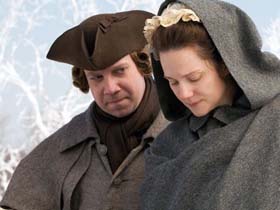
Adams, played by Paul Giamatti, is true to the obstinate Adams of history. Stubborn, tactless, arrogant, and possessing a curious blend of idealism and egotism, he often verges on sabotaging the Revolution. Wisely, the series introduces Adams in the best possible light, beginning with his fierce defense of the British grenadiers arrested for the Boston Massacre. It was no small feat for Ellis to plunge into McCullough’s massive book and find a natural starting place, but he picked the right one. The trial, which cost Adams much of his Boston law practice, not only provides stirring courtroom drama but offers a cutaway view of the period’s tumultuous politics and Adams’s own unshakeable faith in the power of law.
Appreciating Giamatti, however, takes a bit of time and work. Over the first two episodes, it’s hard to shake the feeling that Giamatti is miscast. First, he seems out of place, but then he’s playing a man who felt out of place among his colleagues. “I am obnoxious, suspected, and unpopular,” Adams says to Jefferson in an effort to push him into writing a declaration of principles for the new continental Congress, “and you are not.”
Giamatti’s clipped English sounds like that of an Englishman starting to lose his accent. But the New England and Virginian cadences we’re familiar with today didn’t exist in the 1770s, and Giamatti’s strange American-English hybrid was probably about right for a Massachusetts man of his time. Eventually, the ear adjusts to the awkward rhythms of accented speech. When it does, Giamatti’s performance gains stride.
The secondary characters are well portrayed. Stephen Dillane gives a muted, wonderfully nuanced performance as Thomas Jefferson, and British actor Tom Wilkinson is a smart and sly Benjamin Franklin.
Laura Linney’s Abigail Adams is as vivid a character as her husband. Linney is flawless, powerful and immediately winning. Early in the film, she shines as she chastises John Adams for having “overburdened your argument with ostentatious erudition.”
The Congressional debates over the question of independence are among the best scenes in the film. Without becoming didactic, Ellis touches all the arguments concerning the proper role of government that are still made to this day. You may actually be holding your breath when the final vote for independence is taken.
Less effective is the latter portion of the film that deals with Adams’s frustrating diplomatic mission to France and Holland. Adams’s bluntness and Franklin’s subtlety are artfully contrasted, but we’re never quite sure which man’s tactics are the most successful in bringing about European aid and British defeat.
Tak Fujimoto’s cinematography illuminates the late eighteenth century in a sepia-toned light, and Rob Lane’s score, accentuated with period instruments such as violins and flutes, is never obtrusive. It suggests what the characters are feeling without trying to tell us what to feel.
Because there are almost no battle scenes, the film does not become too ponderous for what it wants to say. Human interest is the focus, as in a terrifying sequence on the smallpox inoculation of Abigail and the Adams children and a brief, thrilling sea battle with a British frigate during Adams’s Atlantic crossing. No matter the national issues at stake, John Adams never loses sight of the cost of the American Revolution to those who fought it.