
How Illegal Immigration Was Born
On May 6, 1882, a century and a quarter ago today, President Chester A. Arthur signed a law banning almost all immigration from China to the United States. It affected only a small percentage of immigrants, but it marked the birth of illegal immigration. The Chinese Exclusion Act and its subsequent extensions altered the legal definition of American citizenship far more than its original drafters could have foreseen. It wasn’t repealed until 1943, 61 years later, and it continues to reverberate in immigration policy today.
Before 1882, immigration to the United States was barely regulated at all. Passports weren’t required, and 98 percent of all immigrants to Castle Garden in New York Harbor were admitted. Citizenship was not as easy to acquire, but the concept of illegal immigration did not yet exist. Almost anyone who wanted to move to America was free to do so.
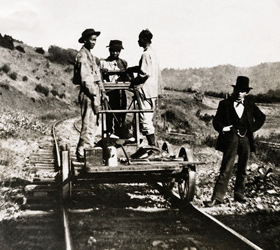
The earliest Chinese immigrants, most of them bound for San Francisco, began arriving in the late 1840s. Lured like so many others by the Gold Rush, they arrived in a territory that was unregulated and teemed with newcomers, some from the East Coast and the Midwest and more from Europe, South America, and Asia. By 1853 more than half of San Francisco’s population had been born abroad, and the city was absorbing more new people every day. In the next few decades, Chinese immigrants spread across the country, working on the Transcontinental Railroad, replacing striking white factory workers on the East Coast, and, in a particularly badly conceived and ill-fated scheme, going to the South to replace freed black plantation workers. Though the Chinese population still remained relatively small, numbering about 60,000 in 1870, more and more states began to have a noticeable Chinese presence. Even so, the vast majority of the Chinese population in the late nineteenth-century lived in California.
The Chinese came to be perceived as an economic threat in the West. When Irish factory workers in San Francisco went on strike in 1870, demanding an increase in pay from three to four dollars a day, they were quickly replaced by Chinese who accepted only a dollar a day. Cartoons and popular songs like “The Heathen Chinee” depicted the Chinese as rat-eating weirdos and job-stealers. One verse in “The Heathen Chinee” went, “‘Can this be?/ We are ruined by Chinese cheap labor’/ And he went for that heathen Chinee.”
The taunts became codified in state and local anti-Chinese policies and laws that set the stage for the 1882 Exclusion Act. Some were aimed at Chinese-dominated industries, like laundries, which in San Francisco were subjected to a “sidewalk ordinance” that forbade anyone to walk with a pole and baskets over his shoulder. A California foreign miners’ tax was carefully worded to single out the Chinese in a mixed-race industry.
Drought and the end of a silver-mining boom hurt a volatile economy, and unemployed Californians began to lash out. A mob of 10,000 rioted in San Francisco for three days in 1877, burning buildings in Chinatown and boats at the docks, leaving four dead and fourteen wounded. Such violence went unpunished, and since Chinese residents were barred from testifying in criminal and civil cases in California, the Chinese side of the story was ignored. Many Chinese decided to return to China.
Those who went back found a country in chaos. China had lost the two Opium Wars against Britain, and each year brought new unequal treaties with Western powers; the country was also facing aggression from Russia and Japan. The Qing Dynasty was in its death throes, and it was in no position to negotiate with the United States over the problems of a few emigrants abroad.
In 1880 President Rutherford B. Hayes, responding to pressure from politicians from the Western states, amended the Burlingame Treaty. It had originally been signed in 1868 as a pact between China and the United States guaranteeing “the inherent and inalienable right of man to change his home and allegiance” and promising that “Chinese subjects . . . residing in the United States, shall enjoy the same privileges, immunities, and exemptions in . . . residence, as may there be enjoyed by the citizens or subjects of the most favored nation.” The revised treaty, partly negotiated by former President Ulysses S. Grant, allowed the United States to limit immigration from China.
This treaty revision was designed to appeal to politicians from the Western states. Determined to expand on it, California Sen. John F. Miller introduced a bill in 1881 to stop Chinese immigration entirely for 20 years. President Chester Arthur vetoed it, worried that the Qing government would cut off access to shipping ports in retaliation. Politicians and their followers in Western states howled. Protesters even burned Arthur in effigy.
On May 6, 1882, a slightly gentler version of Miller’s bill—banning Chinese immigration for only 10 years and allowing merchants, teachers, and students to immigrate—was signed into law by President Arthur. Later that year he signed a more general law barring paupers, criminals, and lunatics from entering the country.
In retrospect, what seemed like fairly minor legislation was the beginning of a major shift in how immigration was perceived in the United States. Now there were two classes of immigrants, legal and illegal. All subsequent amendments, extensions, and variations of the act would further codify the distinction.
The Chinese reacted to the law, which was extended permanently in 1904, with a combination of legal challenges, organized protests, and subterfuge. The Geary Act in 1892 required that all Chinese residents register for certificates of lawful residence and, more important, forbade them to bear witness in court cases or be given bail in habeas corpus cases. In 1895 the Supreme Court ruled that district courts must not even review Chinese habeas corpus petitions, effectively putting Chinese residents into extralegal limbo.
Many Chinese refused to register for the certificates and mounted challenges such as Fong Yue Ting v. United States and Lem Moon Sing v. United States. Back in China, residents of Shanghai and Canton refused to patronize American businesses and prevented American ships from unloading their cargoes.
However, the most effective way to get around the laws was by subterfuge, namely through the use of “paper sons.” The concept of paper sons arose from two distinct events, an act of man and an act of God: a landmark civil rights case, United States v.Wong Kim Ark, and the 1906 San Francisco earthquake.
The Fourteenth Amendment stated that “All persons born or naturalized in the United States, and subject to the jurisdiction thereof, are citizens of the United States and of the State wherein they reside.” Wong Kim Ark, born in San Francisco, had been detained and denied permission to enter upon returning from a trip to China. Wong challenged the ruling, and the Supreme Court ruled that the Fourteenth Amendment was race-neutral, and that any person born in the United States was automatically a citizen, and furthermore, any child of an American citizen was also a citizen. That meant that if you could prove that your father (or, in rare cases, your mother) was an American citizen, you had the right to immigrate.
This would normally have been difficult to prove, since few Chinese residents had been born in the United States. But after the 1906 earthquake and fire destroyed all San Francisco’s birth and citizenship records, the government had no way of knowing who had or had not been born in the country. Many claimed the birthright, or registered the births of nonexistent children. Papers for fictitious children were sold in China, allowing Chinese to immigrate despite the laws. Incoming “paper sons” were subjected to intense scrutiny at immigration checkpoints, and many were denied entrance. Nevertheless, the big loophole was the primary means of Chinese immigration to the United States until 1943, when the Chinese Exclusion Act was repealed and 105 Chinese immigrants a year began to be let into the country. In 1965 the Immigration and Nationality Act repealed the national-origins quota system, and Chinese immigration into the United States increased significantly.
In the late nineteenth and early twentieth centuries, even at the height of anti-Chinese paranoia, the Chinese were always a very small minority. In 1880, 105,456 Chinese lived in the United States, and by 1920, only 61,639 remained. But the Chinese Exclusion Act was the foundation for the definition of illegal immigration, and the court cases that challenged the act had ramifications that are felt today. Illegal immigrants with legal children still come up constantly in the immigration debate, and the fear of illegal immigrants as competition for low-paid jobs remains the emotional backbone for opponents of liberalized policies. Undoubtedly immigration controls would eventually have been instituted in the United States even without the Chinese Exclusion Act, but the racial, economic, political, and legal reasoning behind the law still shapes the immigration landscape, and thus the debate, more than a century later.