
How the North Lost the Civil War
In his novel Sartoris, the great Mississippi writer William Faulkner asks his title character, Col. Sartoris, why he fought for the Confederacy. “Damned if I ever did know,” Sartoris answers.
From the late nineteenth century through the dawn of the modern civil rights era, most Americans were taught that the Civil War had been a vaguely nonideological affair, a family quarrel between two brothers, Johnny Reb and Billy Yank, whose bonds of affection were so fundamentally strong as to allow for a swift and triumphant reunion in the war’s aftermath. The only thing standing in the way of national reconciliation, according to this enduring historical myth, was Reconstruction, an era when rapacious carpetbaggers, opportunistic scalawags, and dimwitted ex-slaves imposed a harsh and corrupt rule on the former Confederate states. The Compromise of 1877, which saw federal troops removed from the South, closed out this last chapter of the Civil War and allowed Col. Sartoris and his neighbors to get on with life.
In reality, the Compromise of 1877 allowed Col. Sartoris—and most white Americans—to develop a striking case of amnesia. As historians since the 1960s have reminded us, the Civil War was very much about slavery, and Reconstruction was a bold, forward-looking experiment in interracial democracy.
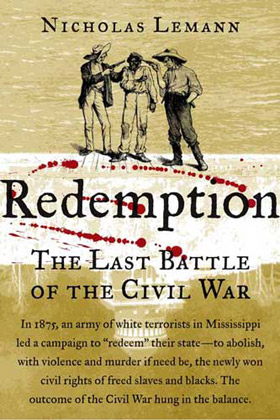
In his new book, Redemption: The Last Battle of the Civil War (Farrar, Straus and Giroux, $24), Nicholas Lemann, the dean of the Columbia Graduate School of Journalism, applies his considerable talents as a storyteller to helping general readers catch up with the last 30 or so years of historians’ rethinkings. Focusing primarily on the race wars that engulfed Mississippi between 1865 and 1875, Lemann explains that few white Southerners were resigned to their defeat or acquiescent in the face of black emancipation and citizenship. What they failed to win on the battlefield, a white supremacist nation, they won in a thousand different skirmishes. Theirs was a long war of attrition. Through violence, ballot-box fraud, and bribery, they were determined to overturn Reconstruction. In the end they proved more committed to white supremacy than Northern whites were to black equality.
Drawing on extensive research, and writing crisp prose, Lemann follows the lives of Adelbert Ames, a Union officer turned radical Republican politician, and his wife, Blanche Butler Ames, whose father, Benjamin Butler, was a leading radical congressman from Massachusetts. It was Butler who gave birth to a popular expression in postwar politics, “waving the bloody shirt,” when he did just that with the garment of a murdered federal tax collector, during a speech on the House floor.
In 1869 Ames, then the military governor of Mississippi, was elected to the United States Senate, the state having adopted a republican constitution guaranteeing suffrage for black men and been readmitted into the Union. Ames served almost four years in the Senate before becoming Mississippi’s elected governor, largely on the back of a shaky political coalition of freed slaves and white Republicans.
In 1875 a collection of militias known as the “White Line,” made up of well-armed former Confederate soldiers, plunged Mississippi into a summer of extreme violence, culminating in a heavily rigged electoral victory for the Democratic party. The new legislature impeached Ames. He resigned his office rather than face trial in the state senate.
Shortly before his adopted state was “redeemed” by the White Liners, Ames wrote presciently of what was happening, not just in Mississippi but throughout the South. “Yes, a revolution has taken place—by force of arms—and a race are disenfranchised—they are to be returned to a condition of serfdom—an era of second slavery,” he said in a letter to Blanche, who despised the Confederacy and spent most of her husband’s gubernatorial term in Massachusetts, where her parents maintained a large and prosperous homestead. “The nation should have acted, but it was ‘tired of the annual autumnal outbreaks in the South.’ . . . The political death of the Negro will forever release the nation from the weariness from such ‘political outbreaks.’ You may think I exaggerate. Time will show you how accurate my statements are.”
Indeed Ames was not exaggerating, and time did bear out his prediction. By 1877 the South was firmly in Democratic hands, and the experiment in biracial democracy had largely come to a close. The Jim Crow era that followed was simply a codification of the outcome of the violent counterrevolution of the 1870s.
If Adelbert Ames appears in Lemann’s book as a well-meaning (though somewhat naive) champion of black equality, President Ulysses S. Grant plays the role of a weak and ineffectual leader. In the months before Mississippi was “redeemed,” Ames and his father-in-law all but begged the President to marshal federal troops to put down the White Liners and ensure an honest off-year election. Lemann concedes that Grant sympathized with Ames’s Reconstruction project, but finds that the President felt constrained by the North’s waning interest in, or stomach for, the ten-year-old military occupation of the former Confederate states.
Redemption is full of irony and drives home just how tenuous Reconstruction really was. For most of his term in the U.S. Senate, Ames, though he was the former military governor of Mississippi, didn’t own a home in his adopted state, and he was reluctant even to visit there during the long congressional recesses, for fear of assassination. In fact, though he was deeply committed to shoring up black political equality and modernizing Mississippi’s public-sector infrastructure, he ran for governor chiefly to solidify his hold on the state and thus ensure his return to the Senate. Blanche, for her part, was biding her time until the couple could reunite in Washington.
Though Lemann tells a gripping story of romance (between Blanche and Adelbert Ames), extreme violence (which runs throughout the book), and political intrigue (it seems that everyone in the 1870s was on the take), in many ways the strongest section is the concluding chapter, which chronicles another case of Southern “redemption,” this one literary and historical. In the years after 1875 professional scholars, pop historians, filmmakers, and novelists wove the South’s white-supremacist version of the counterrevolution into the fabric of public memory. Lemann explains just how this happened and alerts his readers to the dangers of historical romance.
Even as late as 1955 Sen. John F. Kennedy, in his book Profiles in Courage, described Reconstruction as a “black nightmare the South could never forget,” and Adelbert Ames as a corrupt and ruthless carpetbagger. Lemann’s book will help general readers wade through the thicket of Reconstruction-era myth, which lingers even in the best popular history.
P. B. S. Pinchback, a black politician who served briefly as Louisiana’s Reconstruction-era governor, got it exactly right when he angrily told a Northern audience, “Gentlemen, as disagreeable as it may be for you to hear and as unpleasant as it is, there is no denying the fact that the bloody shirt is no mythical garment . . . today, in that vast area of the country lying south of Mason and Dixon’s line . . . neither free speech, free press, peaceable assembly, not the right to keep and bear arms, or security for persons and property, are enjoyed by Republicans.”
It would take another hundred years before the final battle of the Civil War could be fought, also in a thousand skirmishes. In the meantime, the Adelbert Ameses and Blanche Butlers of the world could only shake their heads in wonder. One imagines that if he were asked, in retrospect, why he had fought in the Civil War, Ames might have replied, “Damned if I ever did know.”