
The Last Naval Battle in History
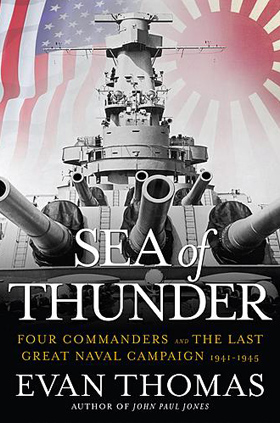
In the autumn of 1944 a battle was fought in the seas around the Philippines that was “confused, tragic, deadly, heroic, and it is largely forgotten.” It was the culmination of centuries of naval warfare, the swan song of the battleship, the final occasion on which massed ships confronted one another at gun range. It was, Evan Thomas declares in his masterly new book Sea of Thunder: Four Commanders and the Last Great Naval Campaign (Simon & Schuster, 432 pages, $27), an account of the naval war in the Pacific, “the last and largest naval battle in history.”
“Most Americans,” he points out, “do not know when the Battle of Leyte Gulf was fought, where Leyte Gulf is [and] they certainly don’t know why the battle mattered.” At the climax of his account of the war in the Pacific he sets out to teach the when, where, why, and especially who, of this momentous encounter that involved 200,000 men on 300 ships spread over 100,000 square miles of ocean.
After the 1941 attack on Pearl Harbor, a shaken U.S. Navy regrouped, turned the tide at the Battle of Midway, and then began the long march across the ocean. The American fleet “rolled like a wave, westward toward Japan.”
The point came, Thomas tells us, when “Japan could no longer trade space for time as it backed across the Pacific.” If the Americans could retake the Philippines, they could cut the sea lane between Japan and her oil-producing colonies to the south and strangle the country.
The invasion of the Philippines, led by General Douglas MacArthur, was scheduled for October 20, 1944. The site chosen was Leyte Gulf, on the southeast corner of the island of the same name. The Navy would be assigned to protect the force from attack by sea.
The bulk of that task went to Adm. William Halsey, whose aggressive tactics had already made him something of a folk hero (“Kill Japs. Kill Japs. Kill more Japs,” was his motto). “Blunt, impetuous, careless about details,” “Bull” Halsey was the perfect antidote for a dispirited nation after Pearl Harbor. Thomas questions whether he was the right man to direct the operations of the massive Third Fleet, a collection of vessels “so vast that he could not see it all.”
Halsey had long been itching for a climactic fight with the Imperial Japanese Navy. Unknown to him, the Japanese high command had decided that the time for such a confrontation had come too. Deciding to play their ace in the hole, they sent out a fleet under the command of Admiral Takeo Kurita that included two super-battleships, the Yamato and the Musashi. The ships surpassed any warships that had ever floated. Their 18-inch guns, the largest of all time, fired shells weighing 3,200 pounds each.
But the course of the war had already made clear that the day of battleship dominance was over. The aircraft carrier had become the key naval weapon. Halsey, who had wanted to be an aviator himself, knew this. Even Admiral Matome Ugaki, the martinet who commanded the main part of Kurita’s force and “looked to the past with a fatalistic reverence,” understood that without air cover a fleet was vulnerable. And by this point in the war, the Japanese carrier force was severely depleted.
The plan was for Ugaki’s massive warships, attacking from the west, to thread their way through the Philippine archipelago north of Leyte. A smaller force would penetrate south of the gulf. A third contingent, consisting of the few remaining Japanese carriers, would act as a diversionary force. With luck, they might be able to lure Halsey’s huge fleet away, evening the odds.
In addition to Halsey’s force, the American Seventh Fleet was also guarding the landing flotilla. This group, under the command of Admiral Thomas Kincaid, reported directly to MacArthur and, remarkably, could not communicate with Halsey except through slow, roundabout channels.
In the early morning of October 23, two American submarine commanders spotted Ugaki’s group approaching. They sank Kurita’s flagship, though the admiral survived. The next day, wave after wave of Halsey’s dive bombers battered the Japanese fleet, sinking the mighty Musashi. The Japanese turned back.
Meanwhile, Kincaid had detected the Japanese contingent approaching from the south and sent out what he called a “welcoming committee” that included battleships salvaged from the bottom of Pearl Harbor. The Americans utterly destroyed the attackers.
Halsey then took off with his entire fleet to pursue the carriers to the north. He was dreaming of a knockout punch that would effectively destroy the Imperial Navy and hasten the end of the war. “Halsey had made his name by bold actions,” Thomas notes, “not by hedging.” One of his aides admitted, “We were obsessed with the carriers.”
It was a blunder of epic proportions. Ugaki and Kurita turned around again and entered the sea north of Leyte Gulf unimpeded. There they surprised a group of escort carriers, ships far smaller, slower, and more lightly armored than the fleet carriers. A few destroyers had been assigned to guard them. Neither side could believe their eyes. The Japanese guns opened up. The American fleet seemed doomed.
At this point, the fourth key figure in Thomas’s book, Commander Ernest Evans, entered the picture. Evans was a Cherokee Indian who had graduated from Annapolis and was commanding the destroyer USS Johnston. A quick-thinking fighter, he immediately laid down a smoke screen to protect the carriers, then steered his ship directly for the Japanese fleet. His torpedoes disrupted the attack and sank a cruiser.
In the melee that followed, Evans again charged the Japanese, firing his five-inch guns against their behemoths. “Like bouncing papers wads off a steel helmet,” one of his officers observed. The Johnston was shot to pieces and sank, but the Japanese had been thrown into confusion. Kurita chose not to proceed toward Leyte but to retreat. His decision saved thousands of lives on both sides.
Thomas tells this story with clarity and great drama. He conveys the scope of an enormous battle while offering evocative glimpses into the men who fought it. Making good use of Japanese sources and interviews with veterans, he conveys the tension, fatigue, and uncertainty that plagued the officers on both sides.
He peppers his account with vivid details. A sailor passing a dying comrade on a sinking aircraft carrier sees him hold up his hand in a mute gesture. The shipmate understands and removes the man’s wedding ring to save for his wife. An American airman, his ammunition gone, flings a Coke bottle at a Japanese battleship. Thomas’s description of the agony of the survivors of the Johnston, who spent three days in shark-infested water, is vivid and heartbreaking.
“Who can know,” he asks rhetorically, “what it is really like to stand, bone-weary, on the bridge of a ship in action . . . unsure of the enemy’s strength and whereabouts, yet forced to make fatal decisions?” To Thomas’s credit, his book helps us to imagine something of the awful weight that rested on the shoulders of the hard-pressed commanders.
October 25, 1944, was “the last and most destructive day in the long history of fleets fighting at sea.” While not the apocalyptic clash that Halsey had envisioned, the battle delivered a crippling blow to the Japanese. Weak going in, the Imperial Navy was never an effective fighting force afterward.
Desperate, the Japanese high command decided that very day to launch a new tactic. It was, Thomas writes, “the last day of the great fleets. It was also the first day of the suicide bombers.” An American escort carrier was sunk by a Japanese pilot who crashed his plane into its flight deck. Americans had to learn a new Japanese word, kamikaze.