
The Men Who Won World War II in the Air
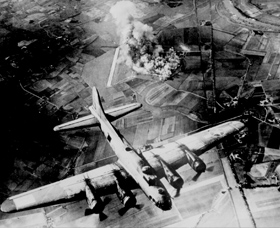
My father was an infantryman in World War II; his brother-in-law was a ball-turret gunner on a B-24. A few years ago my father invited his brother-in-law to a reunion of his infantry division. “I thought you might like to meet some people who fought in the war, before they all disappear,” he said. One of the merits of Donald L. Miller’s Masters of the Air: America’s Bomber Boys Who Fought the Air War Against Nazi Germany (Simon & Schuster, 688 pages, $35) is how completely it gives the lie to that little joke.
Miller’s absorbing and comprehensive history concentrates on the Eighth Air Force (originally the Eighth Bomber Command), in which his father served, and which bombed the Third Reich from bases in Great Britain. He points out that its airmen suffered more deaths than did the whole of the U.S. Marine Corps. Seventy-seven percent of the Americans who flew in combat against the Reich prior to D-day wound up as casualties, and over the course of the war 1 in 10 of the 350,000 Americans who served with the Eighth Air Force were killed flying combat missions. If you add to those deaths battle wounds and those shot down who became POWs, Miller claims that the Eighth Air Force suffered the highest casualty rate of any group in the American armed forces (and still not counting a very large number of psychiatric casualties). In October 1943 airmen in the Eighth Air Force had worse than a one in four chance of surviving a tour of 25 missions, and in specific outfits it was worse. Only 14 percent of those who arrived in 1943 and served with the Hundredth Bomb Group, an outfit Miller follows pretty closely, made it to 25 missions.
Who were they? All sorts, remarkably like how they were sentimentalized in the movies—Harvard men and coal miners, cowboys and people who wound up with doctorates in physics, Clark Gable and Jimmy Stewart, and more than a third of a million more. The one thing they had in common was that almost all of them had volunteered for the duty. Most of them flew in B-17s and B-24s, four-engine heavy bombers with crews of 10, or the single-seat fighters that escorted those bombers. They fought under appalling conditions, enduring Artic temperatures at 20,000 feet, which produced miseries Miller very effectively describes, as well as the devastating (and in this book graphically described) violence of their enemies. Their role was strategic bombardment—direct attacks on the enemy’s economy, logistics, and morale—rather than tactical bombing in direct support of combat operations. Clausewitz had argued that the purpose of war was the destruction of an enemy’s armed forces, but strategic bombing was the product of a doctrine that instead targeted the enemy’s ability to create and maintain those armed forces.
Did it work? It is now fashionable to assert, with very selective use of partial evidence, that strategic bombing was and will always be a failure, an assertion that gains a little force from the way bombing’s enthusiasts tend to overstate their case. After the horrors of World War I, strategic bombing’s enthusiasts claimed that their method of making war would be swift and decisive. Some of them also thought it would be relatively humane, some that it would win wars without land forces being involved at all. Most thought that we could bomb with pinpoint precision by daylight, without fighter escorts, and at relatively trivial cost in American lives. None of this turned out to be true. Strategic bombing was nonetheless for a long time the only way the Western Allies could make war on Adolf Hitler, and in the long run it was a devastatingly effective weapon, one that made a decisive contribution to destroying the Third Reich, and the intensity of arguments to the contrary seem directly proportional to ignorance of modern scholarship on the war. Miller knows this, and he is illuminating about the much-misquoted and seldom-read Strategic Bombing Survey conducted after the war.
The judgment of modern specialist historians, which Miller agrees with, is that strategic bombing worked, although not in the way intended, which is to say either alone or by destroying German morale. Contrary to the conventional wisdom, strategic bombing almost certainly did do appalling damage to German morale, but the demoralized subjects of an efficient tyranny became more passive and more dependent on that tyranny. Strategic bombing made its very significant contribution to victory in other ways. It forced the Luftwaffe’s fighters to stay over Germany, where American escort fighters destroyed them. That made the advances by the Allied armies much cheaper; in some cases, it made them possible. It diverted vast German resources into air defense, and by the end of the war it paralyzed German war production. The premier historian of the air war, Richard Overy, says that in 1944 the effects of the bombing deprived front-line German forces of 50 percent of the equipment and ammunition they would otherwise have received.
What was it like to fight this part of the war? The B-17, the Flying Fortress, was designed to fly without fighter escort; the massed defensive fire of its machine guns was supposed to protect a formation of the planes from enemy fighters. The B-17 was indeed heavily armed, and early in the war a crippled one flying home on three engines destroyed three German fighters attempting to shoot it down. But a formation of B-17s had a number of potential weaknesses, one being that relatively few of its weapons could fire directly ahead. A German fighter attacking head on had to get through a cone of defensive fire 600 to 1,000 yards ahead of the formation, but once closer it became very hard to hit and could attack with devastating effect. When the Luftwaffe used appropriate weapons and tactics, the bombers took appalling casualties. Eventually America developed what the bomber generals had long held to be unnecessary, a long-range escort fighter capable of reaching almost any target in Europe. In March 1944 over Berlin, the new P-51 Mustangs, the best conventionally-powered fighter of the war, annihilated an appreciable portion of what remained of the Luftwaffe. Very little of the Luftwaffe was left to threaten the Normandy invasion or impede the Red Army’s advances. American bombers also faced flak, antiaircraft artillery, an ever more formidable weapon as defensive tactics improved and numbers of guns increased; over the course of the war, flak shot down something like 5,400 American aircraft, while German fighters shot down 4,300. Flak inflicted 71 percent of the wounds suffered by Eighth Air Force airmen.
It is now becoming fashionable to call Allied strategic bombing during the Second World War a monstrous war crime. Is this true? (See yesterday’s feature at AmericanHeritage.com.) IT killed 600,000 German civilians, at the cost of 60,000 Allied airmen. Miller, to his credit, describes both forms of death without euphemism; his book describes the horrors the Eight Air Force inflicted, as well as the ones it suffered. Over the course of the war only half the bombs dropped by an American bomber would land within 750 yards of their targets. This meant killing a lot of civilians, even when one was not aiming at any. Few of the airmen who lived long enough to tour both the cities they had smashed and the concentration camps they helped put out of business—Miller quotes some of them—seem to have questioned the violence they had inflicted, when they compared it to the nature of the violence that they helped bring to an end, and until very recently most of posterity has concurred.
Masters of the Air covers a lot of ground, both figuratively and literally. The bombers first got to England by flying to Greenland and then Iceland, sometimes flying through the worst weather in the world. Once in the United Kingdom they flew out of East Anglia, where more than a hundred air bases were built for them. Miller describes most of the Eighth Air Force’s war, including the construction of those bases, as well as strategy, tactics, and campaigns. Some of the material was new to me (for example, the vileness with which the Swiss behaved toward some airmen interned in their country).
This is an absorbing if rather sprawling book, but its sprawl is more of a strength than a weakness, especially for readers who are not going to read a whole shelf of books on the air war. Miller and his research assistants have read through a vast amount of the specialist literature as well as a lot of primary sources, and they have conducted numerous interviews with veterans. Miller communicates the psychological toll the bomber war took on its participants; he is good on the experiences of POWs; he addresses some of the effects of race and American racism on airmen based in England; and he integrates the history of the air war with the general history of the war in Europe. He offers illuminating and sometimes amusing forays into social history. (On the effects of the relative pay of American and English airmen, the latter joked about “the new utility knickers: one Yank and they’re off.”) He is very good at charting the ebb and flow of morale and describing airmen’s recreations, in both London and the East Anglian villages from which they flew. And he is admirably sane and clear about what the air war cost, on all sides, and also about what it achieved.
As it happens, at least 3,812 American air crew are still in East Anglia; that’s how many are buried at the American war cemetery in Madingly, just outside of Cambridge, on ground donated by the university. Another 5,125 names are inscribed on a wall there, of men whose remains were never recovered or positively identified. If you drive or bike to the cemetery, you pass signs directing you to a nearby crematorium; if you have a certain turn of mind, you may at that point find yourself reflecting that had the men buried at Maddingly been less effective at their job, the latter site might be a lot larger and operate under foreign management.