
At the Movies: All the King’s Men
There’s nothing more disappointing than a labor of love that arrives stillborn. All The King’s Men, the long-delayed film from screenwriter (Gangs of New York) and director (Searching for Bobby Fischer) Steven Zaillian, and produced by, among other people, James Carville, is by no means a disgrace. Somewhere along the line, if not on the screen than on cable or DVD, you’re probably going to want to take it in. But the film’s lack of focus and its truncated adaptation from Robert Penn Warren’s novel will frustrate those who know the book and puzzle those who don’t.
All the King’s Men, a Pulitzer Prize winner published in 1946, has a legitimate claim as an American classic. It certainly qualifies as an epic (the new paperback edition from Harcourt is 661 pages), and it is certainly the greatest American novel ever written about politics. Warren–from an old-fashioned conservative Southern family–found himself, much to his own surprise, fascinated by the life and career of Louisiana governor and later U.S. senator Huey Long and the populist frenzy which accompanied his meteoric rise to power. Long was assassinated in 1935 at the age of 42, while preparing to challenge Franklin D. Roosevelt for the Democratic presidential nomination, though most are convinced this was simply a stepping stone to launching his own third party. He left Americans all over the country wondering whether his legacy was one of American fascism or grass roots progressivism–Warren suggests it might have been a combination of the two.
Willie Stark, Warren’s reimagining of Huey Long, is one of the most recognizable figures of twentieth-century American fiction–or at least it was before the last couple of decades, when English teachers began to doubt that high school students should read any novel about the South more complex than To Kill A Mockingbird. Warren’s novel was made into a much honored film in 1949 that won several Academy Awards, including Best Picture, Best Actor for Broderick Crawford as Willie Stark, and, most memorably, Best Supporting Actress for Mercedes McCambridge. Zaillian has gone on record that he never saw the version written and directed by Robert Rossen, and it’s probably just as well; though it’s a concise (at 110 minutes) and effective film, it’s basically melodrama with only a superficial association to Warren’s great novel.
This is all by way of suggesting that All the King’s Men might really be unfilmable, except as a mini-series. Zaillian tries mightily to weave all of Warren’s themes and subplots into his narrative, but it leaves the film feeling crammed and overstuffed. Much of the amazing cast (which includes Kate Winslet, Anthony Hopkins, Patricia Clarkson, James Gandolfini, and Kathy Baker) appear as if they were shuffled on set for cameos.
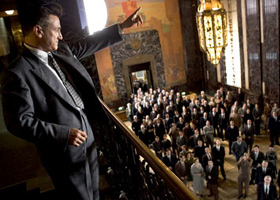
The main problem with any film version of All The King’s Men is that in the novel Willie Stark is largely a character seen from the perspective of others, mostly from the narrator, Jack Burden, clearly a stand-in for the author himself. On the printed page, this technique worked well (Gore Vidal used it effectively in his own political novel, Lincoln). You simply can’t do that in a movie version, which screams out for a charismatic actor to bring Stark to life. Sean Penn is one of our greatest living film actors, perhaps the greatest, but he is studied and cerebral in a role that demands an actor who grabs the audience by its collective lapel, the way Stark did his constituents. Penn strains, arms waving and chest heaving, to act the kind of character that, say, a younger John Goodman could simply have been.
Zaillian gives us several scenes with Penn’s Stark whipping crowds of disaffected working men into near hysteria (the crowd surely would have rioted had they been able to hear, as we can, James Horner’s accompanying score). But he never really shows us the intimate one-on-one meetings that would explain how Stark inspired these emotions. (Oddly enough, another method actor, Paul Newman, was able to suggest this quality in a charming, relaxed performance as Huey Long’s brother, Earl, in the 1989 film Blaze.) The miscasting of Penn leaves Jude Law’s Jack Burden in the lurch; we don’t see what it is about Willie Stark that would have drawn Jack to him in the first place. In fact, there appears to be no urgent need for Jack’s narration at all, which makes Law seem superfluous.
There’s another problem. For reasons that aren’t clear, the story is set in the early 1950s rather than the mid-1930s, when the Depression exacerbated the widespread discontent of Southerners with big businesses like Standard Oil. The production is handsome and polished where it needs to be lean and hard scrabble. The early 1950s, a period of surface content and prosperity, simply don’t seem capable of producing such explosive characters and events.
All The King’s Men is intelligent and well acted, but it isn’t rooted in the time and place that spawned Huey Long or his evocation, Willie Stark. The result is a film that seems to have nothing of urgency to say about our own time.