
At the Movies: Bobby
It’s hard to imagine a stranger convergence of influences than have come together in Emilio Estevez’s Bobby. Who would have thought that so many actors (all of whom, apparently, worked in this film for less than their usual fees) were anxious to make a movie about Robert F. Kennedy, and who would have thought that Emilio Estevez would have been the one to kick-start it, much less write and direct it? Estevez has a pageful of TV directing credits, but scarcely any in feature films, except for the pretentious and disjointed The War at Home(1996), about a Vietnam veteran home for Thanksgiving in 1972, and Men At Work (1990), an innocuous comedy costarring Estevez and his brother, Charlie Sheen.
Estevez has apparently been storing up a lot of ambition over the years and spent a lot of time watching classic cinema. We can be thankful that his model here is the Robert Altman of Nashville (multiple characters, plot lines that intersect at a critical moment) rather than the more obvious choice, the Oliver Stone of JFK(conspiracy theory). Unlike Stone, Estevez, at 44, isn’t old enough to have been caught up in the swirl of events surrounding his subject. Though he says he was introduced to RFK as a toddler, he’s much too young to have experienced the Kennedy era in any way but secondhand. Bobby isn’t about politics per se, though, and it really isn’t that much about Bobby Kennedy. It’s about more than 20 diverse characters coming together at the Ambassador Hotel in Los Angeles during the 1968 California Democratic primary, and how their lives connect through Bobby Kennedy.
In truth, the real subject of the film might be said to be the sixties itself, as if Estevez were nostalgic for a time he was too young to know but whose ghosts haunted him in his youth. (His father, Martin Sheen, played Bobby in a 1974 TV special on the Cuban missile crisis, The Missiles of October, and later played John F. Kennedy in the 1983 miniseries Kennedy.) It’s all here for those of you who lived through at least some of it: a reference to The Graduate, strains of Simon and Garfunkel and the Mamas and the Papas, and even 1960s baseball (the Dodgers pitcher Don Drysdale was in the process of setting a record for consecutive scoreless innings). There is even a dollop of period dope humor when a couple of RFK’s aides get high with a hippie dealer (in a surprisingly sharp and funny performance by Ashton Kutcher). Estevez must have spent a lot of time on dad’s knee hearing what a wild time it was.
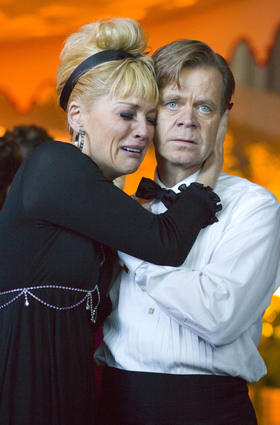
Not all the characters in Bobby, though, are out for good times. Some, like Anthony Hopkins’s retired hotel doorman, who likes to play chess with guests, most notably one played by Harry Belafonte, are just along for the ride. Some, like the hotel manager William H. Macy, are good folks in some ways (he lets his employees off work to vote) and questionable in others (he cheats on his wife, the hotel beautician, played by Sharon Stone). Lindsay Lohan, working her second small role in a serious film (she was last seen in Altman’s A Prairie Home Companion) is affecting in the underwritten part of a girl who agrees to marry a classmate (Elijah Wood) to keep him out of the draft and Vietnam.
Most of the characters’ dreams and aspirations are summed up in Demi Moore’s alcoholic lounge singer, whose shouting matches with her husband (Estevez) bring to mind Elizabeth Taylor and Richard Burton in Who’s Afraid of Virginia Woolf?, one of the most controversial movies of the mid-sixties. Moore’s is the strongest of the surprise performances in the film—a surprise because we aren’t used to seeing her or several others in this film get a chance to sink their teeth into a genuine role. She is scheduled to sing before Kennedy’s introduction at the victory party, and you can see that like many of the other people at the hotel, she’s prepared to put aside her cynicism and invest the last of her ideals in the candidate.
Estevez as writer and director has bitten off a great deal more than he can chew here, perhaps more than anyone could. His best decision as a filmmaker may have been to leave the part of Bobby Kennedy to Bobby himself, through wonderfully restored footage. But he’s not enough of a director—though there are indications that he may evolve into one—to deftly manage the swift changes from comedy to drama, and some of the roles need more fleshing out. (It’s the kind of film that might actually benefit from an additional 10 to 20 minutes on DVD.) And yet this upstart has attempted, and come surprisingly close to pulling off, the kind of film that his more experienced colleagues, like Steven Spielberg, seem to shy away from.
Bobby reminds one of Samuel Johnson’s judgment on a woman preaching: Like a dog walking on its hind legs, it’s not particularly well done, “but you are surprised to find it done at all.” Bobby is far from a great film, but it is a very heartfelt one about the difference that some people feel politics can make in their lives and the sense of loss that lingers after the death of a politician who embodies their ideals.