
At the Movies: Borat
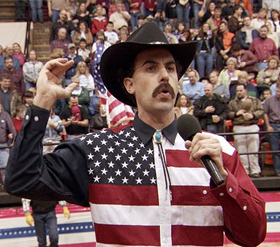
Borat, the new “mockumentary” by the British comic Sacha Baron Cohen, subtitled “Cultural Learnings of America for Make Benefit Glorious Nation of Kazakhstan,” has made a swarm of film critics dizzy trying to pin down the film’s—and Cohen’s—antecedents. So far no one has had much success.
If you’re not familiar with Baron Cohen’s comedy, the Peter Sellers of The Goon Show era might be a good clue, and for a visual, think of your reaction when you first saw Sellers as Inspector Clouseau. The only other connection I can think of is Groucho Marx, to whom Baron Cohen’s character of Borat bears a striking resemblance; Borat might be the illegitimate son of Marx’s Rufus T. Firefly, the president of Freedonia in Duck Soup. I suspect both Sellers and Marx were early influences on Baron Cohen, but Boratseems to have birthed itself, sprung fully formed from the tortured psyche of the most original comic mind to hit the screen so far this century.
American audiences may not be prepared for Borat or its creator, whose only previous feature film appearance was as the obnoxious gay French race car driver Jean Girrard in Talladega Nights. His bit gave the Will Farrell vehicle a comic jolt that lifted it above the ordinary. (A scene where Girrard races along at 120 mph reading Camus’s The Stranger while a French girl croons the Stones’ “Paint It Black” had to be Baron Cohen’s inspiration.)
Baron Cohen has built a substantial cult following in the United States with Da Ali G Show, which features him as a white Brit rapper clad in wraparound shades and gold track suit. The show’s daring is illustrated by its willingness to ruthlessly satirize its natural fan base, not just white kids trying to act black but the extreme pretensions of black rappers themselves. (It made the catch phrase “Is it because I black?” instant common currency.) The character was quickly embraced by hipsters and intellectuals including Noam Chomsky, who was introduced by Baron Cohen as “My main man, Professor Norman Chomsky.” Many viewers channel surfing and stumbling on the show for the first time probably have had no idea what to make of it; I know I didn’t, but I laughed till I was sick. And I’ll bet that will also be the reaction of most of those who can be induced to see this film.
One of several characters first introduced on Da Ali G Show, Borat Sagdiyev is supposedly a journalist for his country’s state-run television network and “the sixth most famous person in Kazakhstan” (can any American journalist claim as much?). The film purports to be a documentary on Borat’s travels in the United States, and it’s no small part of its ingenuity that in many ways that’s exactly what it is. Directed by the Seinfeld script writer Larry Charles, the interviews in Borat are done in the fake cinéma vérité style that fans of Jon Stewart’s The Daily Show have become accustomed to.
Undoubtedly some of Borat’s interview subjects are professional actors, but some couldn’t possibly be, and absolutely none of them seem to be. All of them, from riders aboard a New York subway train to white Southern evangelicals, must contend with Borat’s English, which sounds as if it was translated into Esperanto, then into Kazakhstanian, and then back again into English. Much of it is incomprehensible even when you can understand it. Borat’s sister is proudly introduced as “the number-four prostitute in all the country.” The black Reagan administration conservative Alan Keyes is cheerfully called “genuine chocolate-face.” Texans at a rodeo cheer at Borat’s proclamation that “I support your war of terror” and that “George Bush may drink the blood of every man, woman, and child in Iraq.” (Baron Cohen’s fractured rendition of “The Star-Spangled Banner” should imprint itself indelibly on the memories of American school kids.)
There is a thread, sort of, that runs through the “movie film,” as Borat calls it. He is in love with Pamela Anderson and determined to make his way to California and marry her in the proper Kazakhstanian fashion, which involves a burlap sack and which indirectly results in perhaps the greatest nude wrestling match (with his producer, played by Ken Davitian) in cinematic history. (Pamela Anderson plays herself, in some of her finest screen work to date.)
The plot, though, is just filler (or perhaps cream filling) to flesh out the film. Baron Cohen’s subject is satire—not the wimpy P.C.-hampered variety known to American TV and movies but savage, take-no-prisoners stuff. It begins with clips of practices from his native country like the popular medieval holdover “the Running of The Jew” (in which Borat points to an egg left on the ground by a woman and gleefully tells kids, “Crush that Jew-chick before it hatches”) and works its way to the deepest strains of American prejudice, which, in bizarre ways, reflect on Borat’s own bigotry.
No one, from feminists to frat house boys to born-again Christians, is spared. Or, rather, for some almost inexplicable reason, no one whom Borat meets seems to want to be spared. Your reaction to many of the interviewees’ comments may be similar to what you feel when you watch some of the subjects of the interviews by Jon Stewart’s correspondents, namely, “How can people say things like that with a camera in their face?” You may find yourself alternately laughing and wincing, which must be precisely the effect Baron Cohen is pushing for. (What other reaction could a sane person have to Borat’s belief that a woman’s brain is “the size of a squirrel’s”?)
Borat is America seen through a looking glass, darkly. It’s so funny and nasty you can almost hear Lenny Bruce, Sam Kinison, and Richard Pryor laughing in the background.