
At the Movies: The Namesake
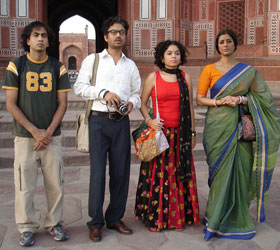
Jhumpa Lahiri’s fiction has touched a nerve with readers on at least two continents. Most American fiction dealing with the immigrant experience has been written by the children of Jewish, Irish, or Italian parents. Lahiri’s Pulitzer Prize-winning collection of stories, Interpreter of Maladies, and her widely read novel The Namesake see the New World from a different direction, the latter book through the eyes of a Bengali family as they adjust to life in a New England university town.
What fascinates American readers of The Namesake is the mirror it holds up to modern Western culture. When Ashima, mother of the story’s main character, sees her first American apartment, she finds it “not at all what she had expected. Not at all like the houses in Gone With the Wind or The Seven-Year Itch, movies she’d seen with her brother and cousins at the Lighthouse and the Metro.” She doesn’t like its draftiness, its dreary dark-brown curtains, or its roaches, but she does write home about “the powerful cooking gas that flares up at any time of day or night” and the hot and cold tap water, “safe enough to drink.” Their children, who begin drifting almost at birth from Bengali customs, “celebrate, with progressively increasing fanfare, the birth of Christ, an event that children look forward to far more than the worship of Durga and Saraswati.” Bengali celebrations “can’t compare to Christmas, when they hang stockings on the fireplace mantle, and set out cookies and milk for Santa Claus, and receive heaps of presents, and stay home from school.”
More than her purely literary gifts (which are considerable, though she still lacks a truly distinctive writing style), the basis for Lahiri’s popularity, I think, is not that she has tapped a new vein so much as that she has joined together two old ones, nostalgia and alienation. We see her characters struggle with the erosion of their identity through exposure to television, popular music, and fast food, and we think of the quality of life that our own parents and grandparents keep telling us we have lost. And many of us find ourselves feeling, perhaps too easily, that there must be something wrong with a society that has so little respect for tradition.
The director, Mira Nair, was a bit out of her depth with the sprawling Vanity Fair (2004), though it’s hard to think of any director who wouldn’t be with that novel; with Lahiri’s novel she’s right at home. Her film version of The Namesake cuts back on social comment and ups the ante on nostalgia.
The film’s protagonist, Gogol—his father names him for his favorite Russian writer, and for another reason that becomes apparent as the story progresses—is played by Kal Penn, a New Jersey–born Indian-American actor who made an impression in the comedy Harold & Kumar Go to White Castle (2004). The script, by Sooni Taraporevala, softens the edges of the character, who isn’t especially sympathetic in the book, and Penn plays the part with relish. His Gogol doesn’t seem so much alienated as confused by too much choice between the richness of Bengali culture and the abundance of America. At times he seems like Robin Williams dazzled by Bloomingdale’s in Paul Masursky’s lovely immigrant movie Moscow on The Hudson (1984).
Gogol’s parents, played by two Indian art-house veterans, Tabu (as Ashima) and Irfan Khan (as his father, Ashoke), could use a bit more fleshing out, but then, the characters could have used that in the novel as well. Their struggle to keep faith with their Bengali heritage will touch a chord in almost anyone whose parents or grandparents moved here from “the old country.” (They renew their emotional ties with their ancestors by watching Satyajit Ray movies, much as Irish-Americans must have watched A Tree Grows In Brooklyn.)
The basic faults of The Namesake are those of the novel. The Bengalis are presented with more complexity and insight than the Americans, in particular Gogol’s wealthy WASP girlfriend, Maxine (Jacinda Barrett), who seems mostly to be a plot device set up to illustrate the failure of Gogol’s assimilation. Exactly why assimilation would be a bad thing for Gogol and other Hindu Americans when it has done so well for other immigrant groups is a question neither the book nor the film satisfactorily answers. Still, The Namesake’s excursion into this territory is fresh from just about any perspective. It could light a path for any future seeker of the American dream.