
Southern Discomfort: Getting Through the Civil Rights Era
It’s been a brutal election season for George Allen. A former governor of Virginia who currently represents his state in the U.S. Senate, Allen has been plotting a run for the Presidency. He needed—scratch that; he needs—a decisive reelection victory this fall to burnish his résumé and shore up his base in anticipation of the 2008 GOP primaries.
But things haven’t been going so well for him. Though he was born in 1952 and was just a kid when the major battles of the civil rights movement were being fought, he has a race problem. It isn’t just that he used a racial epithet to mock an Indian-American in the employ of his Democratic opponent, or that he has ties to the Council of Conservative Citizens, a shadowy offshoot of the dreaded old White Citizens Councils. The problem reaches back further than that—as far back as 1970, when Allen pinned a Confederate flag to his lapel before sitting for his high school yearbook photo.
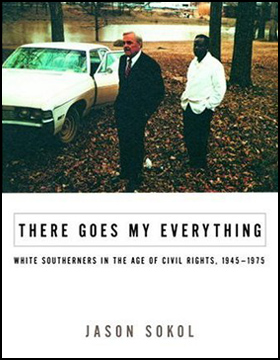
George Allen, who is now fighting for his political life, is an excellent reminder that the civil rights era didn’t end in 1965, with the passage of the Voting Rights Act, or in 1968, with Martin Luther King’s assassination. It stretched well into the 1970s, arguably the most interesting and under-studied civil rights decade, as white and black Southerners adapted themselves to integrated schools, ballot boxes, and public accommodations. In There Goes My Everything: White Southerners in the Age of Civil Rights, 1945-1975 (Knopf, $27.95), Jason Sokol, a Cornell University historian, offers a deeply researched and superbly written chronicle of how George Allen’s generation, and his parents’ as well, grappled with the realities of a post-Jim Crow South.
Sokol’s book spans the period between World War II, when many white servicemen first came into real contact with black men, albeit in a Jim Crow army, and 1975, when court-mandated busing was rapidly forcing Southern schools to desegregate, and when a combination of court and executive-branch pressure was forcing the last holdout restaurants, bowling alleys, and movie theaters to open their doors to black Americans. Readers will be surprised to know that as late as the 1980s the Terrell County Medical Clinic in Georgia had separate waiting rooms for black and white patients, or that as late as 1985 Terrell County’s courthouse still had Jim Crow bathrooms, or that doctors’ offices and bowling alleys in Walterboro, South Carolina, were still thoroughly segregated in 1974. “These stories do not stand as freakish anomalies that prove the rule of progress.” writes Sokol. “Rather, they question those very claims to progress, and expose the underside of its most glorious triumphs.”
The book is not, however, an angry or righteous exposé of Southern white racism. It is a sensitive, nuanced, and balanced look at how Southern whites dealt with one of the most remarkable—and relatively bloodless—social revolutions of modern times. Leaning heavily on oral histories, diaries, and memoirs, Sokol allows Southern whites to tell their stories in their own words, and if any one theme pervades his book, it is diversity. Diversity of opinion and reaction. Regarding the decision of Prince Edward County in Virginia to close its public schools rather than integrate them, we learn from the state’s superintendent of education that “the vast majority of our people are struggling valiantly and honorably for survival of a way of life, and . . . for the survival of their schools. . . . They are inwardly confused, hurt, and torn.”
There are monsters in the book, like Lester Maddox, the Atlanta cafeteria owner who chased black diners out of his establishment with a gun and an axe handle and then defiantly closed his restaurant rather than integrate it. Sokol doesn’t go easy on old Lester (and why should he?), who comes off looking like a character straight out of central casting, dripping with sweat and hate.
But we also meet Ollie McClung, owner of a popular and prosperous barbecue shack in Birmingham. (Shack might be the wrong word for it; in the late 1950s McClung was raking in $350,000 a year for his ribs and chicken.) Like Maddox, McClung challenged the Civil Rights Act, which barred segregation in places of public accommodation. But unlike Maddox, when the Supreme Court ruled against McClung in December 1964, finding that his restaurant was engaged in meaningful interstate commerce (much of its pork and beef was purchased from out-of-state vendors), he opened his doors to black diners. “As law-abiding Americans we feel we must bow to the edict of the Supreme Court,” he grudgingly announced, adding that “this could well prove the most . . . disastrous decision handed down by the court.” On December 16 five black diners went to Ollie’s to feast on his legendary barbecue. To everyone’s surprise, McClung’s included, nothing happened. “Everything was all right,” he said. “Everything was lovely,” added one of the black customers. “Lovely. Not a single incident. We sure enjoyed Ollie’s good barbecue.”
Sokol’s opening chapter is in many ways the most provocative. Though scholars like John Dittmer and William Chafe have demonstrated the mobilizing effect World War II had on black rights consciousness, Sokol shows us that the war against Nazi racism also provoked a range of responses from white Southerners. Some, a distinct but important minority, agreed with a white Georgian who observed, “We are fighting a Jew-baiter in Germany and I don’t see how we can be consistent if we support a Negro-baiter in Georgia.” More were inclined to agree with Loy Harrison, who feared the democratizing effects of wartime service. He observed that “until George [a local black man] went in the Army he was a good nigger. But when he came out, they thought they were as good as any white people.”
Readers looking for moral certainties or for reinforcement of popular stereotypes of white Southerners will find Sokol’s account disappointing—and this is precisely the book’s strength. What we find instead are thousands of voices, confused, stunned to learn that “their Negroes” weren’t happy after all, and mostly resigned to the likelihood of Jim Crow’s fall without a firm appreciation of exactly what it would mean. “Desegregation was absolutely incomprehensible to the average Southerner—absolutely inconceivable,” said a Greensboro attorney.
Jimmy Breslin, the New York City newspaperman, saw exactly what was happening. Observing the scene outside Montgomery’s Jefferson Davis Hotel in 1965, Breslin wrote: “You have not lived in this time when everything is changing, until you see an old black woman with mud on her shoes stand on the street of a Southern city and sing ‘. . . we are not afraid . . .’ and then turn and look at the face of the cop near her and see the puzzlement, and the terrible fear in his eyes. Because he knows, and everybody who has ever seen it knows, that it is over. The South as it stood since 1865 is gone.”
In Virginia, George Allen’s poll numbers have plummeted in the wake of his racist comment to an opposition campaign worker. What was once a safe seat is now up for grabs. It is, as Breslin said, over. Too bad no one sent Allen the memo.