
Travel: The Very Best Things to See and Do in Oklahoma
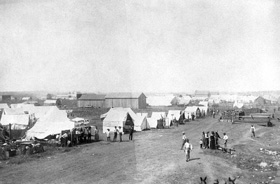
A century ago today, on November 16, 1907, Oklahoma became the forty-sixth state. Oklahoma City, the state capital, and Tulsa are both holding lavish events today, with parades and fireworks. So is Guthrie, which was once the state capital and, before that, the site of a hectic 1889 land rush. We can’t make it to any of those, but we’re saluting the occasion by letting you know of the best places to go anytime to take in Sooner State history.
Oklahoma’s name is derived from two Choctaw words, okla, for “people,” and humma, for “red.” In 1830 the federal Indian Removal Act moved the Choctaw tribe (along with the Cherokee, Seminole, Chickasaw, Creek, and many others) west from the Southeastern United States to what was soon officially designated Indian Territory. Part of that territory would eventually, along with the nearby panhandle, become the state of Oklahoma, as the government took back the land, bit by bit, to make room for white settlement. Still, a very strong Native American presence remains today, particularly in the eastern part of the state, much of which remained Indian Territory right up to statehood. For Native American culture, the first place to go is the Red Earth Museum, in Oklahoma City.
The museum was founded in 1978 as the Center of the American Indian, and it houses a permanent collection of more than 1,400 items, including fine art, pottery, basketry, textiles, and beadwork from tribes from Oklahoma and all over the country. It also has a library of 200 videos and more than 1,000 books on Native American culture, and an especially notable collection of exquisitely carved totem poles from Pacific Northwest tribes.
With white settlement spreading west after the Civil War, the federal government, under President Benjamin Harrison, opened up the area’s “unassigned lands”—those not officially a part of the Oklahoma Territory or Indian Territory—in April 1889. The land rush that ensued is legendary. Some settlers staked claims before the official opening date, earning the nickname “Sooners.” The epithet was meant as a term of derision, but Oklahomans came to embrace it.
The initial land rush, nicknamed “Harrison’s Hoss Race,” was fast and furious, and the area’s population grew by tens of thousands over a single night. Much of the action was in Guthrie, which became the largest settlement for many miles, but Oklahoma City, to the south, also saw a huge influx. The Oklahoma History Center, in Oklahoma City, contains more than 2,000 artifacts covering a wide range of topics, including settlement, military history, and local arts history. Outside, you can take in the history of oil in the state through actual working machinery; inside, you can learn about 39 different tribes and play with more than 200 interactive audiovisual displays. The place is a must for anyone curious about the state’s past.
For military history, visit Fort Sill, near Lawton, in southern Oklahoma. Gen. Philip Sheridan, just after the Civil War, led cavalry attacks against hostile Indian tribes from there. Frontier scouts based there during the Indian Wars included Buffalo Bill Cody and Wild Bill Hickok. The famed Apache warrior Geronimo died of pneumonia at Fort Sill in 1909 as a prisoner of war and is buried there. You can visit his grave and take in numerous exhibits on military, civilian, and Native American life in the nineteenth century.
Mineral and oil extraction would become the state’s biggest business, and many entrepreneurs became rich by the early twentieth century. One audacious home of the Oklahoma upper class of that era, the 55-room Marland Mansion, in Ponca City, is open to the public. Built in the 1920s by an oil millionaire and future Oklahoma governor named E. W. Marland, the sprawling house contains gorgeous stained-glass windows, Waterford crystal chandeliers, and hand-carved oak mantelpieces. Perhaps the most impressive and imposing objects on the grounds are the several life-size statues of Marland family members, commissioned by themselves.
Two museums honor an Oklahoman who became one of America’s most original public figures—the humorist Will Rogers, who was born in Indian Territory in 1879. He first made his name with his lasso-throwing skill at Wild West shows and on vaudeville stages. His witticisms soon earned him even more fame, and he appeared in more than five dozen movies and wrote countless newspaper columns before dying in a plane crash in Alaska in 1935. His two museums, in Claremore and Oologah, showcase memorabilia including his very extensive saddle collection. The Rogers family tomb is in Claremore, and the museum’s research library there contains more than 2,000 volumes by, about, or touching on Rogers, as well as works on Native Americans, vaudeville, and early motion pictures.
It’s hard to think of Oklahoma nowadays without remembering the Oklahoma City bombing of April 19, 1995, when a truck bomb in front of the Alfred P. Murrah Federal Building killed 168 people, including 19 children. It was the worst terrorist attack on American soil before September 11, 2001. The Oklahoma City National Memorial is a moving tribute to those who died on that terrible day, with photographs, audio recordings, and even damaged furniture from the blast, as well as a moving Gallery of Honor that commemorates each one of the attack’s victims. It’s a monument to resilience in the face of unspeakable tragedy.
Indeed, the centennial celebrations taking place today are all about how people have survived and thrived in Oklahoma. For more information on those observances, visit www.oklahomacentennial.com. For information on the places featured in this article, visit these websites: Red Earth Museum: www.redearth.org/museum.php; Fort Sill Museum: http://sill-www.army.mil/Museum/Home%20Page.htm; Oklahoma History Center: www.okhistorycenter.org; Marland Mansion Estate: www.marlandmansion.com; Will Rogers Museums: www.willrogers.com/index3.html; Oklahoma City National Memorial: www.oklahomacitynationalmemorial.org.