
Why We’ll Never Know Nat Turner
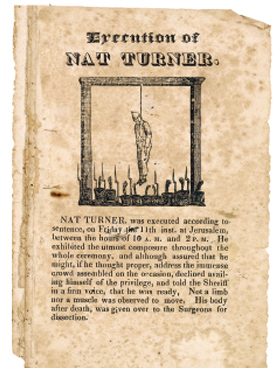
A hundred and seventy-five years ago today, a 30-year-old black slave named Nat Turner, supported by about 60 followers armed with guns, clubs, axes and swords, launched the bloodiest slave revolt in American history.
Visiting a reign of terror on the farmhouses around Southampton County, Virginia, Turner’s small army murdered 61 men, women and children, all of them white, before being overwhelmed by state militia. The scope of the violence was unprecedented. At the Waller farm, Turner’s followers murdered Levi Waller, his wife, and their 10 children. At the Vaughan farm, they shot to death an aged widow, her daughter-in-law, and her 15-year-old son. As word of the rampage spread, hundreds of frightened whites converged on the aptly named town of Jerusalem, seeking protection from the 250 federal troops who had been dispatched from Richmond.
Turner’s rebellion lasted only 48 hours, though Turner himself wasn’t apprehended by state officials until almost two months later, on October 30. On November 5 he was convicted and sentenced to death, and just six days after, on November 11, he was publicly hanged. As an enthusiastic crowd looked on, his dead body was skinned and dissected. Rumor quickly circulated that parts of his corpse were preserved as souvenirs, in a foreshadowing of the gruesome spectacle lynchings that later abounded in the early Jim Crow-era South.
Though in the aftermath of Turner’s revolt white Southerners came down hard on African-Americans, in truth they had little to fear. We now know that there are very good reasons why North America’s black population never executed the kind of vast, bloody uprisings that brought down the slave systems in Haiti and Santo Domingo (today’s Dominican Republic).
Of the 11 million Africans who were forcibly transported to the Americas, only 600,000 were delivered to what became the United States. In South America and the sugar islands of the Caribbean, young male slaves were worked to death on large plantations; in North America, slaves were better-fed and better-clothed, dispersed on small and middling farms, and encouraged to marry and procreate. None of this detracts from the brutality of slavery here; neither does it ignore the yearning of every American slave to be free, or the long and complex pattern of slave resistance. But it does explain why Nat Turner’s uprising, modest in scope as it was, exists alongside only a handful of other revolts, notably Denmark Vesey’s 1821 conspiracy and Gabriel Posser’s revolt in 1800. Compared with their counterparts in the sugar islands, American slave communities were organized in smaller units, more dispersed, and full of older people, children, and women—not ideal candidates for a bloody rebellion.
If Nat Turner’s revolt represented a brief and rare insurrectionary moment, it still sent shockwaves throughout Virginia and much of the American South. In a frenzy of retaliatory violence, vigilantes in Southampton County murdered at least 120 African-Americans, both slave and free, torturing, maiming, and burning many of their innocent victims at the stake. Writing years later, Thomas Wentworth Higginson, a leading pre-Civil War abolitionist, described one such scene where “a party of horsemen started from Richmond with the intention of killing every colored person they saw in Southampton County. They stopped opposite the cabin of a free colored man who was hoeing his little field. ‘Is this Southampton County?’ He replied, ‘Yes, sir, you have just crossed the line, by yonder tree.’ They shot him dead and rode on.”
While Southern whites were cracking down hard on their slave and free black populations, a small but influential group of white Northerners seized on Nat Turner’s uprising—and the noble, reserved way he faced the gallows—to highlight the cruelty of the slave system. In January 1831, shortly before the Turner crisis, William Lloyd Garrison of Boston launched a new broadside called The Liberator, dedicated to the immediate and unconditional abolition of chattel slavery. Rejecting the moderate and gradualist approach preferred by most opponents of the institution, many of whom thought the answer to the country’s race problem was the colonization of black Americans in Africa, Garrison promised to be as “harsh as truth, and as uncompromising as justice. On this subject, I do not wish to think, or to speak, or write, with moderation. No! no! Tell a man whose house is on fire to give a moderate alarm; tell him to moderately rescue his wife from the hands of the ravisher; tell the mother to gradually extricate her babe from the fire into which it has fallen;—but urge me not to use moderation in a cause like the present. I am in earnest—I will not equivocate—I will not excuse—I will not retreat a single inch—AND I WILL BE HEARD.”
Like other “immediate abolitionists,” Garrison was driven by an evangelical fervor derived in subtle ways from the great religious awakening then engulfing large parts of the United States. To such a sensibility, Nat Turner provided a very convenient hero. Though most abolitionists were avowed pacifists, they couldn’t help but revere his professed religiosity. How they even knew about Nat Turner, the Christian warrior, is as fascinating a story as the uprising itself.
In the short space of time between his arrest and his hanging, Nat Turner dictated his life story to a white lawyer named Thomas R. Gray, who soon thereafter published his heavily annotated transcript under the title The Confessions of Nat Turner. As recorded by Gray, Turner had had a religious apparition on May 12, 1828, when he “heard a loud noise in the heavens, and the Spirit instantly appeared to me and said the Serpent was loosened, and Christ had laid down the yoke he had borne for the sins of men, and that I should take it on and fight against the Serpent.” Borrowing freely from Christian theology, Turner explained—or so Gray reported—that “the time was fast approaching when the first should be last and the last should be first.” His bloody revolt was God’s design, and he was merely God’s instrument.
It was dramatic material, and well-tailored to a country gripped by evangelical enthusiasm. In later years, Turner’s diaries inspired a number of novels, including Harriet Beecher Stowe’s Dred, from 1856. But the best interpretation of Turner’s life is also the most controversial. In 1967 the novelist William Styron reinvented Turner’s voice in his celebrated (but widely contested) work also titled The Confessions of Nat Turner. Unlike his predecessors, Stowe among them, Styron discarded Gray’s Confessions as historically unreliable and instead imagined Turner’s voice and story from scratch. The reaction from black intellectuals was fierce. In a a book called William Styron'’s Nat Turner: Ten Black Writers Respond, several leading African-American critics excoriated him for ignoring Turner’s voice. “You’ve Taken My Nat and Gone” was the title of one of the essays.
However, the critics were themselves ignoring a historical problem. Nat Turner was already gone. His voice, gone too. What little we know about the leader of that insurrection—who may or may not have been a religious fanatic—comes from a collection of interview notes recorded by a white Southern lawyer with a keen eye for profit in publishing.
The real Nat Turner, whoever he was, died 175 years ago. All that remains is his story.