
An Interview with the creators of the recent mini-series Comanche Moon
Successful literary collaborations are rare. The few exceptions—Mark Twain and Charles Dudley Warner (The Gilded Age), Charles Nordhoff and James Norman Hall (Mutiny On The Bounty), Lou Abbott and Bud Costello (“Who’s On First?”), Randy Roberts and James Olson (A Line In The Sand)—do not usually reach beyond a single genre. Larry McMurtry and Diana Ossana have now mastered two: the novels, Pretty Boy Floyd and Zeke and Ned; and their Academy-Award-wining screenplay for Brokeback Mountain, adapted from Annie Proulx’s short story.
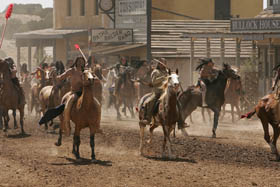
While working on the set for the mini-series Comanche Moon, adapted from McMurtry’s novel and a prequel to the hugely successful Lonesome Dove, they granted American Heritage magazine an interview, McMurtry’s first in decades. Comanche Moon aired on CBS January 13-16.
AH: (To Diana) Your short story, White Line Fever, is set in the contemporary West and shows remarkable empathy for a pregnant girl who strikes out by herself to make a new life in Arizona. In the novels and screenplays you've co-written with Larry, do you tend to identify more with the female or male characters?
Diana: Larry seems to feel I have an affinity for the male characters in projects we co-write, but I think that's because he feels more for women characters. When I create fiction, I can't recall that I feel more drawn to the men; what I do feel is that I am the character I happen to be writing. I feel whatever it is they're feeling, as if I AM the man or the woman or the child, whatever sex or age the character happens to be.
Trying to explain where fiction comes from is difficult, if not impossible. It comes from some obscure place in one's imagination. I just know that when I'm engaged in the act of fiction writing, the world I'm creating is as real to me—sometimes more real—than the world around me.
AH: (To both) Can you talk about how you work together? Is it always a democratic process, for instance? Do you both have an equal vote as to what works and what doesn't, what stays and what goes?
Larry: It’s a totally democratic process; in essence for us it’s meant taking what comes our way. About the only job we’re turned down was The Return of Rin Tin Tin, and if it should come around again, which it might, we’d probably take it.
Screenwriting jobs don’t grow on trees, no matter how popular you’re considered to be. We avoid purely speculative jobs that are not likely to be movies no matter how good the script—but we consider ourselves lucky to have been offered projects that we can execute effectively as screenwriters—and see them get made.
Diana: Ditto as to most of what Larry said, except we DON’T take everything that comes our way. There have been several projects I wanted to do that he simply batted away...except for Brokeback Mountain. I insisted he read the short story; he doesn’t usually read short fiction, because he says he can’t write it.
When Larry writes alone, he is much more elaborative in his prose. When he writes with me, however, it’s much more skeletal. I take his pages— usually five a day—and fill them in, deleting and adding pages and narrative. I then print my pages, which I give to him in the evening so he has them for his morning writing. We do that every day until we have a first draft.
Most of the time it’s totally democratic, but we’ve had some Olympic-sized arguments about specific things, such as the ending for Pretty Boy Floyd. Larry says he has no memory of that, but I think it’s because he lost that one.
AH: Well, I don't know that it's true Larry can't write short fiction–Comanche Moonclocks in at only 700-plus pages. That’s short by the standards of some of Larry’s novels.
Larry: I’ve written several books shorter than Comanche Moon, including the very slender and just published When the Light Goes. But they aren’t short stories or short fiction. The only short story I’ve ever written is called There Will Be Peace In Korea, published in the Texas Quarterly long ago. Tommy Lee Jones has done a fine reading of it on audio book.
Diana: Short stories are much more demanding than novels; they require a kind of precision not necessary in long-form prose. It’s easier certainly to meander around in a novel. Larry, basically a wanderer himself, enjoys the more forgiving form of a novel.
AH: Did you have to cut any major characters or plot lines for the mini-series?
Diana: It wasn’t so much that we had to give up major characters or story lines; the last part of the novel is so unrelentingly grim that we found it necessary to newly imagine a large portion of Part Three of the miniseries.
AH: (To both) A couple of decades ago, in his book of essays on Texas, In A Narrow Grave, Larry wrote, “The figure of the Westerner is gradually being challenged by more modern figures. At the moment, the Secret Agent seems to be dominant.” James Bond made a big comeback last year in Casino Royale by adapting to the times. While there aren’t any more Communists to fight, there are plenty of terrorists. It also seems to me that the Westerner, in one form or another, is still very much with us—whether in your novels or in Deadwood and films such as Brokeback Mountain, Open Range, or even The Three Burials of Melquiades Estrada, which, by the way, I think borrowed a major plot line from Lonesome Dove when Tommy Lee Jones’ character carries his dead friend hundreds of miles back home.
Do you think the Westerner will continue to have a future? If so, in what ways will he or she have to adapt?
Larry: I don’t think much about the figure of the Westerner. There’s a good piece by Douglass Jeffrey in the current (spring) issue of the Claremont Review of Books on myself and the rest. It’s good.
Diana: The Westerner will always be with us, in one form or another, since it’s such a vital part of America’s history. The notion of an adventurous loner, free of restriction, a risk-taker, someone who lives by the seat of his pants, so to speak, is integral to the romantic notion, right or wrong, of what it means to be a man in this country.
It continues to exist in both literature and film: war stories; spy stories; stories about space and astronauts; even historical works, as in Ridley Scott’s Gladiator, or the neurotic criminals in The Sopranos; and even the couple in Mr. and Mrs. Smith—a sort of contemporary version of Butch Cassidy and the Sundance Kid, but with the female counterpart much more prominent, active, and modern than Etta Place, as embodied by the Angelina Jolie character. The Westerner will never disappear entirely from our consciousness. As Larry himself said, he initially wrote Lonesome Dove as an anti-mythic western—but readers everywhere loved it and embraced the myth even tighter than before.
AH: What’s next?
Diana: We’re working on Boone’s Lick, a novel of Larry’s that was published in 2000. Tom Hanks will star in it. It’s tentatively scheduled to begin filming later this year. We’re also working on a pair of two-hour pilots for ABC and FOX. It’s good to be busy!