
In 1814, my ancestor Admiral Cockburn destroyed the Nation’s Capital. He also freed some 6,000 slaves.
-
Fall 2026
4 months ago By Edwin S. Grosvenor Volume71Issue4
Editor’s Note: is the author of over a dozen books, Washington editor of Harper's Magazine, and a Peabody Award-winning filmmaker. He is also a descendant of Admiral Sir George Cockburn, who ordered and led the burning of Washington, D.C during the War of 1812. Cockburn recently published Washington Is Burning: Corruption and Lies in The Age of Trump, in which portions of this essay appeared.
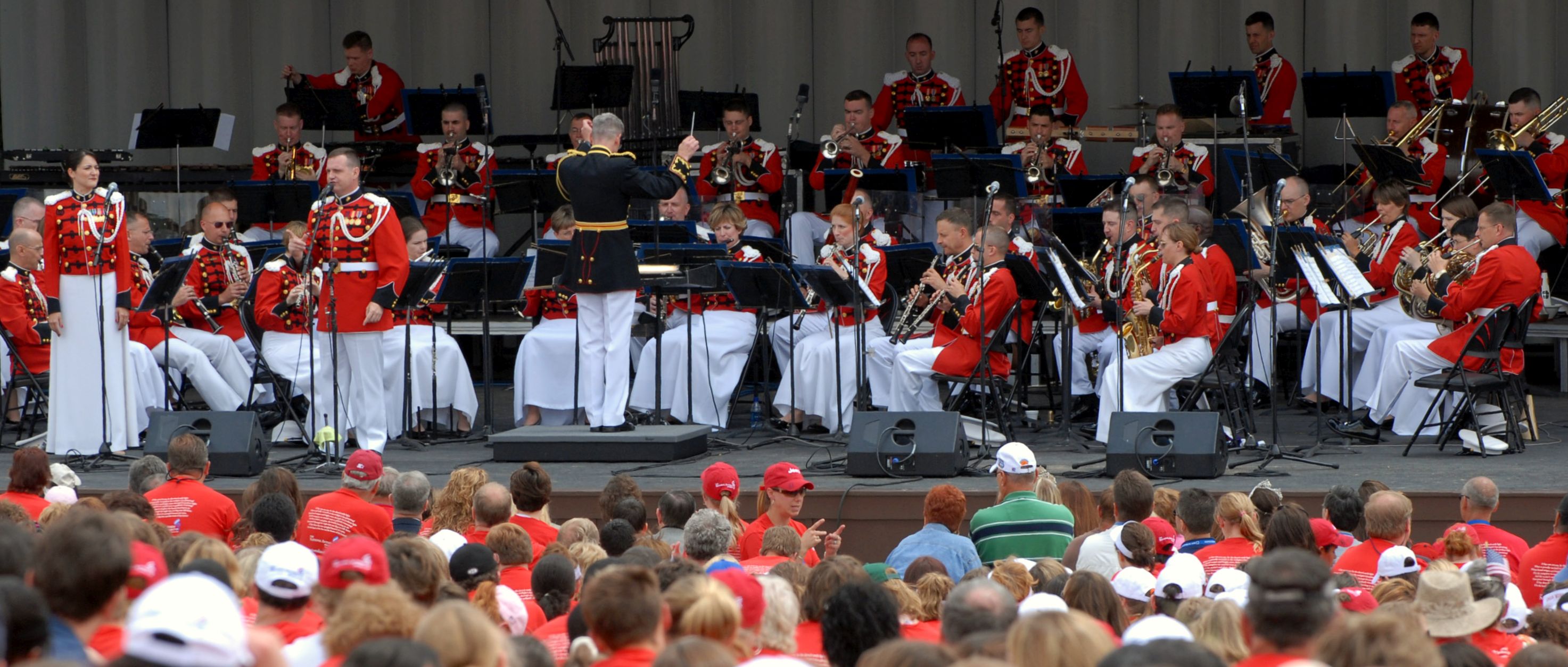
On a sunny Saturday in June, 2014, thousands gathered on the National Mall in Washington, DC, to sing “The Star-Spangled Banner.” The event marked the two-hundredth anniversary of Francis Scott Key’s composition, officially adopted as the national anthem in 1931. As the melody rang out over the grass and along Constitution Avenue, it echoed off neighboring memorials and galleries, including the partly built National Museum of African American History and Culture a block and a half down the street.
Although preceded by a lengthy program of musical performances, the actual words of the anthem got short shrift. As usual, only the familiar opening verse was sung because of various ideological stumbling blocks in subsequent verses – most especially the third, with its fervent hope that
No refuge could save the hireling and slave
From the terror of flight, or the gloom of the grave.
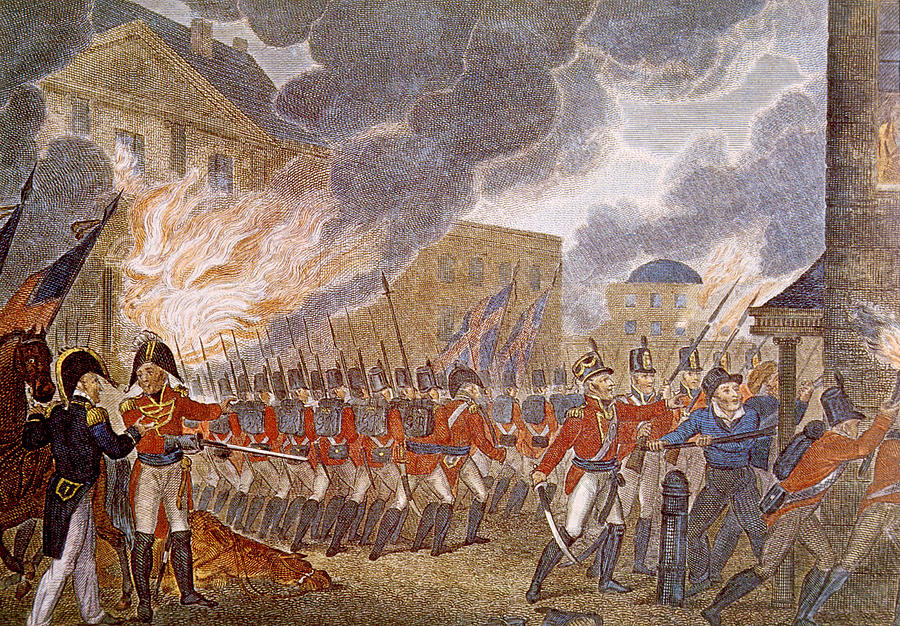
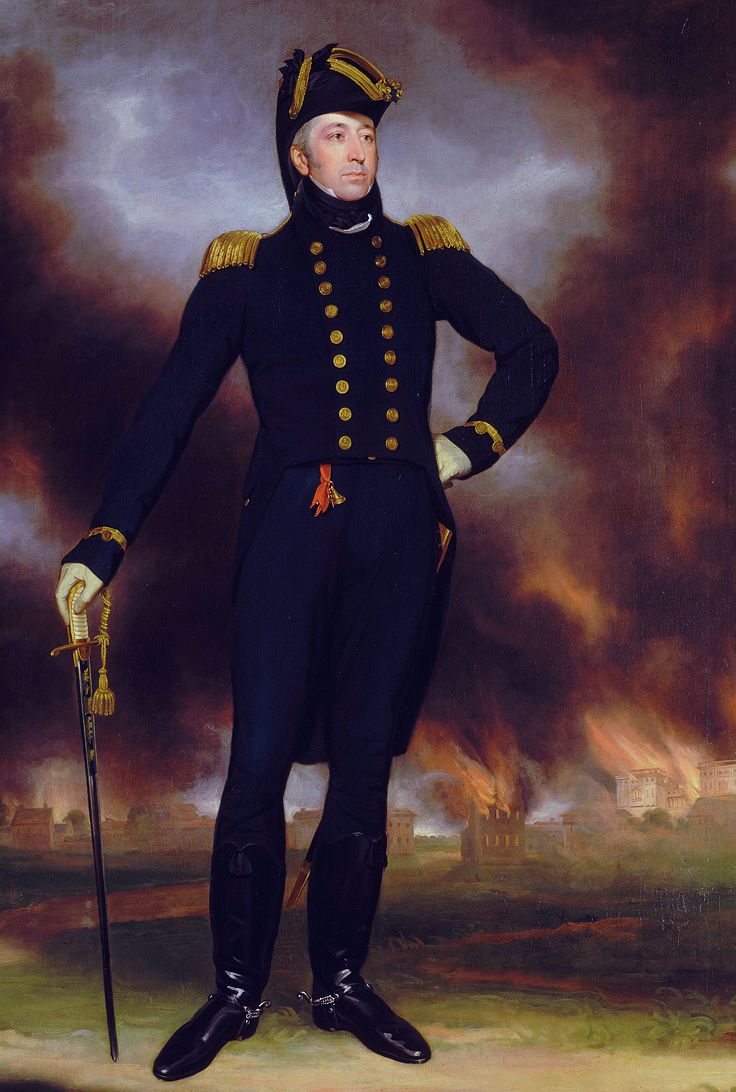
For me, the words always evoke a glow of family pride, because Key’s malign desire that fleeing slaves should find no refuge was directly inspired by the actions of my distinguished relative Admiral Sir George Cockburn of the Royal Navy. Two hundred and twelve years ago this August, he fought his way to the White House at the head of an army partly composed of slaves he had freed, armed, and trained, and torched the place, along with the Capitol and much of official Washington. In the course of a two-year campaign, Cockburn rescued as many as 6,000 slaves, and despite Francis Scott Key’s hopeful verse – not to mention angry demands from the US government – he sailed them away to freedom.
Obviously, the admiral qualifies as one of the great emancipators, and I am proud to claim a connection. In a recent conversation with Dr. Lonnie Bunch, Secretary of the Smithsonian who oversaw creation of the African American museum as its founding director, I suggested that he include George Cockburn in a Hall of the Righteous, cheek by jowl with Abraham Lincoln and William Lloyd Garrison. He was nice enough to hear me out, although he made it clear that his intention is not to produce a Black version of the nearby Holocaust Memorial Museum, with its Wall of Rescuers, but something far broader in scope. The real challenge, Bunch told me, is to avoid a “rosy view of the past. Romanticized memory is not history.”
To maintain a rosy view of the War of 1812, it is best to concentrate on the tattered banner and its mythic survival amid British rockets and bombs. There is less romance in the full story. It was also a war of aggression, launched by President James Madison partly in hopes of conquering Britain’s Canadian colony, thought to be easy prey while the British were distracted by their life-and-death struggle with Napoleon. Not for the last time, expert opinion expected a walkover. “The acquisition of Canada this year, as far as the neighborhood of Quebec, will be a mere matter of marching,” wrote Thomas Jefferson soon after war was declared. A fellow ringleader of the war party, Henry Clay, assured Congress that “the militia of Kentucky are alone [able] to place Montreal and Upper Canada at your feet.”
As with more recent enterprises, things did not go as planned, especially since the military was woefully unprepared and led by incompetent commanders. The Canadian expedition ended in disaster. Fort Detroit surrendered to the British and large portions of Maine and Michigan fell under enemy occupation. By the time the British agreed to call it a day, the bitterly divided United States was war-weary and on the verge of bankruptcy.
By then George Cockburn was the most hated man in (white) America, vilified in the press as the “great bandit.” The scion of a Scottish landed family ruined by his speculator father, he had entered the navy at the age of fourteen. From then on, he was almost continually at sea – and, once war with France broke out in 1793, frequently in combat.
This conflict, initially waged against revolutionary France and then against Napoleon, was essentially the first world war, fought across much of the globe and offering plenty of opportunities for a tough, ambitious professional such as Cockburn. At twenty-three, he was already a captain, in command of a 215-man frigate. Horatio Nelson, Britain’s greatest naval hero, would soon praise the young officer’s “zeal, ability, and courage, which shine conspicuous on every occasion which offers.”
By 1813, when he first arrived in Chesapeake Bay, Cockburn was forty-one years old and a rear admiral. His mission was straightforward: to inflict as much damage as possible on this economic heartland, thereby dissuading pro-war Democratic-Republicans (as opposed to antiwar Federalists) from their rash attack on the British Empire. “I have no hesitation,” he wrote to a superior officer, “in pronouncing that the whole of the shores and towns within this vast bay, not excepting the capital itself, will be wholly at your mercy, and subject if not to be permanently occupied, certainly to be successively insulted [raided] or destroyed at your pleasure.”
This ruthless scheme, which Cockburn was to follow to the letter, would have been absolutely impossible without first-class intelligence operatives to alert his raiding parties to enemy forces and guide them around the tortuous shoreline. Fortunately, volunteers for such a mission soon appeared: slaves. At first they were single men, eagerly welcomed by the British as the pilots and guides they needed. But the numbers quickly grew as entire families made their way to the ships. At this point the invaders made a crucial decision: they would accept any slave – man, woman, or child – and guarantee they would not be handed back to their owners.
It was a shrewd assault on the young republic, which at the time was really two nations: a free people, intoxicated by their new democracy, and an enslaved people, ill-fed, clad in rags, and routinely brutalized. In fact, the revolution had in many ways made the lives of enslaved Americans even worse. For example, among the goals of Virginian Founding Fathers such as Jefferson had been the breakup of big landed estates. Whereas in colonial times such estates passed to a single heir (the eldest), they could now be divided equally among siblings.
This meant that slave families, too, were increasingly broken up. In his pathbreaking history The Internal Enemy: Slavery and War in Virginia, I772-1832, Alan Taylor points out that “the revolution had produced a tragic contradiction by promoting greater equality for white men while weakening the security of black families.” In addition, observes Taylor, “by diffusing slave ownership, the new laws also broadened public support for slavery.” A nascent movement in favor of emancipation that had flickered during the years of the Revolution soon died away.
In Taylor’s view, family separation was the most onerous of all the miseries inflicted on enslaved Blacks. Perpetually indebted Virginia and Maryland planters were happy to breed and sell surplus bodies, regardless of family ties, to the expanding cotton plantations of the deep South. So enslaved Black men, especially those living within easy reach of the coast, led their families to the British in large numbers.
The British understood very well that slavery was their enemy’s Achilles’ heel, and when Cockburn and his fleet returned to the Chesapeake in the spring of 1814 after wintering in Bermuda, he was determined to take full advantage. His orders read:
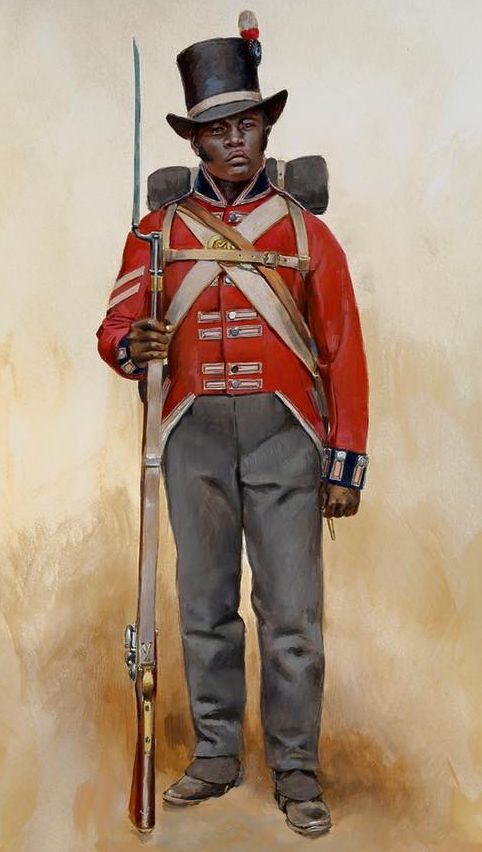
On May 29, horrified planters had their first look at the next stage of the British scheme. A raid on Pungoteague, on Virginia’s Eastern Shore, featured the Colonial Marines, a regiment of former slaves now armed and trained on Tangier Island, Cockburn’s base in the middle of the bay. The rags in which their owners clothed them had been replaced by bright red uniforms, and they were eager for battle, rapidly putting the defending militia to flight.
“I was highly pleased with the conduct of the Colonial Marines,” reported the raid’s commander, “every Individual of which Evinced the greatest eagerness to come to Action with their former masters.”
Cockburn, delighted with his recruits, noted happily that they excited “the most general & undisguised alarm” among the populace. He was certainly correct. “Our negroes are flocking to the enemy from all quarters, which they convert into troops, vindictive and rapacious – with a most minute knowledge of every bye path,” wrote an American commander in early August. “They leave us as spies upon our posts and our strength, and they return upon us as guides and soldiers and incendiaries.”
Raids along the coast in the spring and summer of 1814 left dozens of towns, plantations, and stores burned, with livestock and freshly harvested tobacco carried away. Yet these were merely precursors to Cockburn’s ultimate plan to strike at the heart of the enemy by raiding Washington itself. This, he calculated, would be a devastating psychological blow, discrediting the Madison administration and drawing enemy troops away from Canada. Furthermore, the Americans had burned York, as Toronto was called in those days, so this could be billed as justified retaliation.
To enlist the support of his superiors, Cockburn invited the cautious army commander, General Robert Ross, along on a night raid to demonstrate the feebleness of the American defenses. He somehow forgot to mention that he had raided the same place three nights before, driving off the militia and cowing the local residents. The brass were duly convinced. “Traditionally, the British fighting in America are portrayed as the blundering redcoats, prey to light-footed Americans sniping from behind trees,” Taylor told me. “But Cockburn was the resourceful, innovative, and flexible commander in this war, and a superb tactician. In fact, he was just the kind of commander that we admire today.”
The advance on Washington, with the Colonial Marines very much to the fore, was launched in the third week of August. As Cockburn had predicted, the American defenses were in a sorry state; a hurriedly assembled militia was swiftly routed on August 24 at Bladensburg, on the outskirts of the capital. Francis Scott Key, who as a militia officer had been busy offering unsolicited advice to the commanding general, was among those stampeding back to the city and beyond. Only an improvised US naval artillery unit, partly manned by free Blacks, made a stand.
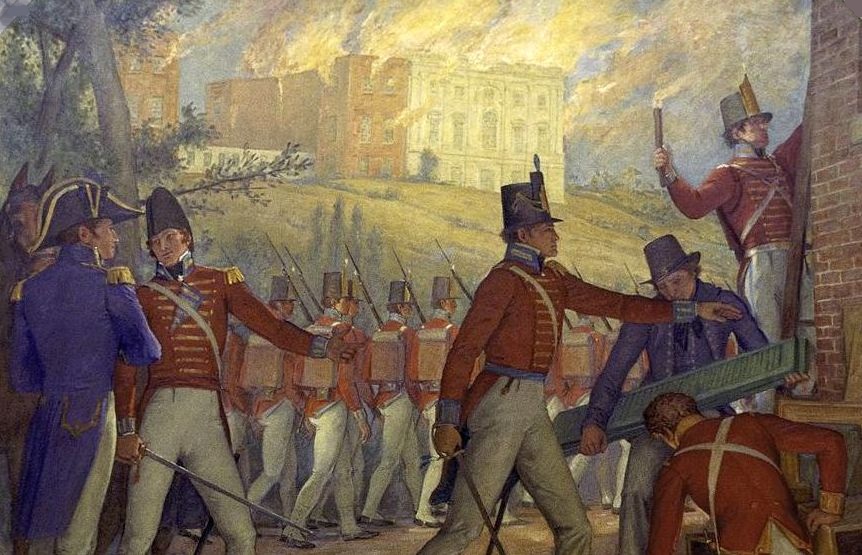
Most significantly, the American collapse was accelerated by a rumor among the troops that a slave revolt had broken out in their rear. Walter Smith, a brigadier general of the District of Columbia militia, summarized the abiding paranoia in the ranks: “Each man more feared the enemy he had left behind, in the shape of a slave in his own house or plantation, than he did anything else.” The sight of the Colonial Marines, charging in the British vanguard, cannot have been reassuring.
With Washington now at his mercy, Cockburn contented himself with destroying public buildings, such as the Capitol, military installations, and the offices of the National Intelligencer, a newspaper that had been regularly abusing him. His ultimate goal was the White House, from which President Madison had fled a few hours before, followed by his wife, Dolley.
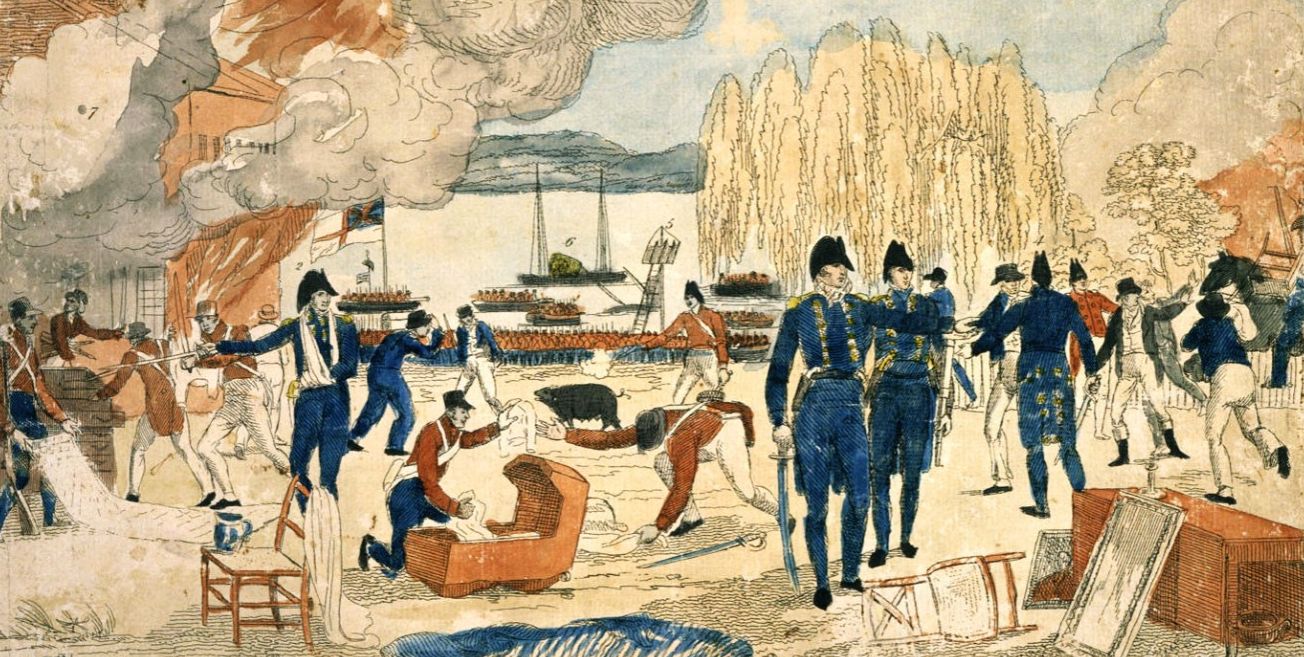
Cockburn took possession accompanied not only by some of his officers but also by a squad of Colonial Marines – men who only a few months before had been items of property, subject to disposal at the whim of their owners. The admiral and his party first helped themselves to a dinner ordered by Dolley in expectation of an American victory and collected souvenirs (Cockburn took the First Lady’s chair cushion, remarking lewdly that it would be a reminder of “her seat”). Then they piled up the furniture and set fire to the building.
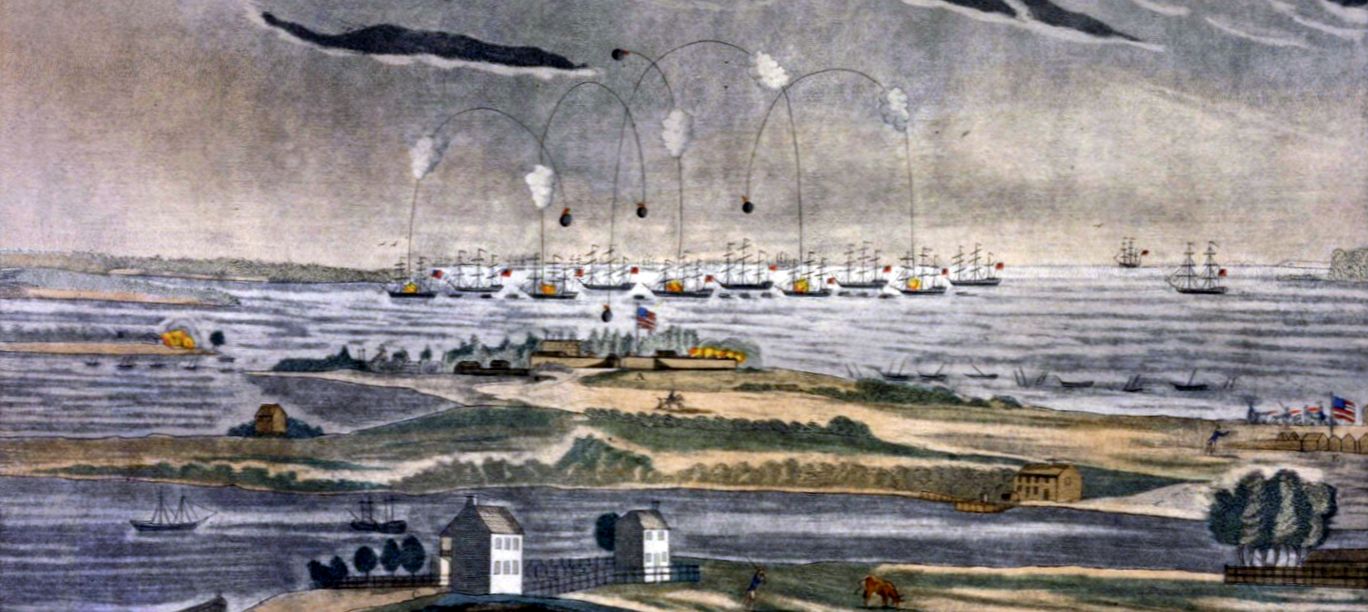
Following the subsequent failed attack on Baltimore that inspired Key’s verses, Cockburn moved south to harry the Georgia planters and rescue more slaves, recruiting many of them. The motive for his rescue work clearly went beyond military expediency-he continued to encourage fugitives up to the last days of the war, and indeed into the peace. Despite angry American insistence that the peace treaty mandated the return of all property (meaning, especially, former slaves), Cockburn bluntly refused to hand them over and shipped everyone off to Bermuda. Most eventually settled in Canada, but the Colonial Marines accepted an offer of land in Trinidad. Settled in villages, each under the command of their company sergeants from the old regiment, they were known as the Merikens. Their descendants live there to this day.
Memories of the time when invaders had freed and armed the slaves and brought the republic to the brink of collapse persisted among both slaves and the slave owners who dominated government policy in the ensuing decades. Fearful that the threat might one day reappear, the United States commissioned coastal fortifications as a defense against the Royal Navy. One of these was Fort Sumter, ultimately the flash point for the war that ended slavery once and for all.
Meanwhile, the Colonial Marines and the significance of their role were gradually eased out of official history. Francis Scott Key, on the other hand, went on to a long career as a powerful crony of President Andrew Jackson, a mentor to Chief Justice Roger Taney of Dred Scott fame, and, as district attorney for the capital, an energetic prosecutor of abolitionists.