
A private pilot named Kenneth Arnold kicked off a worldwide craze when he claimed he saw a string of shiny saucers fly past Mount Rainier in 1947.
-
Spring 2026
9 months ago By Edwin S. Grosvenor Volume71Issue2
Editor's Note: Mike Bezemek is a journalist and the author of Mysteries of the National Parks: 35 Stories of Baffling Disappearances, Unexplained Phenomena, and More, published by Sourcebooks in 2025. The following essay comes from chapter one of the book.
Through the cockpit windows, the snowy hulk of Mount Rainier dominated the horizon. A private pilot was steering his two-seat prop plane toward the 14,411-foot dormant volcano. Along the way, he studied the southwest slopes for wreckage. The previous winter, a U.S. Marine transport plane carrying thirty-two servicemen had vanished in a storm. When the weather cleared, there was no sign of the plane, which presumably had crashed into the mountain and been buried by snow.
Now, it was a sunny afternoon in late June 1947. The pilot’s name was Kenneth Arnold, and he was flying solo on a short hop from Chehalis to Yakima for a business trip. Back home in Boise, Idaho, Arnold was an experienced search-and-rescue volunteer who had learned about a $5,000 reward for locating the lost plane. After two unsuccessful flybys, he was about twenty miles west–southwest of the summit when he banked toward the mountain for the cabin.
Suddenly, a blinding flash illuminated the cabin. Arnold scanned the sky, worried he might be on a collision course with another plane. All he saw was a silver DC-4, far off to the southwest, heading toward Seattle. Then he noticed another flash coming from the north in the direction of distant Mount Baker. A chain of nine bright objects was flying south at incredible speed.
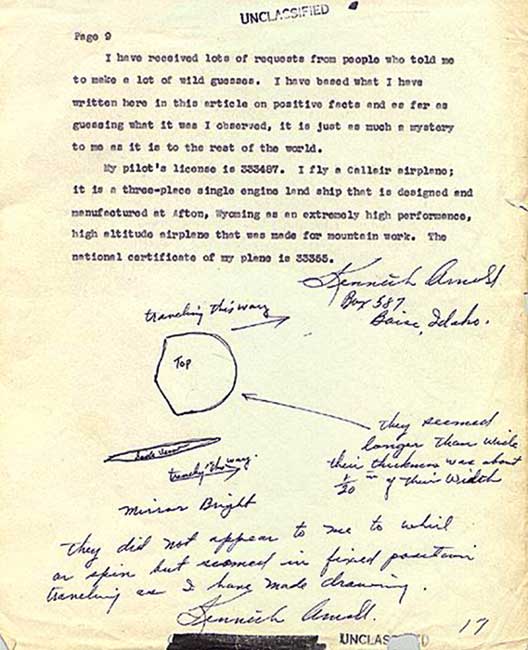
As the strange objects approached, Arnold tried to comprehend what he was seeing. They flew in an echelon, a roughly diagonal formation often seen with military planes or geese. But the shapes seemed too big to be birds, perhaps comparable in size to the distant DC-4. They were also moving faster than any aircraft known to man. Despite maintaining the formation, each individual vessel flew erratically. They fluttered and tipped their wings, which flashed reflections of the sun.
As these skittering objects passed in front of Mount Rainier, Arnold noted their silhouettes. Each was shaped like a crescent moon with a convex triangle protruding from the rear, somewhat like a boomerang or the later flying wing. When viewed on edge, they seemed improbably thin. What most surprised Arnold was that he couldn’t spot any vertical stabilizers. Were these experimental military jets with camouflaged features?
Using the clock on his instrument panel, Arnold timed the formation as it traveled from Mount Rainier past Mount Adams, more than forty miles to the south. One minute and forty-two seconds. Once the objects were out of sight, Arnold gave up his original search for the plane wreckage and turned toward Yakima. On the way, he calculated the objects’ speed. Around 1,700 miles per hour, though he later decreased this estimate by one-third.
Well, that settled it. Yes, there were reports of rocket planes with needle-sharp noses being tested in the California desert. But a human pilot had yet to break the sound barrier, which was typically around 767 miles per hour. Just a few years before, in the latter stages of the Second World War, the Nazis had unveiled a secret rocket. Called the V-2, it hurtled through the sky at 3,500 miles per hour.
Arnold decided the mysterious crafts were most likely a new type of guided missile. Hopefully this was a demonstration flight by Americans and not a daring incursion by the Soviets. People had to be on guard, after all. It was the beginning of a new conflict that some were calling a cold war.
After landing in Yakima to refuel, Arnold sought out his friend, the general manager of a local airline. As Arnold enthusiastically relayed his experience, pilots gathered around to listen. The audience seemed skeptical of his descriptions. It was probably just the latest military project. Arnold was inclined to agree. Once his plane was ready, he took off for a short flight to his final destination of Pendleton, Oregon, where he planned to attend an air show. This time, upon arrival, a small crowd was waiting for him. News had traveled by telephone from Yakima. Soon, almost everyone at the airfield was listening to the story.
The next morning, Arnold took his maps and calculations down to the local FBI branch but found it closed. Instead, he visited the nearby offices of the East Oregonian. There, he briefly met with a young reporter named Bill Bequette. When asked to describe the objects, Arnold said their motion was like a saucer skipping across water. The up-and- coming Bequette judged Arnold to be credible. The pilot seemed genuinely puzzled by his encounter. So, the reporter decided to submit a short dispatch to the Associated Press (AP). This might lead to an answer from officials. Bequette’s report was only a 150-word summary of the incident, starting with an errant paraphrase: “Nine bright, saucer-like objects…”
When Bequette returned from his lunch break, the receptionist said reporters from across the country had called. Everyone wanted more information about these saucers. Throughout the day, dozens of newspapers published the AP dispatch. Various aviation experts were soon responding with skepticism. An army spokesman in Washington DC claimed that there were no highspeed experimental flights being conducted near Mount Rainier.
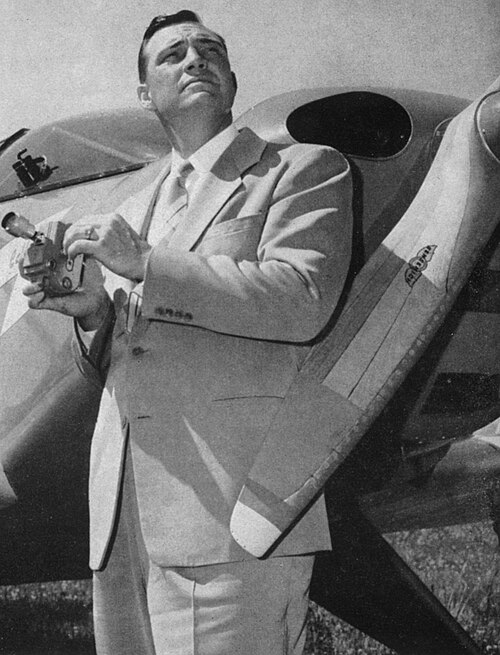
That afternoon, Bequette went to Arnold’s hotel to interview him. The reporter spent the rest of the day writing a longer article, which was phoned into the AP. “Like the tail of a Chinese kite,” Arnold reportedly said about the objects’ weaving motions. The reflection of the sun off the objects was so bright, it blindedhim like an arc light. Regarding the mystery crafts, they were “flat like a pie pan and somewhat bat-shaped.” Arnold summed up the whole experience: “It seems impossible—but there it is.”
On the morning of June 26, this longer article was picked up by newspapers across the country, many of which ran it on the front page. The Chicago Sun offered their own twist with a modified title: “Supersonic Flying Saucers Sighted by Idaho Pilot.” Though Arnold hadn’t described the objects as flying saucers, this soon-to- be- infamous term spread across the country like wildfire.
In the coming days and weeks, there were numerous reports of other sightings. The first was from a private pilot named Byron Savage, who claimed to see a saucer flying high above his yard in Oklahoma City. He offered support for Arnold.
“I know that boy up there really saw them.”
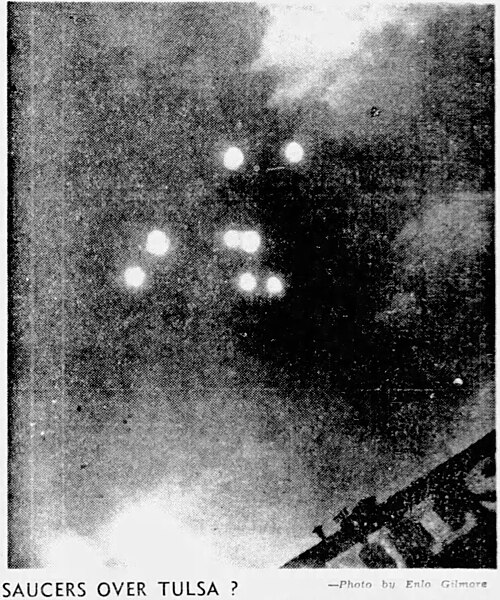
Next came a guy in Kansas City who saw nine noisy saucers leaving vapor trails. Then a prospector in Oregon claimed to see five or six saucers over the Cascade Mountains. An advertising man in Hollywood described six silver saucers heading toward Mount Wilson. A coast guard yeoman named Frank Ryman claimed a bright speck in a photograph he had taken was a saucer hovering over Seattle.
When one Chicago man heard an object loudly bounce into his backyard, he naturally assumed a saucer had crashed. A closer inspection revealed a circular sawhad fallen from a nearby construction site. The man shared the story with reporters but wisely changed his mind about calling the FBI.
The sightings quickly spanned the country, with reports of saucers in almost forty states, including New York. This caused some consternation from the skeptical New York Times, with one journalist noting that saucer colors now ranged farbeyond silver to white, orange, and even technicolor. From Canada to Mexico to Australia and South Africa, saucers were being spotted around the world.
By now, Kenneth Arnold, the instigator of the affair, was back home in Boise, watching dumbfounded as everything unfolded. The outside of his house was besieged by reporters. Letters, telegrams, and phone calls poured in. On July 3, nine days after his sighting, an overwhelmed Arnold was desperate for an escape.
He and a friend, Colonel Paul Wieland, flew out to the isolated tip of the Olympic Peninsula for a holiday fishing trip. Arnold brought along a newly purchased movie camera, hoping to capture proof of what he had seen. Wieland, a career military man, had recently returned from Germany, where he had participated in the Nuremberg trials against Nazi war criminals. Wieland told his friend something he knew firsthand: A wary eye could spot artillery shells whizzing through the air at 700 miles per hour. At the very least, Arnold’s claim was visually possible.
On Independence Day, United Airlines Flight 105 sat on the tarmac before a scheduled flight from Boise to Pendleton. Before Captain Emil Smith boarded the DC-3, someone asked if he’d ever seen flying saucers.
“I’ll believe them when I see them,” joked Smith.
Only eight minutes into the flight, the copilot pointed out a loose formation of five flat and circular crafts maybe thirty miles out. Smith and the copilot called in the stewardess to ask what she saw.
“Why, there’s a formation of those flying discs!”
The objects were silhouetted against a cloudless sky that was glowing with evening light. They appeared to be smooth on the bottom and rough on top. Smithradioed the control tower in Ontario, Oregon. The operators said they saw nothing. From the cockpit of Flight 105, the crew watched the five objects disappear to the northwest, and then four more followed after them.
A day later, Arnold and Wieland wrapped up their fishing trip and flew east. They stopped in Seattle to refuel on their way back to Idaho. Local newspapers were filled with stories about flying saucers, including the Flight 105 account and Yeoman Ryman’s alleged photograph. Hoping to see an enlargement of Ryman’s snapshot, Arnold went downtown to the office of International News Services. By chance, Captain Smith was there to provide details about his experience. The two men hit it off over coffee and discussed their sightings. They parted as instant friends. Because the taller captain towered over Arnold, he would come to nickname him Big Smithy.
Back in Boise, Arnold became increasingly disturbed that the military was not taking the matter of flying saucers seriously. But a week later, an official with the U.S. Army Air Forces invited Arnold to submit a report. He sent off a detailed letter. Despite the ensuing media circus, Arnold insisted that his initial sighting, among others, must be investigated.
A few days later, two members of military intelligence took off in an A-26 bomber from Hamilton Field in California. Their destination was Boise. During dinner with Arnold and his wife, Lieutenant Brown and Captain Davidson said they didn’t know what the flying saucers might be. But, like everyone, they were “practically bug-eyed” from watching the sky. After dinner, Arnold drove them all to the Boise airport to meet Big Smithy during his brief stopover between flights. Before flying back to California, the officers asked Arnold to keep them informed of anything unusual.
As if these events weren’t strange enough, the bizarre story was about to take another turn. By late July, Arnold had received several letters from Raymond Palmer, editor of Amazing Stories. This long-running pulp magazine was devoted to sensational tales, mostly science fiction, though occasionally stories were presented as factual. Palmer wanted to hire Arnold to investigate a reported saucer encounter in Tacoma. Two harbor patrolmen named Harold Dahl and Fred Crisman claimed to have fragments from one of the objects. After debating for a few days, Arnold agreed to the request in exchange for $200 in expense money.
During his early morning flight to Tacoma, Arnold witnessed another sighting. Over twenty brass-colored objects were flying over the Grande Ronde Valley toward his plane. They looked like ducks. But the terrific speeds and similar movements to the original nine objects convinced him these were not birds. The pilot-turned- investigator filmed the encounter. Unfortunately, the movie was a failure, only showing a few minuscule dots.
Arnold observed further oddities at the airport. Upon arrival, he was told hotel rooms in Tacoma were hard to come by. After calling around unsuccessfully, he decided on a lark to try the Winthrop, the most prominent hotel in the city.
“Yes, Mr. Arnold,” said the clerk. “We have a room and bath for you.”
Arnold asked several times how that was possible when he hadn’t made a reservation. Could there be two Kenneth Arnolds? he wondered. The clerk muttered something about the room and hung up. At the hotel, Arnold demanded to question this clerk, but he’d gone off duty. Strange, thought Arnold, as he went up to his room.
He began his investigation by searching the phone book. Upon finding an H.A. Dahl, he dialed. It was the right man who answered, but he seemed reluctant to talk. After some convincing, Dahl agreed to visit the hotel. Upon arrival, he resumed warning Arnold not to get mixed up with this flying saucer business.
When Arnold persisted, Dahl relented and told his story. He was patrolling the bay on a cloudy day with his teenage son and the boy’s dog along for the ride. As they approached Maury Island, six strange aircraft began circling overhead. Each was about a hundred feet wide and shaped like a donut. Dahl beached the boat to take photographs of the objects. There was a muffled explosion, and a saucer started spewing metallic materials. One type was thin and white. Another type was darker and heavier. Steam rose from the water where the debris fell. Many pieces landed on the beach. A scrap minorly injured the boy, said Dahl, while larger fragments sadly killed their dog.
After the saucers flew away, Dahl quickly collected some samples and went for help. His superior, Crisman, was skeptical about the whole thing. Then he motoredout to Maury Island. His tune changed after spotting another saucer and some twenty tons of fallen debris. The next morning, Dahl was at his home when a nondescript man in a black suit came to the door. The purpose was to issue a vague threat. If Dahl wanted to protect his family, he better not discuss what happened with anyone.
Arnold was speechless. The account seemed unbelievable, yet this man sounded sincere. Feeling vexed, Arnold called up Big Smithy in Seattle. The pilot was so intrigued, he canceled his flights and came down to help investigate. Yet the more they looked into it, the more dubious the story became. When Dahl shared the dark fragments he had collected, Arnold was unimpressed. They looked like lava rocks or slag. When an oddly enthusiastic Crisman showed up, he claimedto have lost Dahl’s photographs. Plus, his white saucer fragments seemed to be nothing more than scrap aluminum.
The four men agreed to visit the scene of the explosion. However, shortly before their planned departure for Maury Island, the motorboat conveniently broke down. Strangest of all, a reporter from the Tacoma Times began repeatedly calling Arnold, claiming to have an anonymous informant sharing everything about their investigation.
Hoping to force the issue, Arnold suggested bringing in military intelligence. Crisman was all for it, but Dahl was uneasy and disappeared soon after Arnold made the call. Later that day, Lieutenant Brown and Captain Davidson flew north in a B-25 from Hamilton Field. After two and half hours listening to Crisman, the intelligence officers had heard enough. While Crisman did convince them to take a box of fragments back to headquarters, the officers left believing it was all a silly hoax. Despite being exhausted, Brown and Davidson decided to fly back that night.
They’d been running ragged over the past week, chasing saucer sightings. Around 1:30 a.m., they were piloting their B-25south at about 10,000 feet when the left engine caught fire. The flight engineer and a ride-along soldier parachuted to safety.
For some reason, Brown and Davidson never followed. They were still onboard as the plane crashed and exploded into flames. Soon afterward, that same reporter at the Tacoma Times wrote an article that would spawn countless conspiracy theories. According to an anonymous informant, the B-25 had been sabotaged to prevent analysis of the Maury Island saucer fragments.
Over the following months, the military would launch a long investigation into flying saucers. The surrounding craze would become a worldwide phenomenon that continues to this day. In the process, a new term would be coined: unidentified flying object or UFO.
Among those earliest UFO sightings came the most famous incident of all. It happened exactly two weeks after Kenneth Arnold’s alleged sighting in the skies above Mount Rainier. The date was July 8, 1947, near Roswell, New Mexico. Some unidentified wreckage was found by a rancher who reported it to the local army base. An official press release described the recovery of a flying disc. Perhaps this was thought to be a clever cover story, a way to conceal a Cold War test project by referencing events around the country. Decades later, it would be revealed that thebase was testing spy balloons designed to monitor Soviet atomic tests. But at the time, this offhand comment set off a cascade of media attention.
During a press conference, the U.S. Army would clarify it had recovered a simple weather balloon. But the damage was done. The ensuing conspiracy theories would quickly overshadow the incident that started it all. Kenneth Arnold’s sighting would soon be all but forgotten by the general public. In its place came sinister tales of captured extraterrestrials and alien autopsies.
The subsequent U.S. Air Force investigations would eventually be named Project Blue Book. Most cases of UFO sightings were easily dismissed. Some were hoaxes, like the Maury Island incident concocted by Harold Dahl and Fred Lee Crisman. Their story would come to be considered the first UFO incident involving so-called “men in black.” These ominous government agents would go on to illustrious fictional careers, as they covered up evidence of extraterrestrials in movies and hit shows like The X Files.
In fact, Crisman would become a repeat character in other major conspiracy theories in American history. In 1963, after President John F. Kennedy was assassinated in Dallas, Fred Crisman would be implicated in his death. The JFK assassination conspiracy investigator Jim Garrison claimed the Tacoma hoaxster was one of the “three tramps” who were arrested near the book depository, thebuilding from where assassin Lee Harvey Oswald shot the president. Though the suspects were later released, some skeptics speculated the three were deep-cover intelligence operatives.
Regarding Project Blue Book, the vast majority of UFO sightings—about 12,000—would be identified as known phenomena, including aircrafts, balloons, or astronomical features like stars or meteors. Though not all investigators agreed, the official determination for Arnold’s sighting was a mirage. Later observers would suggest large birds, possibly white pelicans. They fly in formation like geese but have an angular shape and crescent profile when soaring. Regardless, Kenneth Arnold would spend the rest of his life defending his sighting and trying to obtain proof of what he’d seen.
Another Project Blue Book classification did exist for those flying saucer—or UFO—sightings that could not be readily explained. By the time the investigation concluded in 1969, about 700 cases would fall into this category, including the sighting by Big Smithy and his crew on Flight 105: unidentified.