
William Seward's 1868 attempt to acquire the Danish territory was the country's first, but not the last.
-
Spring 2026
9 months ago By Edwin S. Grosvenor Volume71Issue2
Editor's Note: Mark Kawar is a first-time author whose recent book, America, but Bigger: Near-Annexations, from Greenland to the Galapagos, explores the history of the United States' territorial ambitions, both realized and unrealized. Here, he recounts the very first attempt by American officials to acquire Greenland, a goal the country would pursue again and again over the following years, including most recently during the presidency of Donald Trump.
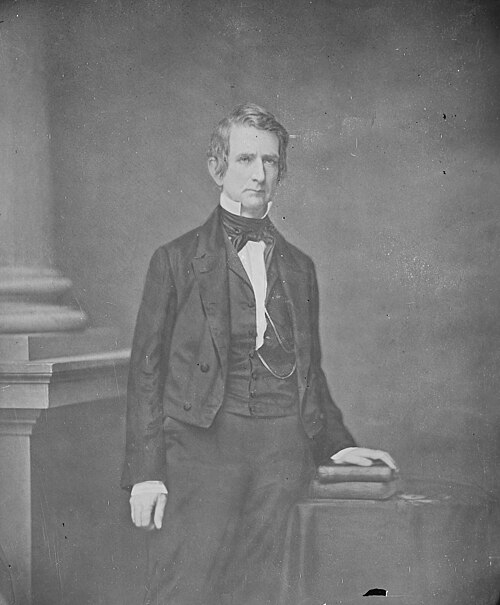
In the 1860s, Secretary of State William Seward had an expansive vision of America’s borders. Over his career, he was involved in multiple annexation attempts, including introducing the Guano Islands Act and plotting to take British Columbia after the Civil War. As a senator in 1853, he predicted that the nation’s borders “shall be extended so that it shall greet the sun when he touches the tropic, and when he sends his glancing rays toward the polar circle, and shall include even distant islands in either ocean.” One of the places in “the polar circle” that Seward had his eye on was Russian Alaska, which he bought in 1867. Two others were Greenland and Iceland.
The rumpled, cigar-chomping Seward was a New Yorker, a former Whig, and an opponent of slavery. He had been considered the favorite for the Republican presidential nomination in 1860 until the meteoric rise of Abraham Lincoln overtook him. Unlike his Democratic Party contemporaries, Seward’s vision of expansionism didn’t involve American sugar plantations in the Caribbean worked by enslaved people. Seward, like many Northerners of his era, sought to make the United States the world’s leading trading nation. He imagined a series of territorial acquisitions, especially ports, to support American commerce. And while Seward wanted America to expand over as much of the world as possible, unlike many of his contemporaries, he sought annexation chiefly through peaceful means.
In 1865, with the end of the Civil War in sight, Seward was no longer worried that territorial expansion would lead to the spread of slavery. So he pursued new lands more vigorously. In 1867, just as he was wrapping up the purchase of Alaska from Russia, he began discussing with Denmark the possibility of buying the Danish West Indies. The Danes had settled the sugar-growing islands as a commercial investment, and they were open to selling the islands for a profit.
While Seward and Denmark were negotiating the purchase, one of Seward’s political allies, Robert Walker of Mississippi, suggested expanding the deal. America should buy not only the Caribbean islands but Denmark’s northern possessions of Greenland and Iceland as well, Walker proposed. Like Seward, Walker was an ambitious expansionist. A leader of the Texas annexation movement, he also advocated taking all of Mexico, buying Cuba, and annexing the Yucatán when he was Democrat James Polk’s Treasury secretary. After the Civil War, his ambitions turned northward. He supported Seward’s campaign to buy Alaska and advocated for the annexation of Nova Scotia. Walker’s idea of buying Greenland and Iceland intrigued Seward, and he commissioned a State Department report about the islands’ potential as part of the U.S.
Medieval Scandinavian travelers had settled in Greenland 1,000 years ago, joining Native Greenlanders who had arrived thousands of years earlier. The European colonies died out, leaving the island in the hands of the Inuit again until European explorers returned in the 16th century and settlers arrived in 1721. In the 18th century, European and American ships hunted whales around Greenland and traded with the Inuit for furs and tusks. So Americans had long been aware of Greenland’s economic potential. Denmark re-established its claim to Greenland in the late 1700s, but kept the island isolated.
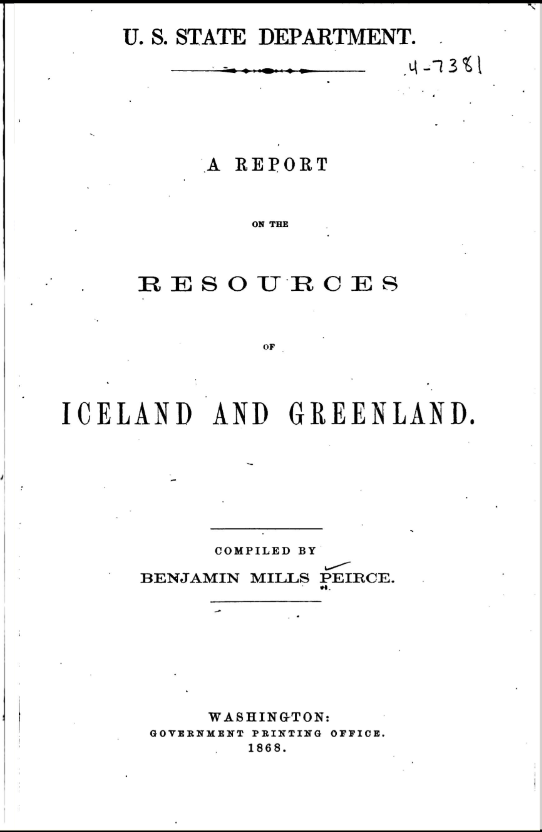
The task of writing Seward’s report fell to a young Harvard-educated mining engineer from Massachusetts, Benjamin Mills Peirce. Walker wrote the report’s introduction, in which he proposed that it would be “ready for use whenever the question [of annexation] might be considered hereafter by the government.” It was printed by the Government Printing Office in 1868, and copies were distributed to members of Congress and other influential people around Washington.
Walker had many optimistic predictions for the future of the two islands should they join the nation. Of Greenland: “not a hundredth part of this vast region has been explored.” Of Iceland: “Only about one-tenth part of its surface (entirely on the coast) is now inhabited.” He estimated Iceland’s population at 70,000 and predicted that it could rise to one million “when fully developed.” Such development would include connecting the two islands with American markets for their minerals, whales, and fish, and building an American telegraph line to Europe passing through Canada, Greenland, and Iceland.
Even more than the two islands’ resources, Walker looked forward to annexation for its geopolitical benefits. America acquiring Greenland, especially, would prevent it from falling into British hands, and its ports would give the U.S. an advantage in any future war with the British. After purchasing Alaska from Russia in 1867, purchasing Greenland would essentially surround Canada, convincing it “peacefully and cheerfully, to become a part of the American Union,” wrote Walker. Most of northern Greenland had not yet been mapped, and the report believed it was much larger than it actually was, stretching over northern Canada. Before the Oregon Country settlement and the Mexican-American War in the 1840s, some in the U.S. had been worried that Britain and Mexico could surround their young nation. Now, Walker, Seward, and their expansionist allies wanted to be the ones surrounding Canada.
Peirce’s report does not mention Denmark’s opinions, though it notes that Icelanders have an “intense patriotism.” The fact that these two islands were under the sovereignty of a foreign country that had not offered to sell them wasn’t a significant consideration. Peirce compiled his facts for the report through library research, rather than traveling to either island or conducting interviews with Greenlanders, Icelanders, or Danes. If Iceland remains under Danish control, it “can never hold an important position among nations,” Peirce wrote. “If, however, a more liberal system should be adopted … the world would be surprised at the rapid advance of this little northern island.” Iceland “has been greatly neglected by Denmark. The Icelanders complain of this, and look forward with hope to association with the United States,” wrote Walker in the introduction. Walker does not explain his basis for this claim of pro-annexation sentiment in Iceland.
Still, Walker saw Greenland as the more likely acquisition target because of its smaller population. Greenland is the world’s largest island, but in the 19th century, it had only about 10,000 residents. Therefore, it fits into the historical pattern of America’s efforts to acquire as much land as possible with as few people as possible. “[W]e should purchase Iceland and Greenland, but especially the latter,” Walker wrote.
Denmark had reached an agreement with Seward in 1867 to sell two of its three West Indies islands (St. Thomas and St. John, but not St. Croix) to the U.S. for $7.5 million (about $160 million in 2024). The voting residents of the islands (adult male property owners) approved the sale in a referendum. But the U.S. Senate declined to ratify the purchase. After the Alaska purchase, senators wanted Seward to rein in his land acquisitions. A hurricane and an earthquake hit the islands within weeks of each other in 1867, further fueling opposition. It would be another 50 years before the U.S. would purchase all three islands in 1917.
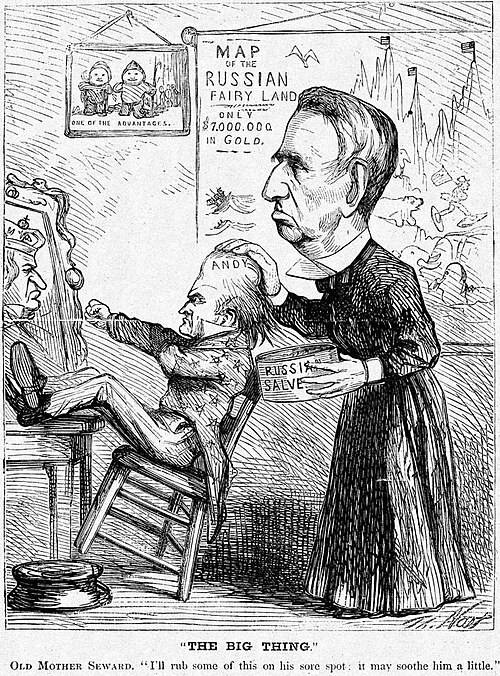
By 1868, Washington had ground to a gridlocked stop. President Andrew Johnson was feuding with Congressional Republicans, who eventually impeached him and nearly forced him from office. Congress was in no mood to let Johnson or Seward have a foreign policy win. Representative C.C. Washburn of Wisconsin obtained a copy of Walker’s Greenland and Iceland report before it had been distributed and drew laughter in Congress when he mocked Seward by asking, “But are we to stop with the purchase of Alaska and St. Thomas? No, sir. I believe a treaty is now being negotiated with Denmark for the purchase of Greenland and Iceland.” Representative Benjamin Butler of Massachusetts derisively referred to “one insane enough to buy the earthquakes in St. Thomas and icefields in Greenland.” Newspapers took a skeptical—often mocking—tone toward the news of another frigid purchase so soon after Seward negotiated to buy Alaska. The Courant of Hartford, Connecticut, wrote that “Mr. Seward will buy up the whole hemisphere from the glaciers of Greenland to the volcanoes of Terra del Fuego, if he only lives long enough and the credit of the nation holds out.” The Intelligencer of Wheeling, West Virginia, ran the front-page headline “More Icebergs!!”
Discussion of the proposed purchase was short-lived, especially after the purchase of Denmark’s Caribbean islands fell through. Though there were rumors that the State Department hid the report after its chilly reception, the National Archives denied this. It simply faded from public attention. Seward conceded that “the desire for the acquisition of foreign territory has sensibly abated,” and the American people “value dollars more, and dominion less.” He never made a formal purchase offer to Denmark for Greenland or Iceland.
In addition to the two islands, other territories that Seward considered acquiring included Canada, Cuba, the Dominican Republic, Hawaii, the Isthmus of Panama, parts of Mexico, and the Danish West Indies. Several of these places would eventually come into America’s fold, but not under his watch. One of America’s most ambitious expansionists had to be content with Alaska and some guano islands.