
A fitting tribute to James Wilson, one of the Constitution's most democratic authors.
-
Fall 2026
4 months ago By Edwin S. Grosvenor Volume71Issue4
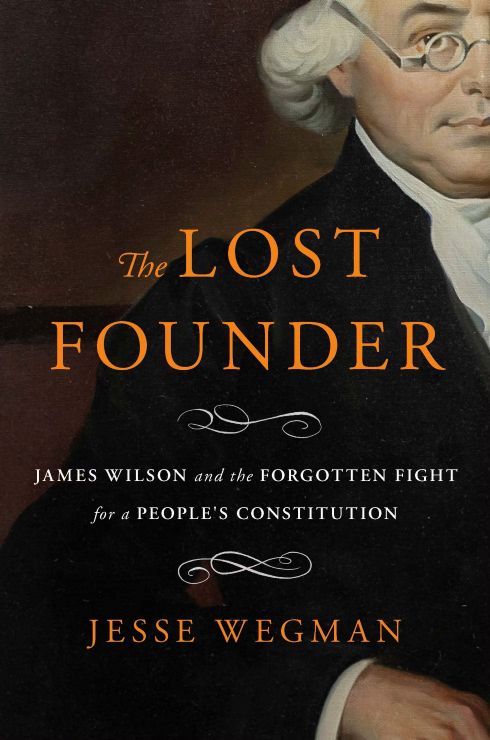
A small, but growing, coterie of constitutional scholars has been asking how it is that one of the framers most responsible for both the broad shape of the Constitution and the document’s small details — some petty, some consequential — is not better remembered?
“If you have not heard of James Wilson,” don’t chide yourself — “most people have not,” writes Jesse Wegman in his readable and revealing new biography of Wilson, The Lost Founder. A former writer on politics and law for the New York Times, Wegman champions Wilson as the most democratic of the Constitution’s authors. Scholars of the Constitution have noted that the ringing endorsement of democracy that is the opening phrase of the Constitution’s Preamble — “We the People” — was Wilson’s.
Wegman notes that Wilson was one of only six delegates to sign both the Declaration of Independence and the Constitution. When the Federalists wanted to persuade voters to ratify the new constitution to replace the foundering Articles of Confederation, it wasn’t Hamilton, Madison, or Jay they turned to first. It was Wilson who launched the great debate over ratification, addressing a crowd at Philadelphia’s State House Yard.
“The great irony of Wilson’s modern-day anonymity is that among his peers there was no question about his prominence,” Wegman writes. “To those who attended the Constitutional Convention with him he was without equal.”
In an 1897 article in Political Science Quarterly an eminent nineteenth-century historian of the Constitution, Andrew C. McLaughlin, wrote of “James Wilson in the Philadelphia Convention” that “as a framer of the constitution” Wilson “seems not to have received [his] just recognition.” Even those who “testify to his ability and influence” fail to “show with some definiteness what were his ideas on the more important problems that presented themselves in the organization of the new government.”
Wegman sets out to remedy that error. For example, he writes that Wilson was one of just five delegates named to the Committee on Detail, tasked in the summer of 1787 with determining the final text of the Constitution. It was “the entire convention in miniature,” Wegman writes. Wilson used his role on the committee to shoulder undecided questions in the directions he favored. Wegman does not exaggerate too much in saying that without James Wilson, “American government as we know it today would not exist.”
Which is true, as far as it goes. But the manias that would later drive him to ruin — the quest for more land, more money, more land, and even more money — significantly diminished his achievements. Though Washington named him one of the first associate justices of the Supreme Court, Wilson failed to pen much in the way of significant legal opinions. But some of the legal concepts he championed could have been (and were) seen as bolstering his own commercial interests.
Born into a family of hardscrabble Scottish farmers, James Wilson won a scholarship that made it possible for him to study philosophy, classics, and politics. As a young man Wilson sailed for America. He became a student of the preeminent Pennsylvania attorney, John Dickinson. It wasn’t long before Wilson would put out his own shingle, eventually charging steep fees.
Wilson was willing to represent unpopular clients, especially if they were able to pay. In the aftermath of the Revolutionary War, many Pennsylvania Loyalists who had found ways to help their British friends were accused of treason. Wilson took their cases and later explained that “when the accused have not been allowed” capable counsel, prosecutions become “dreadful engines of tyranny.” His billables may have been steep, but Wegman points out that Wilson won most of his cases, saving his Tory clients from the gallows.
Much of his earnings went into the purchase of land. But there is no way that lawyers’ fees — even those charged by the most prominent and powerful of attorneys — could pay for all the land that Wilson craved. And so he used the real estate he had acquired to leverage the acquisition of more land.
Driven by a lust for land, and a willingness to buy all he could on credit, Wilson made himself one of richest men in America — and one of the most exposed to fluctuations in the markets.
A string of financial panics in the mid to late 1790s ruined Wilson. Among his many dubious dealings, Wilson had been involved in one of the first great political scandals of the age, the “Yazoo land fraud.” The deal — a sort of Teapot Dome for the early days of the Republic — involved the extensive bribery of Georgia politicians.
Wilson’s contemporaries were embarrassed by his extravagance, such as his showy spending on the young woman — Boston’s Hannah Gray — he had married after a whirlwind 10-day epistolary romance. (Wilson’s first wife, Rachel, had died in 1786.) The charivarists about town mocked him for riding in a fancy carriage with four horses all moon-faced and starry-eyed.
But one can’t help but feel that Wilson was more sinned against than sinning. Come the summer of 1798, a malaria-stricken Wilson was hiding out in a back room of a swampy North Carolina tavern named after its owner, John Horniblow. There, Wilson hoped to evade various sheriffs who were seeking to throw him in jail (where the debtors who couldn’t meet their obligations went). A measure of how low Wilson had fallen: His devoted young bride was reduced to “selling her needlework to help pay the mountain of bills.”
His old friends and colleagues in the land business weren’t much help. Thomas Blount, a North Carolina politician and speculator, did his best to undermine Wilson’s efforts to get back on his feet. Wilson, Blount wrote to his brother, “has no real estate anywhere that is not encumbered with at least one mortgage, & if you rely on his honor, or trust him in any thing, he will certainly deceive you.” If that weren’t harsh enough, Blount was blunt: “Let him go to gaol.”
In a letter to Joseph Thomas, the Philadelphia lawyer who managed his Pennsylvania affairs, Wilson whinged that the men he had chosen to do business with over the years were now having him hunted “like a wild beast.” They had pursued him “with an avidity cruel treacherous and insatiable.” Not that he was going to get much help from Thomas, Wegman notes. In a twist worthy of Waugh, “Joseph Thomas had left his pregnant wife and run off with more than sixty thousand dollars of his clients’ funds, including the last of Wilson’s money.”
Efforts have been made over the years to rehabilitate Wilson and his legacy. But it is hard to defend a man who is so easily dismissed as a “corruptualist and bribe-giver, the leader of the ‘land sharks’ of 1795.”
It doesn’t help when those trying to restore his reputation are hasty and prone to error. Jesse Wegman shakes his head at the 1906 reinterment that moved Wilson’s remains from the little North Carolina cemetery where he had originally been buried. Wilson’s remains were placed under a “massive headstone” at Philadelphia’s Christ Church. Chiseled into the stone is Wilson’s name. The tombstone also states the date of Wilson’s death. That date, Wegman points out, is erroneous — off by a week. Which makes it somehow par for the course of Wilson’s grand yet off-kilter life.