
Some writers ignore a mountain of evidence that is contrary to their theories about the telephone's development.
-
Fall 2026
4 months ago By Edwin S. Grosvenor Volume71Issue4
Editor's Note: Edwin S. Grosvenor is the Editor-in-Chief of American Heritage and author of Alexander Graham Bell: The Life and Times of the Inventor of the Telephone and numerous articles about Bell. He has been interviewed about the telephone by CBS Sunday Morning, Discovery, PBS, NPR, CBC, AP Radio, and other media, and given talks at the Smithsonian, Boston Museum of Science, Museum of Natural History, and numerous other venues.
We like to think that facts matter – that evidence, testimony under oath, and written opinions of judges mean something. Sadly, for some writers it seems more important to advance a new theory to sell books than it is to do the hard work of digging for facts in the historical record.
The first intelligible sentence spoken over a telephone, “Mr. Watson, Come here, I want to see you,” is one of the most famous lines in history. But in a book out this month, The Telephone: A New History, author James Gleick claims that Alexander Graham Bell and Thomas Watson stole the design of the telephone they used to make that first call. The apparatus “was not theirs but rather Elisha Gray’s liquid transmitter, as described to Bell by a corrupt patent examiner,” declares Gleick.
Gleick, a New York Times science writer, has written a charming and comprehensive book about the history of the telephone and its impact on society. But the book is blighted by repetition of an old allegation made by ill-informed writers who don’t understand the principle that made Bell’s innovation different, and who haven’t dug into the mountain of testimony and evidence in the courtroom dramas surrounding history’s most litigated patent.
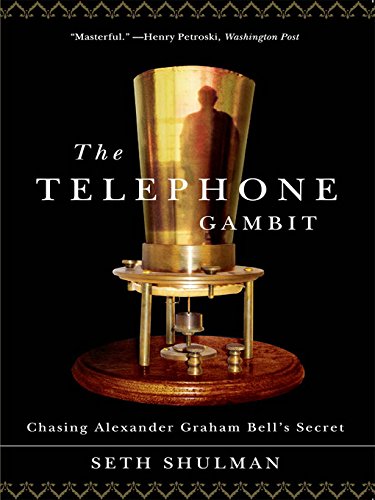
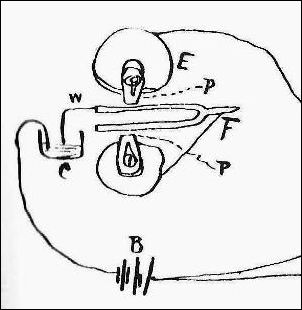
In claiming that Bell stole the idea of the telephone transmitter from Gray, Gleick echoes the central theory of a previous book, The Telephone Gambit. Its author, Seth Shulman believed he had found a “smoking gun” in a similarity between the drawing of the transmitter in Gray’s patent caveat filed on February 12, 1876, and a drawing in Bell’s notebook done a couple of weeks later, on March 10.
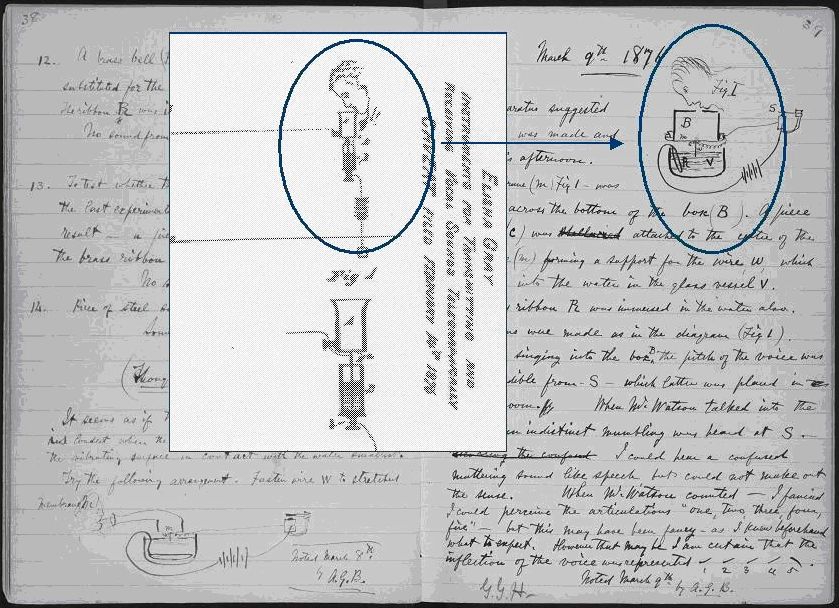
Shulman’s thesis, echoed by Gleick, is that Bell bribed the patent examiner, Zenas Wilbur, into showing him Gray’s patent caveat application in February, 1876, then rushed back to Boston to replicate the device he saw. “Bell plagiarized the successful design for a telephone from his rival Elisha Gray,” Shulman summed up.
The idea that Bell was able to construct such a transmitter only after he saw Gray’s patent caveat is laughable to anyone familiar with the inventor's four-year path to the telephone and the science behind it. In any case, Gray's design, which he abandoned, would never have worked.
The first experiments Bell did before he left Scotland in 1870 – six years before the telephone finally succeeded – involved a liquid transmitter of sorts. The young inventor was inspired by Hermann von Helmholtz's electrical transmission of tones through a wire with his sound synthesizer, and Bell replicated those seminal experiments. He connected a tuning fork, a battery, and an electromagnet (acting as a crude receiver) in an electrical circuit. The tip of the vibrating tuning fork was adjusted to barely touch the surface of a water-and-acid solution in a cup.
When the tuning fork made a tone and vibrated, its tip moved in and out of the liquid, increasing contact with the water and lowering the electrical resistance. At the end of the wire, a second tuning fork vibrated to create the same tone as the first one. Bell's experiments with his “tuning fork sounder” directly inspired his use of the liquid transmitter for the telephone years later.
Bell’s path to the telephone began even before that. As a boy he devised a “talking machine” using a human skull as a model, constructing rubber lips, epiglottis, and throat, and using a bellows for lungs. He was able to get the machine to cry “mama, mama” loud enough to worry his neighbors, who thought they heard a child in distress.
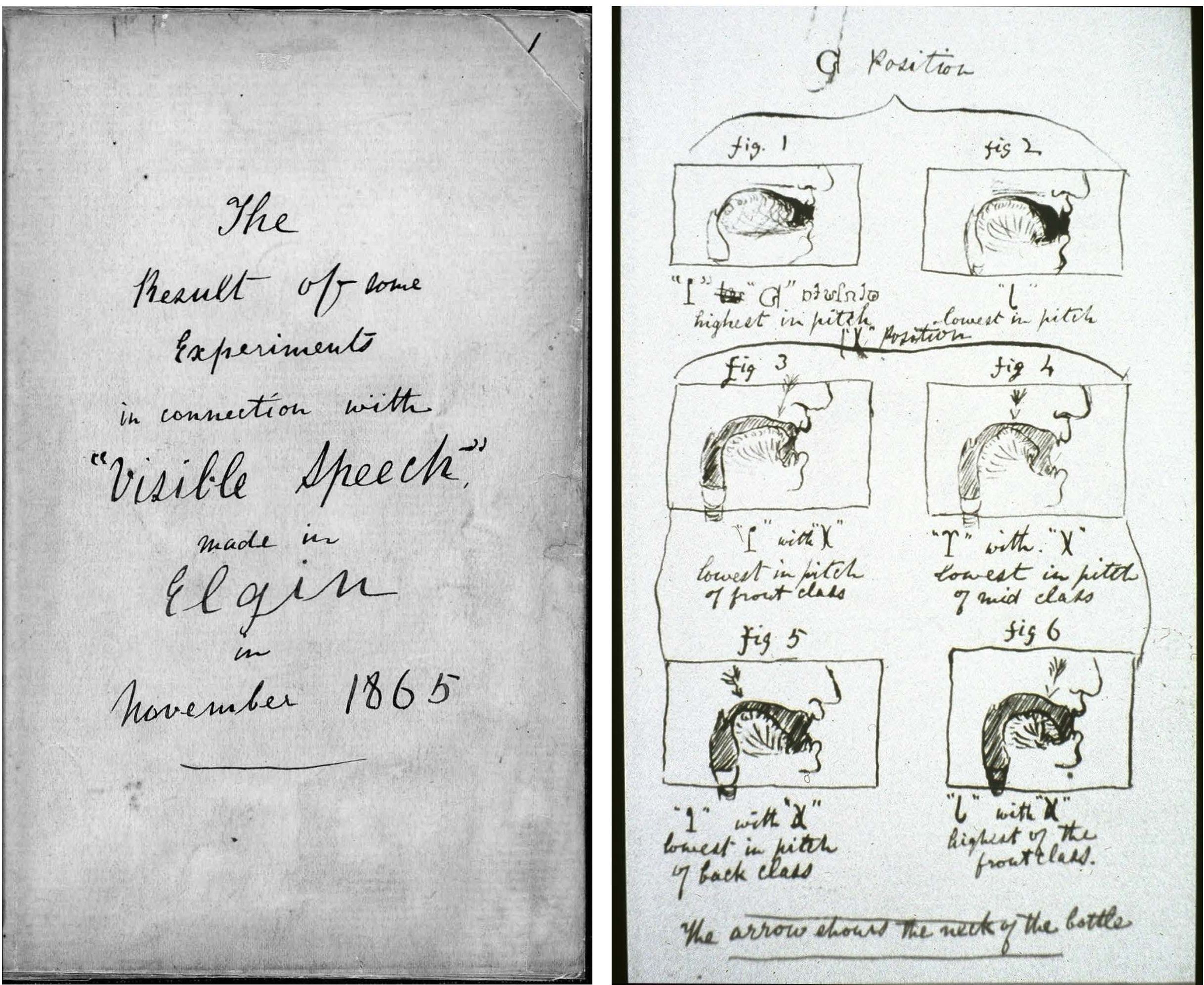
While writing a biography of Bell, I discovered the original handwritten copy of a report about experiments Aleck did in 1865 at the age of 18. To determine how the human mouth created vowel sounds, he stuck tuning forks of different frequencies down his throat and documented different acoustic frequencies of tones that make up vowels. Professional linguists at the time were impressed enough with his research that they elected him to membership in the Royal Philological Society, the world's leading society for the study of linguists and language.
Bell spent many years working with his father Melville Bell's Visible Speech system, which could transcribe with a symbolic system any language or sound a human could make with their mouth. He also trained to become a concert pianist and spent years helping deaf children to improve their speech. He was hired to train teachers of deaf children in his methods to help students with communication.
This early work gave Bell a deep understanding of acoustics and human physiology relating to voice and hearing that would later help him with the telephone – a background that electricians such as Elisha Gray, Philip Reis and Thomas Edison did not have.
By 1873, Bell had emigrated to Boston and earned a professorship at Boston University teaching elocution. He had also begun working intensely in competition with Elisha Gray to develop a device that could sent multiple telegraph messages at the same time through the same wire. Eight years before, an American engineer named Joseph Stearns had made a fortune by inventing a duplex that could sent two telegraph signals at once. He sold rights to use the patent to Western Union, doubling the capacity of its system, and became quite wealthy.
Among the liquids that Bell used in his various transmitters were mercury, salt water, acidulated water, glycerin and alcohol. During the later patent infringement trials, these transmitters were well documented with corroborating witnesses and written records.
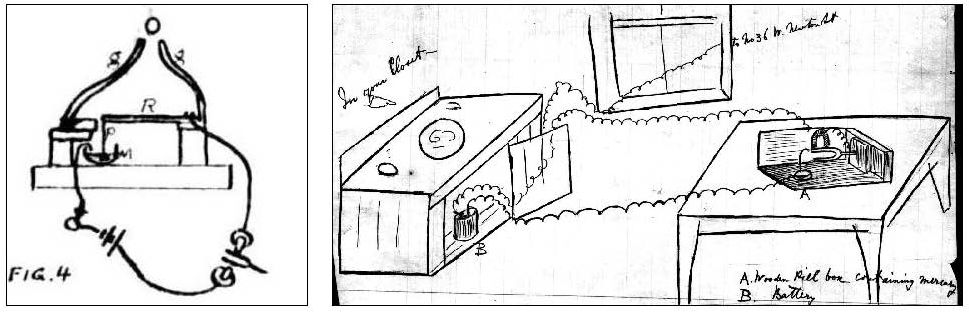
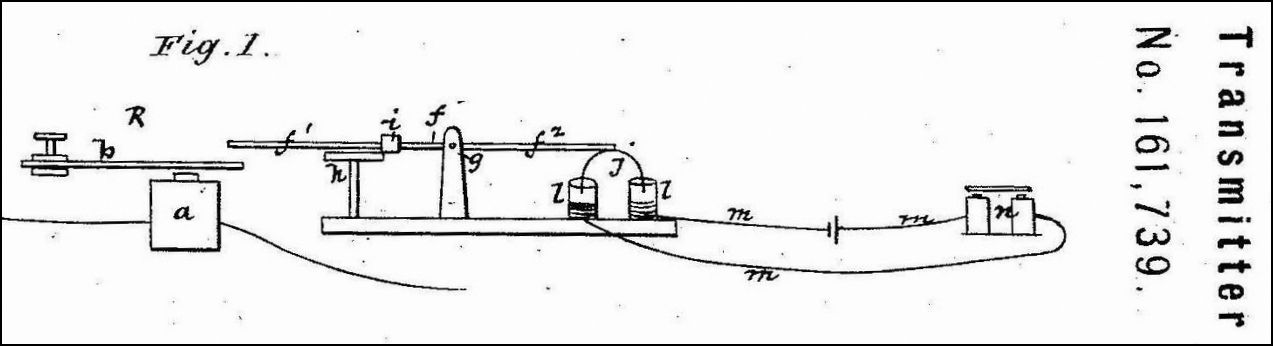
There is one irrefutable piece of evidence that Bell used liquid transmitters long before Gray wrote his caveat: the US Patent Office granted him a patent for a version of his multiple telegraph that used liquid transmitters (see Patent #161739). The diagram labeled “Figure 1” in the patent issue by the USPTO clearly shows two liquid cups (Z) with wires dipping into them.
In the patent, Bell described the instrument as having a platinum bow “the two ends of which extend down toward two mercury cups, l l... the local circuit m, in which the mercury-cups are located, is to be closed when the receiver vibrates. To this end the platinum points I, when the lever is at rest, are elevated far enough to be out of contact with the mercury; but when, by the action of the vibrating receiver the lever is tilted, the platinum points are depressed far enough to dip well into the mercury, thus completing the local circuit and exciting the electro-magnetic instrument in the circuit, which in this case is an ordinary Morse sounder.”
As his evidence of Bell’s alleged theft, Gleick cites only the last affidavit given by Zenas Wilber, the former patent examiner whose job it had been in 1876 to determine whether Bell or Gray deserved the telephone patent. This affidavit has long been discredited, but casual writers of telephone history continue to quote it.
The affidavit was apparently written for Wilber by the lawyers of the Pan-Electric Company, a gang of unscrupulous promoters who were trying to steal the telephone patent in 1886. They had apparently copied the Bell patents, submitted them as their own, and then tried to have the original Bell patent annulled. The scheme was memorably described as “one percent inspiration and 99 percent tracing paper,” by Bell biographer Robert Bruce.
By 1886 the telephone patent had been repeatedly upheld for nearly a decade in an estimated 600 lawsuits in front of many different judges. Bell never lost a case, including before the Supreme Court. So by that time the only way to break the patent was to have the government declare it had been obtained by fraud. The Pan-Electric promoters enlisted the help of none other than U.S. Attorney General Augustus Garland, whose office brought a Federal suit to annul the Bell patent using the questionable new Wilber affidavit.
By this time, former examiner Wilber was impoverished and ill. Bell had seen him passing on the streets and barely recognized him. Wilber agreed to sign an affidavit changing his recollection from his previous four affidavits in which he had said everything in the Patent Office was routine. Now he suddenly remembered that Mr. Bell had given him a $100 bill to show him Gray’s patent caveat. It was most likely a tall tale purchased from a desperate and unwell man. When Wilber was found dead in his bed shortly afterward, the Roanoke Beacon reported that, “his death evidently resulted from hard drinking.”
It seems odd that people who write about the telephone patent continue to quote Zenas Wilber's last affidavit – signed in questionable circumstances and never subjected to cross examination – as if it is fully credible.
The Pan-Electric scam was soon uncovered by Joseph Pulitzer’s New York World and other newspapers. They revealed that the Pan-Electric company had given Attorney General Garland ten percent of the company, and they were also generous with shares to influential senators and a congressman. Garland would have become fabulously rich if the theft had worked as planned.
The Pan-Electric matter blossomed into the biggest scandal of the administration of Grover Cleveland, who lost the subsequent Presidential election. Newspapers across the country reported the twists and turns of the investigation into Pan-Electric by a Congressional committee whose report ran to 1,439 pages.
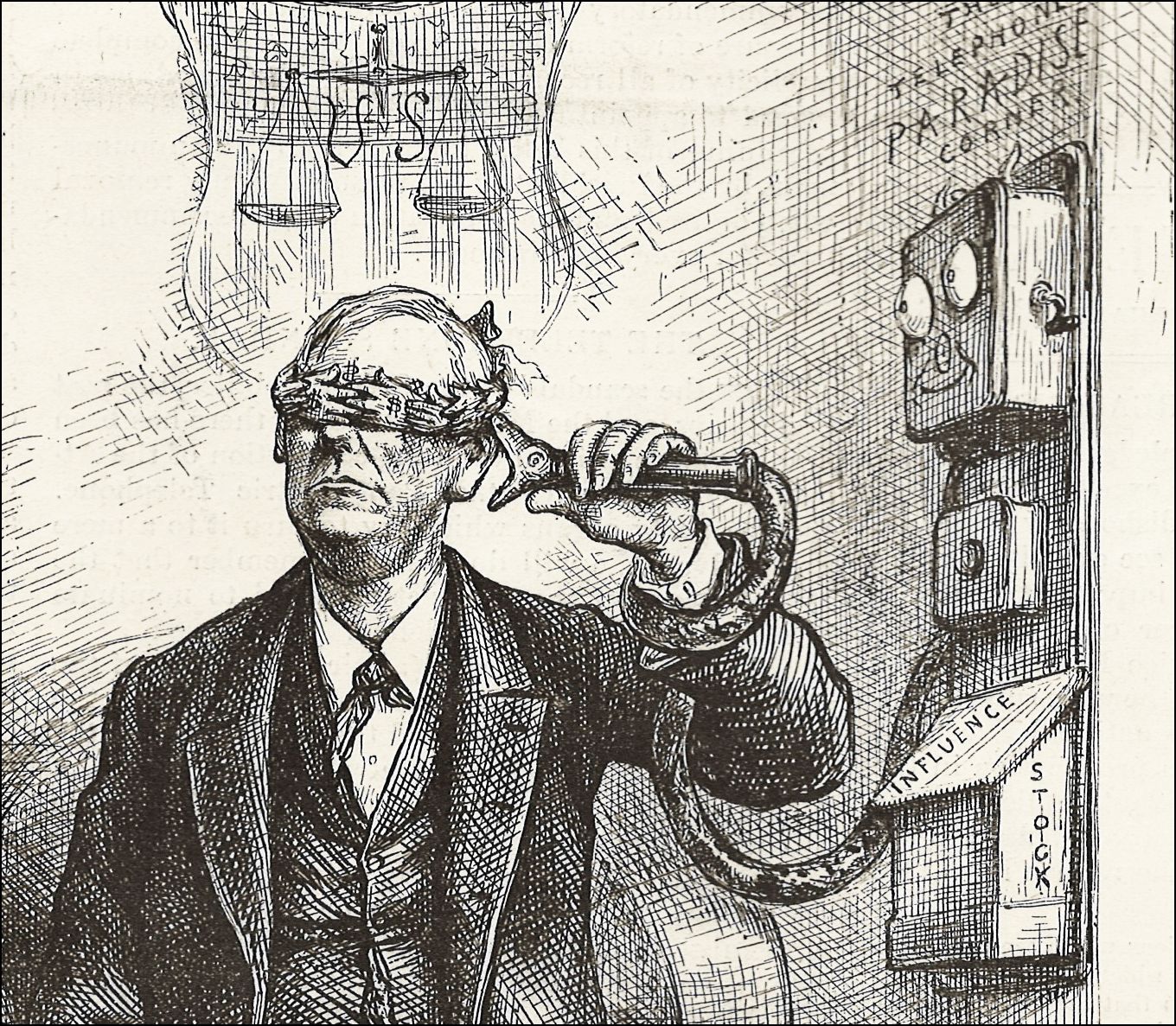
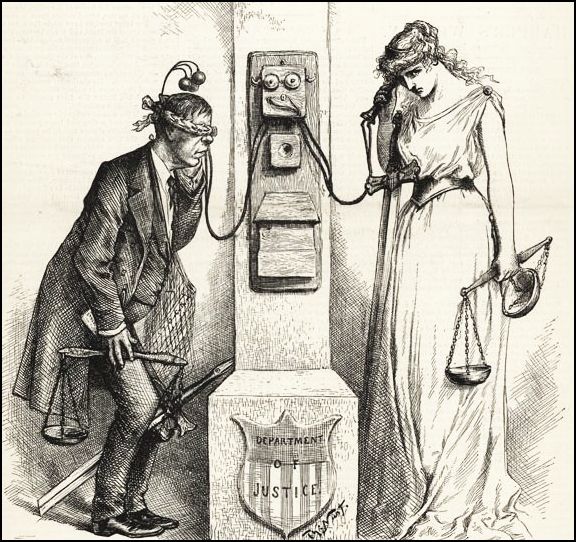
The media had a field day mocking the co-conspirators in the scandal. Almost every issue of Harpers Weekly had a cartoon by Thomas Nast skewering them. When Augustus Garland claimed to have been back in Arkansas and known nothing when the government case was filed, Nast drew cartoon in which a “garland” covers the attorney general’s eyes, blinding him to what is happening. The telephone is labeled “influence” and its cord is a snake that’s about to bite Garland.
In any case, the liquid transmitter was actually a dead-end. Bell was trying to devise a variable resistance transmitter to effect his theory of undulatory current, which he understood and the other claimants – Gray, Reis, Meucci and others – did not. That was what was novel in the telephone patent, not the liquid transmitter. Using liquid to vary the resistance was only one way of producing the desired effect.
A few weeks after constructing the liquid transmitter, Bell returned to a magneto transmitter and never used the liquid version again.
It is baffling that there is still a question about the basic facts of the telephone invention after 150 years, and a mountain of evidence in hundreds of court cases. Bell never lost a single one of those cases.
At least, examining how writers describe the Bell-Gray controversy serves as a useful lesson in historiography and how one assesses the credibility of information sources.