
Defiant colonists pulled down the gold-gilt statue of George III in Manhattan just as thousands of British troops were landing for the attack on New York.
-
November/December 2026
3 months ago By Edwin S. Grosvenor Volume71Issue5
Editor’s Note: Robert Parkinson is a professor at Binghamton University and author of four books including Tyrants and Rogues: Understanding the Declaration of Independence.
On August 16, 1770, the leaders of New York’s Colonial government gathered at Fort George, the fortification on the southern tip of Manhattan originally built by the Dutch a century and a half before. They were there to dedicate a statue of King George III on Bowling Green, the park adjoining the fort’s north grounds. To mark the occasion, at noon the “principal Gentlemen in the City, both Civil and Military” drank several toasts and fired off thirty-two pieces of cannon from the Battery.
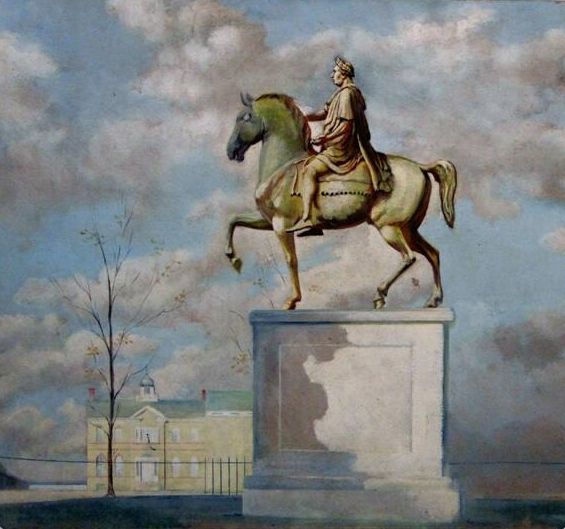
The statue of the king, wrapped in classical garb to resemble the Roman emperor Marcus Aurelius, faced Fort George and, beyond it, New York Harbor. From a height of fifteen feet, it kept vigil while the real king’s American subjects grew increasingly upset with how his administration was treating them.
Not long after the statue reached its fourth anniversary, late in the summer of 1774, John Adams paid it a visit. He was there as part of the Massachusetts delegation traveling to the First Continental Congress in Philadelphia, a development that did not bode well for the future of the British Empire in America. Adams remarked on the beauty of Bowling Green, “railed in with solid Iron, in the Center of which is a Statue of his Majesty on Horseback, very large, of solid Lead, gilted with Gold standing on a Pedastal of Marble very high.”
The golden king sat on his horse for nearly six years — until, on July 9, 1776, General Washington assembled his troops to listen to the announcement that the bonds of empire in the thirteen colonies had finally snapped. As soon as they finished hearing the Declaration of Independence, one group of excited soldiers decided to take out their feelings of betrayal over how King George had abandoned them.
They hurried down Broadway and surrounded their former monarch. Using ropes and bars, the soldiers labored for several minutes to pry George down off his pedestal, and the two-ton king and horse clattered to the ground. They hacked at George’s head, eventually severing it, then knocked off its nose and the laurels surrounding the monarch’s brow. The pedestal remained, but the headless king and horse ended up in a cart and were transported through the city.
The head was put on display in a tavern, while his body went to a foundry in Connecticut, where the lead would be stripped clean of its golden skin and melted down into 42,088 bullets. One patriot gleefully wrote to General Horatio Gates that for the rest of the year British redcoats would have “melted majesty fired at them.”
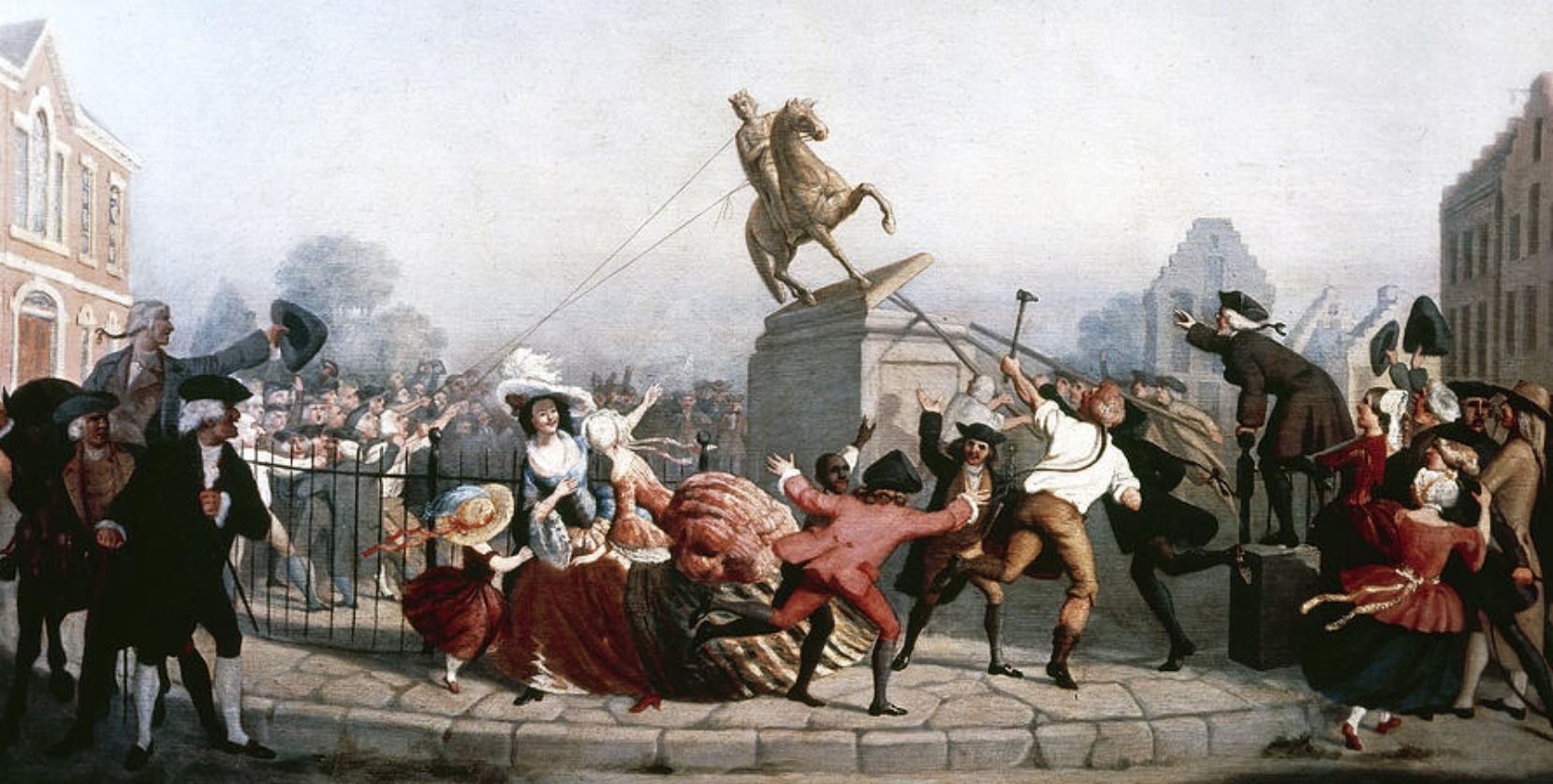
The pulling down of the king in New York City is a staple of histories of the American Revolution; no narrator of 1776 worth their salt can resist this episode as a means to show Americans’ enthusiasm for independence and their Declaration.
But often we miss the wartime context of the proceedings at Bowling Green. The city was already full of rowdy American soldiers, at the same time as the waters surrounding Manhattan were filling up with British warships. On Staten Island, five miles to the south of Bowling Green, the first elements of a massive British invasion force, supported by thousands of German mercenaries, pitched their tents during the early days of July. Over the next few weeks, Bowling Green would become the epicenter of the next phase of the already begun Revolutionary War.
We don’t often consider the Declaration of Independence as a document produced in the heat of a confusing, bloody, and desperate war. It seems to us, rather, just the opposite, a timeless text full of sacred phrases: “all men are created equal,” “life, liberty, and the pursuit of happiness,” “self-evident truths,” “certain inalienable rights.” They have moved people for centuries, stirring generations of revolutionaries all over the world.
Social reformers and radical politicians have embraced the timelessness of the Declaration and treated the document as a universal statement of human rights. African Americans since 1776 have seized upon the Declaration as proof that the founding of the United States has been about equality, and that Americans should dedicate themselves to fulfilling that revolutionary commitment. Abraham Lincoln counted himself among those who worshipped it for those sacred words in the preamble. Women’s rights activists at the 1848 Seneca Falls Convention rewrote it as a “Declaration of Rights and Sentiments,” which stated that “all men and women are created equal.”
But timelessness is not the sense in which the people who wrote and supported the Declaration understood it. The patriots who drafted, approved, and distributed it had no guarantee the future they aspired to would actually happen. For them, the words of the Declaration were born out of emergency, crisis, and fear. At the end of the document, the members of Congress pledged their “lives, fortunes, and sacred honor” to defend American independence. That pledge was not, however, a confident announcement, but a worried one, coming as it did in the middle of fighting a war that was increasingly terrifying as more and more British ships crowded into New York Harbor.

The Declaration was the Revolutionaries’ statement of purpose, a plea to the “candid world” for recognition and legitimacy, not only of the independent United States but of their cause as well. The Declaration’s intent was to get audiences at home and all over the world to believe that they were the securers of the best traditions of British liberty. It was King George, his advisors, and Parliament who were the disruptors. Patriot leaders needed colonial men and women to trust them enough to support the rebellion.
Thus, the patriots had to convey their reasons for rebellion clearly and forcefully. They needed to show everyone that they weren’t taking this step lightly. It was vital for the colonists to convey that there was a systemic plan, a design to destroy American liberty. The evidence had to be compelling and iron-clad.
Therefore, if we want to know what caused those soldiers to thunder down Broadway and surround the King’s statue, it is the Declaration’s twenty-seven grievances that we should pay more attention to, not the opening paragraphs. Investigating the grievances reveals the outer limits of what colonists were willing to tolerate, their dealbreakers.
We have lost touch with many of those issues, but they are not only essential to understand how America came to declare independence on July 4, 1776, but they are also quite relevant to our own time, 250 years later.