
Congress forbade living persons from appearing on paper currency in 1866, after an unpopular Treasury Department official put himself on the five-cent note.
-
Summer 2026
7 months ago By Edwin S. Grosvenor Volume71Issue3
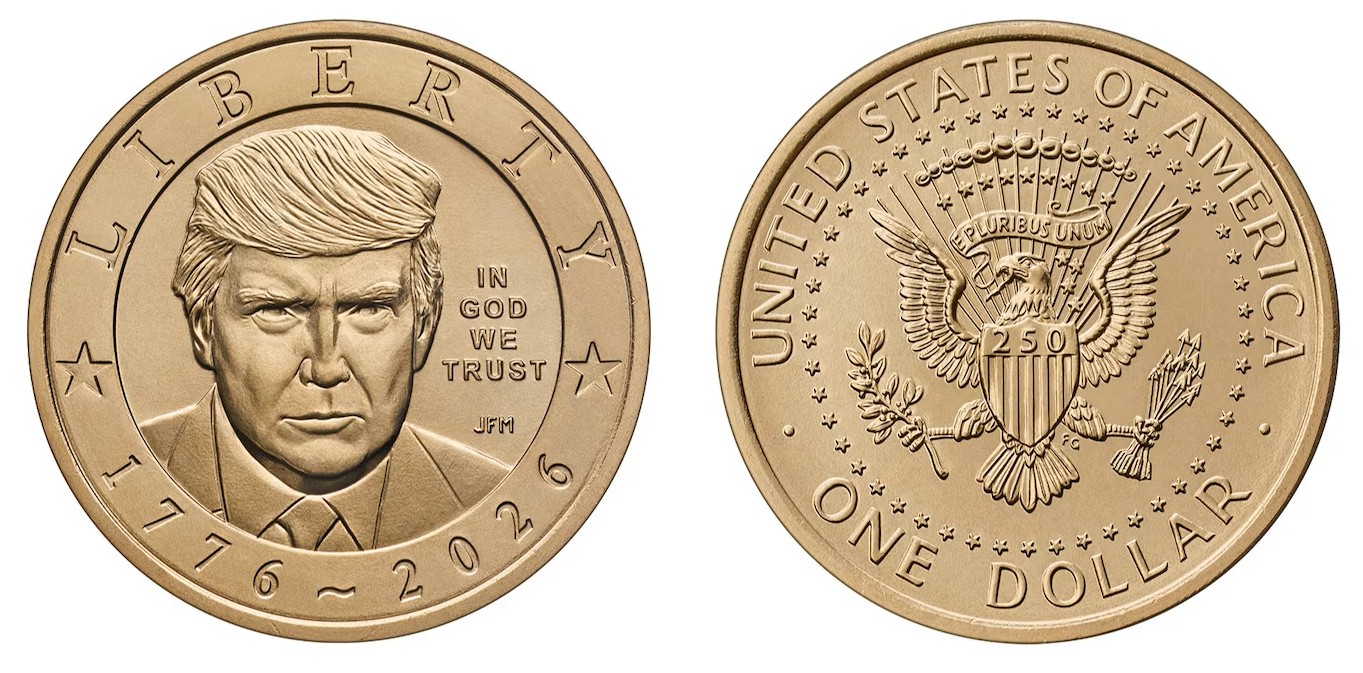
Treasury Secretary Scott Bessent recently unveiled designs for a commemorative $1 gold-colored coin with President Trump's face on the front, which he said the U.S. Mint will produce in honor of the country's 250th birthday. Two months earlier, Bessent had also announced the Mint was planning for a possible $250 note with the president's likeness. Would the issuance of these be legal? Are commemorative coins and bills different from standard ones? It turns out the controversies around images of living persons on currency date back millennia.
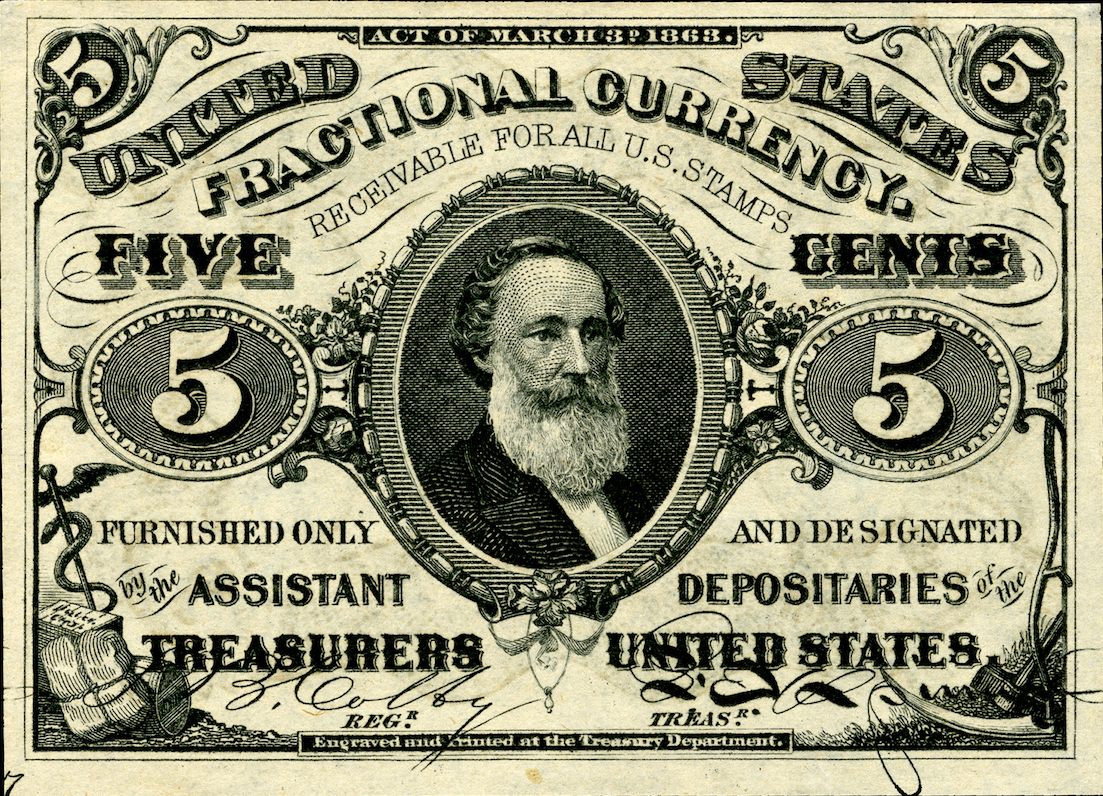
When Spencer M. Clark, head of the Treasury Department’s National Currency Bureau, placed his own likeness on paper money in February 1866, it ignited a firestorm. There had been tradition that the United States would not flatter any living person by putting their face on its money, but other individuals had recently appeared on currency with no outcry.
Clark may have expected the same treatment, but the conflagration over his face on money grew so intense that it led to something he never expected: a strict limitation on who can appear on America’s currency -- a restriction that endures to this day.
The question of whose face should be featured on legal tender in the U.S. arose in 1792, when Congress first authorized the minting of coins. The Senate wanted each coin to depict the president in office when the coin was minted, but the House refused to go along, feeling the idea smacked of monarchy. Rep. John Page of Virginia called it “a stamp of Royalty.”
Another objection Rep. Page had in 1792 was that while President George Washington was a worthy subject for coins, later chief executives might not measure up. The final statute omitted any reference to presidents. Instead, it required the front of each coin to bear “an impression emblematic of liberty” and the back to display an eagle or the coin’s denomination.
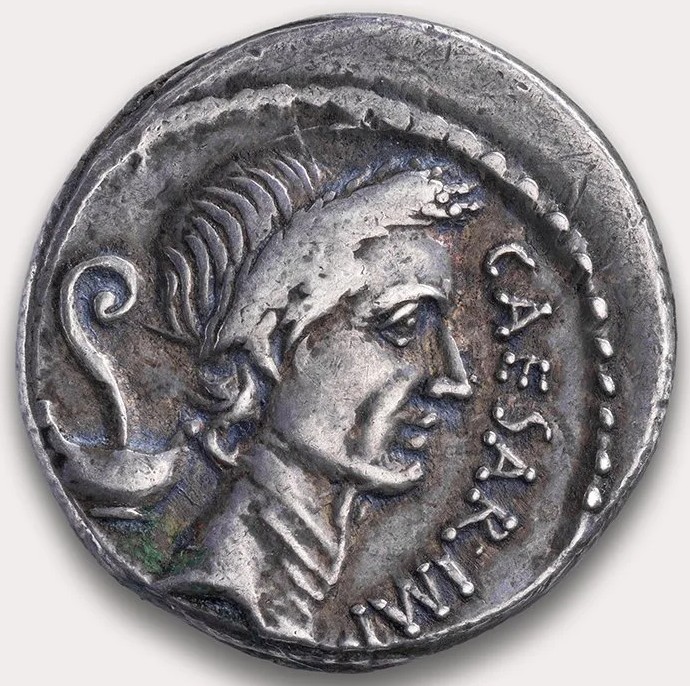
Emperors and kings had adorned coins with their own image ever since Julius Caesar had put himself on Roman denarii in 44 B.C. Britain's King George III had appeared on gold guineas and sovereigns, silver crowns, and numerous copper coins.
It was not until 1862 that paper money appeared in the United States, a development that was a matter of wartime necessity. Too few coins were in circulation because people were hoarding them for their precious metal content. The answer Congress came up with was to print paper money, commonly called greenbacks because of the color of the rear side of the bills.
A year later, Congress authorized fractional currency, and paper money was printed in denominations of three cents, five cents, 10 cents, 15 cents, 25 cents, and 50 cents. These notes were popularly called shinplasters after the medicinal dressings used to treat sore legs.
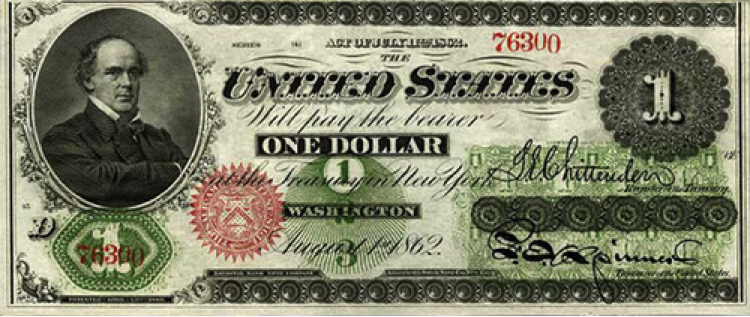
Unlike the situation with coins, there was no restriction on whose likeness could appear on paper money, and the first person shown on legal tender was Treasury Secretary Salmon P. Chase, who graced $1 bills in 1862. “(T)he engravers thought me rather good looking, I told them they might put me on the end of the one-dollar bills,” he joked.
Chase was soon joined by other officials, including President Abraham Lincoln, Secretary of War Edwin Stanton, and U.S. Treasurer Francis E. Spinner, all of whom were featured on fractional currency.
The appearance of these people on paper money caused no great stir, but the use of Spencer Clark’s likeness on five-cent fractional notes in early 1866 was a different matter because Clark, who ran the department that printed paper currency, had already become notorious and unpopular.
Two years earlier, in 1864, news reports had surfaced of Clark’s alleged sexual misconduct with young women working for the Treasury Department, supposedly turning the department into what one congressman called “a place for debauchery and drinking, the very recital of which is impossible without violating decency.”
For example, an 18-year-old woman who worked for the 54-year-old Clark swore he had asked her to wear men’s clothing to accompany him to what she called “a place of amusement in this city where females are not allowed, owing to the nature of the exhibitions or plays usually in vogue at that place of amusement.” As a further example, another female employee described overnight trysts in the master bedroom of Clark’s home while his wife was away.
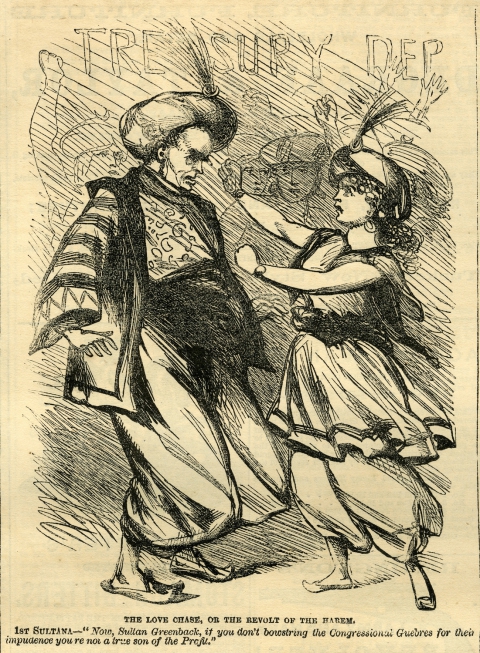
The year 1864 was an election year, and misbehavior by a high-ranking Treasury official could become an uncomfortable political liability for Lincoln, a Republican seeking reelection. On April 30, 1864, the Republican-controlled House appointed a nine-member committee chaired by a future president, Rep. James A. Garfield (R-Ohio), to investigate and put out the fire.
Two months later, the panel’s five-member Republican majority exonerated Clark, but the committee’s four Democratic members excoriated him, labeling the majority report a whitewash. The dissenters called Clark’s conduct “a mass of immorality and profligacy, the more atrocious as these women were employees of Clark, hired and paid for by him with the public money.” Nevertheless, Clark kept his job.
In February 1866, Clark, confident that the congressional inquiry had cleared his name, put himself on the five-cent fractional notes, and the move was greeted with hoots of derision, all the louder because the person he had replaced on the notes was George Washington. “The people prefer Washington to Clark,” the Richmond Whig noted, “and the newspapers throughout the country have given expression to that sentiment.”
Clark’s actions reeked of self-promotion, and the Lancaster (Pa.) Daily Intelligencer marveled at the “ambition…which would lead a man to seek renown by having his likeness on a five cent shinplaster.” People mailed the five-cent notes to Treasury Secretary Chase with “shame” written over Clark’s likeness.
On March 1, 1866, Rep. M. Russell Thayer (R-Pa.) decided to do something about the Clark situation. As the House considered a routine appropriations bill, Thayer proposed adding a provision to bar the “portrait or likeness of any living person” from paper money.
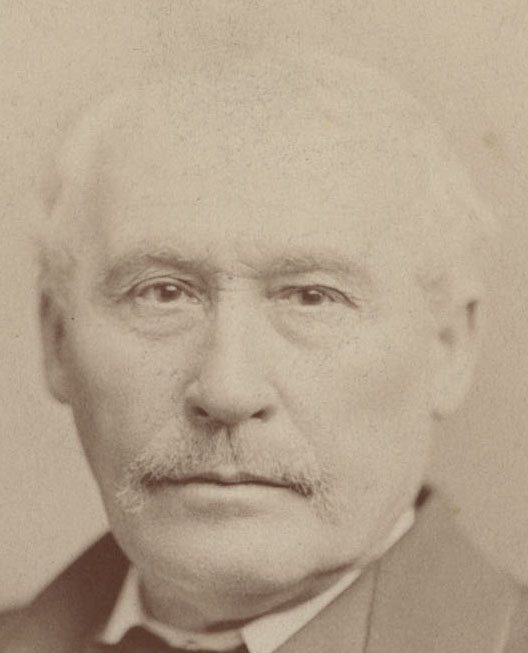
Thayer held up a five-cent note and rhetorically asked his colleagues whose portrait was on it. “(N)ot that of George Washington, who used to adorn it, but the likeness of the person who superintends the printing of these notes,” he said. This was, Thayer argued, “derogatory to the dignity and the self-respect of the nation.” Thayer thought the people featured on currency should be only those “associated with the historic glories of the country.”
Rep. James Brooks (D-N.Y.) agreed, contending that “(n)o man should be immortalized upon the public money of the country until the verdict of posterity has been pronounced upon his name.” Rep. Thaddeus Stevens (R-Pa.) wanted an exception for living presidents, but Thayer stood firm.
On April 7, 1866, the appropriations bill became law, including Thayer’s ban on any living person appearing on paper money. (Despite the uproar, Clark kept his job until 1868, when a financial scandal forced him to resign. He went to work for the U.S. Department of Agriculture until his death in 1890).
The seemingly dormant issue of living persons on paper money resurfaced in May 2026 when Treasury Secretary Scott Bessent announced that his agency is working on a $250 bill featuring President Donald Trump to coincide with the nation’s 250th birthday.
This plan, however, faces two hurdles. The successor to the 1866 statute provides that “(o)nly the portrait of a deceased individual may appear on United States currency,” and federal law contains no authorization for a $250 bill.
This plan has apparently been in the works for some time. On February 27, 2025, Rep. Joe Wilson (R-S.C.) introduced a bill to allow for $250 bills and to permit a living person to appear on paper money “if the individual is or has been the President of the United States.” New authorizing legislation, of course, would end questions of its legality.
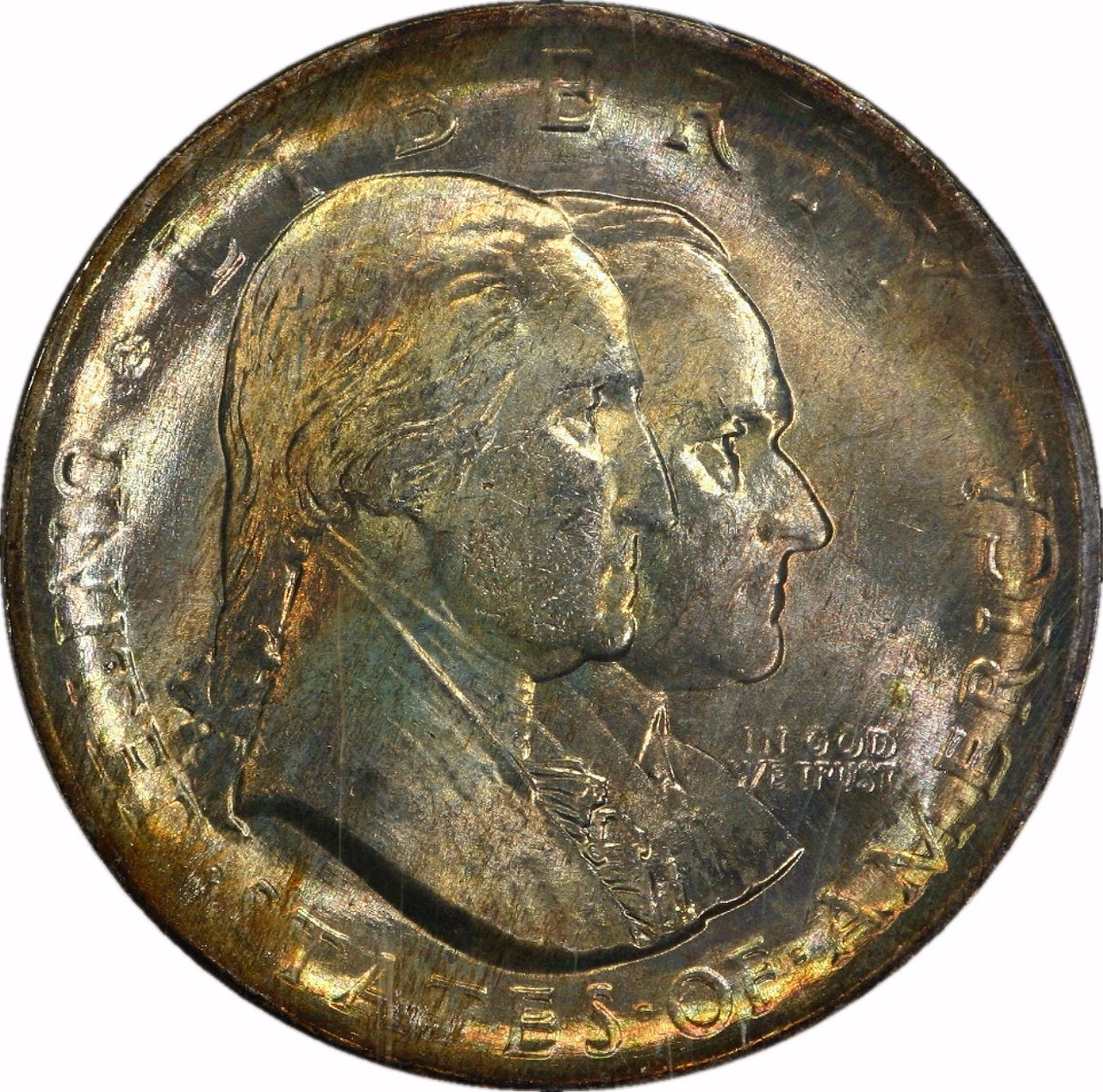
That bill remains stuck in committee, and its future is uncertain. If Wilson’s bill were to pass, Trump would be the first living president to appear on legal tender since Calvin Coolidge was featured on a limited-edition half-dollar minted in 1926 to commemorate the nation’s 150th anniversary.
The coin was meant to help finance the Sesquicentennial Exposition, but proved unpopular. Of the million pieces minted in Philadelphia, 859,408 were returned and melted.