
Some observers see ambiguity in the 22nd Amendment.
-
Fall 2026
4 months ago By Edwin S. Grosvenor Volume71Issue4
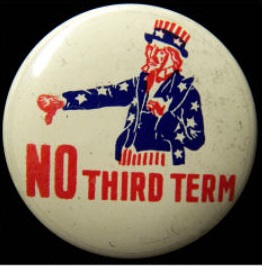
As the 80th Congress convened in January 1947, Republicans took control of the House and the Senate for the first time since 1933. In the intervening years, they had watched in dismay as President Franklin D. Roosevelt, a Democrat, had been elected to a third term and then a fourth. They vowed to prevent any future president from doing the same.
On January 3, 1947, Rep. Earl C. Michener (R-Mich.) introduced a constitutional amendment to bar a third term for any president who had already “served” two terms. By March 21, 1947, both houses had adopted the amendment, but only after it had been modified to specify that no person shall be “elected” president more than twice. This provision – the 22nd Amendment – went to the states for ratification and became law in 1951.
Republicans had rushed this amendment through Congress with what one senator later called an “indecent lack of debate,” and the measure had taken fewer than three months to move from introduction to adoption. In this hurried atmosphere, legislators showed little interest in the nuances in the changes made to the amendment’s wording.
Now, more than a half-century later, the amendment’s loose language threatens to become an issue in the 2028 presidential campaign. President Donald Trump and his supporters have floated the idea of a third term. The theory is that Trump could run for vice president. If his ticket won, the newly elected president would resign upon taking office, and Trump would automatically ascend to the presidency.
Even the president’s most ardent supporters concede this idea is unorthodox and Trump himself has admitted it might be “too cute” for voters to accept. Its legality is open to serious question, but its supporters insist it passes muster. They argue that the 22nd Amendment bars a person from being elected president more than twice but not from otherwise serving a third term, such as via elevation from the vice presidency. This development, strange as it may be, is but the latest chapter in the recurring debate over presidential tenure, a contentious discussion that dates to the earliest days of the republic.
As enacted, the Constitution did not limit the number of terms a president could serve or be elected to. Nevertheless, a tradition soon developed that no chief executive would seek a third term. This practice began in 1796, when the still-popular George Washington retired after his second term. Twelve years later, Thomas Jefferson, the next two-term president, did the same, saying he wanted to follow “the sound precedent set by an illustrious predecessor.”
Both men saw a two-term limit, at least an unofficial one, as sound policy. “(I)n an office of so high and delicate a nature,” Washington noted, a restriction on tenure comports with “the republican spirit of our constitution, and the ideas of liberty and safety entertained by the people.” Jefferson feared that without a curb on incumbency, “the indulgence & attachments of the people will keep a man in the chair after he becomes a dotard, that reelection through life shall become habitual, & election for life follow that.”
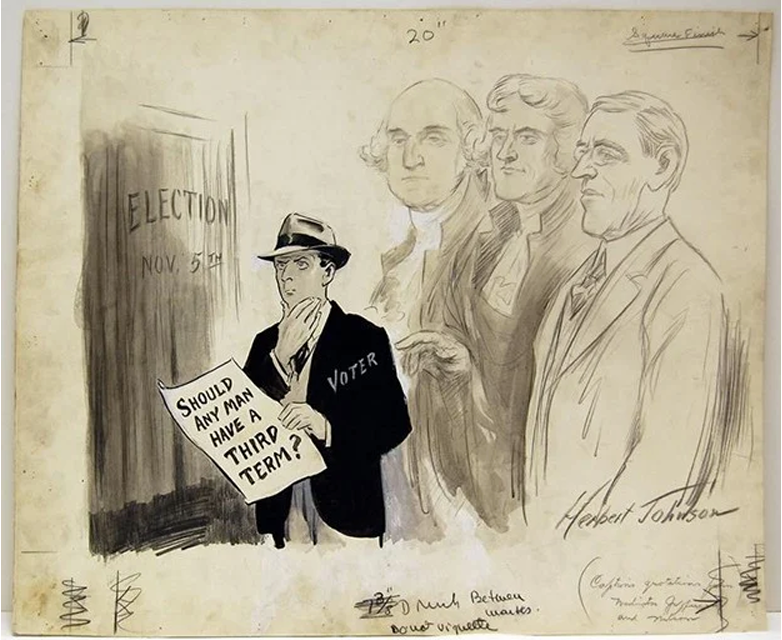
They both believed, however, that a grave crisis could change the equation. “I can see no propriety in precluding ourselves from the services of any man, who on some great emergency, shall be deemed, universally, most capable of serving the Public,” Washington wrote. To Jefferson, the only sufficient exigency would be “such a division about a successor as might bring in a Monarchist.”
For some, precedent was not enough, and the first attempt to codify presidential tenure occurred in 1803 with a resolution to bar a third term unless at least four years had passed since that chief executive had completed his second term. In 1824 and 1826, proposals were made for a two-term limit with no exceptions, and less than a decade later, President Andrew Jackson advocated presidents be limited to a single four- or six-year term. None of these proposals became law, but they were the first of more than 250 legislative attempts that would be made over the years to restrict presidential tenure.
The two-term tradition was tested in 1876 when Ulysses Grant was poised to became the first president since Andrew Jackson to serve two full terms. Grant entertained thoughts of a third term, which his opponents labeled “Caesarism,” but he played it coy. He wrote that he would not seek or accept his party’s nomination “unless it should come under such circumstances as to make it an imperative duty.”
Leaving the door ajar was too much for Congress. The House voted 233-18 to affirm that chief executives “retiring from the presidential office after their second term, has become, by universal concurrence, a part of our republican system of government.” To depart from this tradition, the House declared, would be “unwise, unpatriotic, and fraught with peril to our free institutions.” The nomination went to Rutherford B. Hayes instead.
Four years later, Grant was still interested in a third term. “I cannot decline if the nomination is tendered without seeking on my part,” he wrote. It almost came to pass. At the Republican Convention in June 1880, he was the leading vote-getter for more than 30 ballots. It was not until the 36th ballot that the nomination went to James A. Garfield.
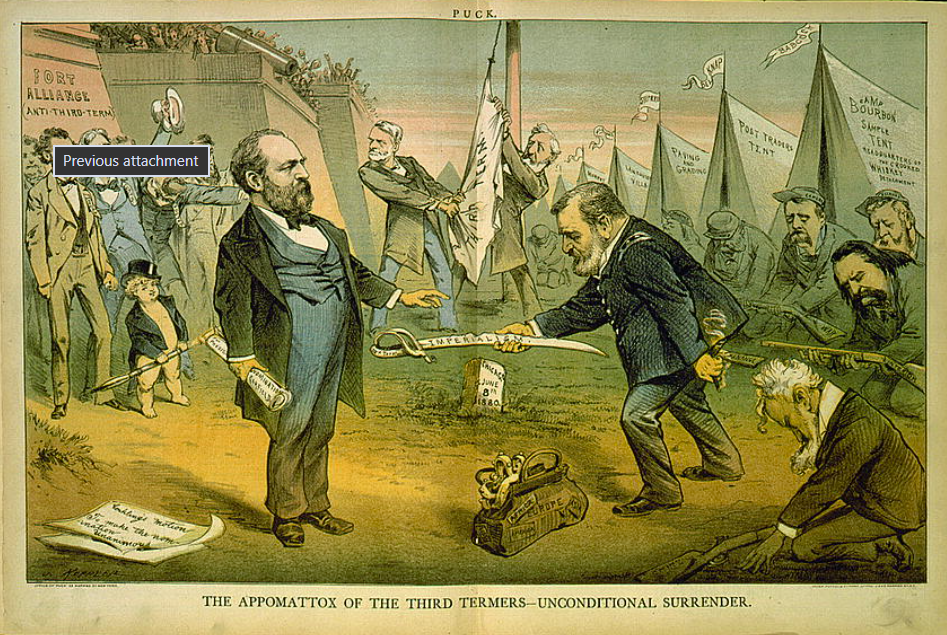
In the early 1900s, Theodore Roosevelt added a twist to the tenure debate. As vice president, he had ascended to the presidency in 1901 when William McKinley was assassinated. He served the remaining three years of McKinley’s term and was then elected on his own in 1904. He pledged not to run in 1908.
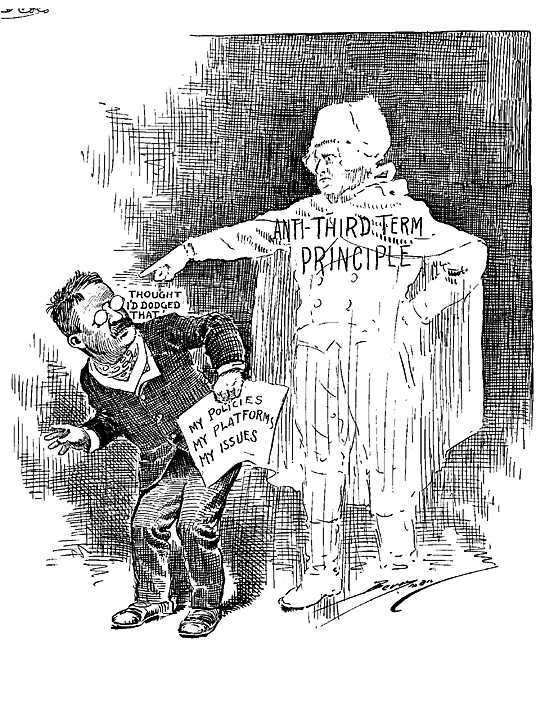
Roosevelt believed the two-term tradition hinged on how many terms a president had served, not how many times he had been elected. In his view, serving out McKinley’s term counted as his first term, and his own election in 1904 constituted his second. “The wise custom which limits the President to two terms,” he explained, “regards the substance and not the form.”
In 1912, however, Roosevelt seemed to change his tune. After a split with the Republican Party, he ran as a third-party candidate. When his opponents confronted him with his earlier pledge not to run again, he brushed off their criticisms as the “veriest bugaboo ever held up to frighten political children.” He contended the two-term tradition barred only three consecutive terms. Because four years had passed since he had left office, he said, his candidacy squared with the established practice.
One who violently disagreed was saloonkeeper John Schrank, who shot Roosevelt at a campaign stop in Milwaukee on October 14, 1912. Schrank later said he had attacked Roosevelt “as a warning that men must not try to have more than two terms as President.” Roosevelt recovered, and Schrank was judged insane. In November, Roosevelt and incumbent William Howard Taft split the Republican vote, and Democrat Woodrow Wilson became president.
The two-term tradition breathed its last in 1940, as Franklin Roosevelt’s second term neared its end. It was a time of unprecedented world crisis. In September 1939, Hitler had invaded Poland, sparking war with Britain and France. By mid-1940, France had fallen, Britain stood alone against the Nazi onslaught, and American neutrality was becoming more precarious. Roosevelt and his supporters saw this as the type of exigency Washington had envisioned as warranting a third term.
Roosevelt did not overtly seek the nomination, but there was no doubt he wanted it. Voters had come to expect chief executives to step down after eight years, and too blatant a pursuit of another term might alienate them. The conflict in Europe proved to be the wild card. In July 1939, before the war began, a Gallup poll showed that fewer than 40% of respondents supported Roosevelt for a third term. A year later, that figure had jumped to nearly 60%.
In July 1940, the Democratic National Convention nominated Roosevelt in what was euphemistically called a “draft,” and he framed his acceptance as a patriotic duty. In times of crisis, he told the delegates, “all those who can be of service to the Republic have no choice but to offer themselves for service.” In the ensuing campaign, Republicans tried to exploit the third-term issue, insinuating the president had dictatorial ambitions, and in his speeches, Republican candidate Wendell Willkie referred to Roosevelt as “Mr. Third-Term Candidate.” Nonetheless, Roosevelt won handily in November.
In 1944, the nation was embroiled in a world war, with victory over Germany and Japan on the horizon. The Democratic Party again nominated Roosevelt, and he won his fourth term in November. He was inaugurated in January 1945 but died less than three months later. Vice President Harry S. Truman succeeded him.
When Congress convened in 1947, the GOP made a two-term constitutional amendment its priority. The goal, said House Speaker Joseph W. Martin, Jr., (R-Mass.) was “to do away with one-man government for once and for all.” The Republican majorities in the Senate and House were less than the two-thirds required to pass a constitutional amendment, however, so the Republicans needed help from the Democrats.
The proposed amendment, introduced by Michener, was strict but clear. It provided that no person “shall be chosen or serve as President…if such person shall have theretofore served as President during the whole or any part of each of any two separate terms.” Under this language, no president could be elected more than twice, and one who ascended to the presidency through death or resignation could be elected only once.
The ensuing House debate blended principle with politics.
Rep. Karl E. Mundt (R-S.D.) insisted the amendment was needed to prevent a president from using patronage and the bully pulpit to keep himself in office indefinitely, and Rep. Charles A. Halleck (R-Ind.), emphasized the measure was nothing new. “(W)hat we are doing here today is simply writing into the Constitution…the so-called two-term tradition that has grown up in our country throughout the years,” he said. The amendment struck the appropriate balance, Rep. Edward O. McCowen (R-Ohio) maintained. “Eight years is long enough for a good President and 4 years is too long for a bad one,” he noted.
Opponents, however, saw the measure as an assault on democracy because it prevented voters from electing the candidate of their choice as many times as they saw fit. “(T)he privilege of choosing whom they please to be their leader,” argued Rep. Sam Rayburn (D-Tex.), “is democracy, real democracy, in action.” Rep. Frank Chelf (D-Ky.) minced no words. He called the amendment “unwarranted, unneeded, unwise, undesirable, unthinkable, unbelievable, unconscionable, and…it actually reeks with putrefaction insofar as keeping good faith with our basic precepts of democracy.”
Rep. John W. McCormack (D-Mass.) feared the measure would tie “the hands of future generations of Americans…to meet any problem that might confront them.” Rep. Joseph R. Bryson (D-S.C.) agreed, envisioning “future crises and exigencies which could well make it mandatory that we continue a Chief Magistrate in office beyond an 8-year period.” Rep. John M. Robsion (R-Ky.) scoffed, doubting the nation would ever be “so bankrupt of leadership and patriotism that we accept the principle of the indispensable man.”
Partisanship was never far from the surface. Mundt accused Roosevelt of using “the great powers of the Presidency to perpetuate himself in office.” This prompted Rep. Adolph J. Sabath (D-Ill.), to allege that Republicans were pushing the amendment to win a “pitiful victory over a great man now sleeping on the banks of the Hudson.”
On February 6, 1947, the House approved Michener’s amendment by the required two-thirds margin. Three future presidents voted. Rep. John F. Kennedy (D-Mass.) and Rep. Richard Nixon (R-Calif.) supported the measure, while Rep. Lyndon Johnson (D-Tex.) opposed it. The amendment went to the Senate.

In the upper chamber, the sticking point became the vice president who assumes the presidency through the death of his predecessor, as had happened three times in the last 50 years (Theodore Roosevelt in 1901, Calvin Coolidge in 1923 and Harry Truman in 1945). Under the Michener amendment, an ascending vice president could be elected to only one term because serving out a predecessor’s term was considered a first term, even if it was only a sliver of that term. Some senators saw this as too restrictive, and this threatened to derail the amendment.
To break the impasse, Sen. Warren G. Magnuson (D-Wash.) suggested taking the ascending-vice-president scenario out of the picture entirely. He proposed a measure that read simply: “No person shall be elected to the office of the President more than twice.” This meant that all presidents, including those who had reached the presidency through death or resignation, could be elected twice.
This language also changed the amendment in an unforeseen way. Substituting “elected” for “serve” raised the possibility, at least in theory, that a two-term president might later get a third term by being elected vice president and regaining the top spot through death or resignation. Even though this hypothetical chief executive would serve three terms, he would be elected president only twice. Under Michener’s amendment, this could not happen because no president could serve more than two terms. Since the Senate’s focus was on the vice president who became president before being elected on his own, however, no one discussed, mentioned or even noticed this potential loophole.
Magnuson’s proposal did not break the deadlock, but it paved the way. After behind-the-scenes negotiations with Senate Democrats, Sen. Robert A. Taft (R-Ohio) came up with the compromise that became the 22nd Amendment. Magnuson’s wording on being “elected…more than twice” was kept, but a provision was added to limit an ascending vice president to being elected only once if he had served more than two years of his predecessor’s term. Otherwise, he could be elected twice.
On March 12, 1947, the Senate approved Taft’s compromise, and the House did the same nine days later. The measure went to the states and took effect in 1951 after the constitutionally required three-quarters of the states had ratified it. Republicans celebrated. “There is no place for kings or dictators in our Republic,” said Guy Gabrielson, chairman of the Republican National Committee.
Although the 22nd Amendment was now law, some still saw it as bad policy, and it took only a few years for the initial attempt to be made to undo it. In July 1956, Rep. James M. Quigley (D-Pa.) introduced a repeal resolution, the first of more than 45 attempts that would be made to rescind the amendment.
The repeal movement gathered steam three years later when, on January 14, 1959, Sen. Thomas C. Hennings, Jr. (D-Mo.) introduced a resolution to undo the 22nd Amendment. The measure was sent to the Senate Subcommittee on Constitutional Amendments, which held a hearing on May 4, 1959. The main witness was former President Truman. “Out of 175 million people in this country,” he joked, “I am the only one to whom the amendment does not apply.” Indeed, the amendment exempted Truman because he was in office when it was enacted. In a more serious vein, Truman contended that limiting presidential tenure is unwise because it neuters a chief executive as a lame duck the moment his second term begins. “You have taken a man and put him in the hardest job in the world…with one hand tied behind his back,” he explained.
Others also spoke in favor of repeal, including the subcommittee chairman, Sen. Estes Kefauver (D-Tenn.), who insisted the 22nd Amendment was “the embodiment of a distrust in the ability of our children and grandchildren to govern themselves.” The amendment had been rushed through Congress, he said, with “an indecent lack of debate on it in both Houses” and a failure to scrutinize all its implications.
On September 1, 1959, the subcommittee approved the repeal proposal and sent it to the full Judiciary Committee. Despite the subcommittee’s endorsement, however, the drive stalled. A Gallup poll showed nearly two-thirds of the public favored the two-term restriction, and President Dwight Eisenhower delivered the coup de grâce when he recommended a wait-and-see approach. “I think the Constitution is something that ought to be amended only after careful thought…,” he said, “(s)o, as of now, I would say, let's let it (the 22nd Amendment) lay on the shelf for a while and see how it works.”
The issue was of only academic interest to Eisenhower. At the start of his second term, he had told reporters, “Look, I will give you people a piece of news. They can repeal it if they want to. I shall not run again.”
During the 1960 presidential campaign, Eisenhower created a stir by raising a possibility no one before him had considered. At a news conference in January 1960, he jokingly suggested the 22nd Amendment would not bar him from running for vice president. “(Y)ou might find out about that one. I don't know,” he said with a chuckle, but he never intimated using the vice presidency as a springboard to a third term. In any event, he did not run.
Perhaps the most unusual attempt to undo the term limit came in 1973 from a group called Citizens for Nixon ’76. Nixon was serving his second term when the group promised a massive advertising campaign to undo the 22nd Amendment. Just how serious this effort was is open to question. The group later conceded it had no ties to Nixon and had used his name only to draw publicity. The campaign never got off the ground, and the Watergate scandals forced Nixon from office before his second term ended.
A highly publicized repeal attempt occurred in 1986, when Ronald Reagan was in his second term and the mid-term congressional elections were approaching. On July 28, 1986, Rep. Guy Vander Jagt (R-Mich.) introduced a resolution to undo the two-term limit. “Ronald Reagan is one of the greatest American Presidents of all time,” he said, “and I want to keep him on the job.” Vander Jagt’s campaign spawned rallies and colorful slogans like "Put Him Back in the Saddle Again."
Vander Jagt, however, was also chairman of the Republican congressional campaign committee. When he introduced his resolution, he announced it in a letter to 300,000 of the party faithful, urging them to donate to the congressional campaign fund. Time magazine wrote off Vander Jagt’s effort as nothing but “a gimmick to fatten G.O.P. coffers.”
Reagan favored repeal, but only for future presidents. In 1986, he said he thought the term limit “interfered with the democratic rights of the people…Why don’t they have the right to vote for whoever they want to vote for?” He acknowledged, however, that it would be unseemly for a president to seek repeal to benefit himself.
Reagan’s pro-repeal position appeared to be a change of heart. While a gubernatorial candidate in California in 1966, he had pledged to seek a term limit for that state’s governors. “(S)omeone who couldn’t solve the state’s problems in eight years, sure isn’t going to turn into a genius in the next three or four years,” he contended. California enacted a term limit but not until 1990.
Trump’s re-election in 2024 brought the 22nd Amendment to the forefront once again with a flurry of proposals. On November 14, 2024, only a week after the election, Rep. Dan Goldman (D-N.Y.) introduced a resolution to affirm that the two-term limit applies to presidents, like Trump, who have served non-consecutive terms. On January 23, 2025, three days into Trump’s second term, Rep. Andy Ogles (R-Tenn.) offered a measure to modify the 22nd Amendment to allow a president to be elected three times. Three months later, Sen. Ed Markey (D-Mass.) asked the Senate to confirm that the 22nd Amendment renders Trump “ineligible in any future elections to be elected Vice-President or President, or to serve as President beyond the conclusion of his current term.” None of these proposals gained traction.
Trump himself has sent mixed signals. In October 2024, he said he would “love to” serve a third term,” and in March 2025, he claimed “(a) lot of people want me to (seek another term).” He insisted there are ways that he could do it, and he mentioned being elected vice president and ascending to the presidency. His online store began selling “Trump 2028” baseball caps. Seven months later, however, he seemed to acknowledge that the 22nd Amendment bars him from serving again, adding that using the vice presidency as the path to another term might be “too cute” for voters to accept.
Nevertheless, conservative influencer Steve Bannon has guaranteed Republicans have a plan to keep Trump in office. “(P)eople ought to just get accommodated with that,” he said. A group called the Third Term Project is also beating the drum. One of its proposals, albeit a far-fetched one, is for a 2028 all-Trump ticket of Donald Trump, Jr., for president and Trump, Sr., as his running mate, with Trump Jr. “gracefully resigning” on Inauguration Day.
What will happen in 2028 is anyone’s guess, and wise observers have learned to expect the unexpected from this president. The chances of a term-limit repeal are nil, with a polarized Congress unable to agree on much less controversial issues. Without repeal, it is difficult to envision a candidate with the gravitas to be elected president who would willingly act as a mere placeholder for his running mate. Whatever transpires, the only certainty is that presidential tenure will continue to be, as it has been since the beginning, a volatile and hotly debated fixture on the American political landscape.