
Even more important than the substance of Marshall’s rulings was what they said about the power of the Supreme Court and the nature of the Constitution.
-
Winter 2026
9 months ago By Richard Bell Volume71Issue1
Editor’s Note: Richard Brookhiser is a senior editor at the National Review and author of over a dozen books, including ones on George Washington, James Madison, and Alexander Hamilton. Portions of this essay appeared in his splendid book John Marshall: The Man Who Made the Supreme Court. President George W. Bush awarded Brookhiser the National Humanities Medal in 2008.
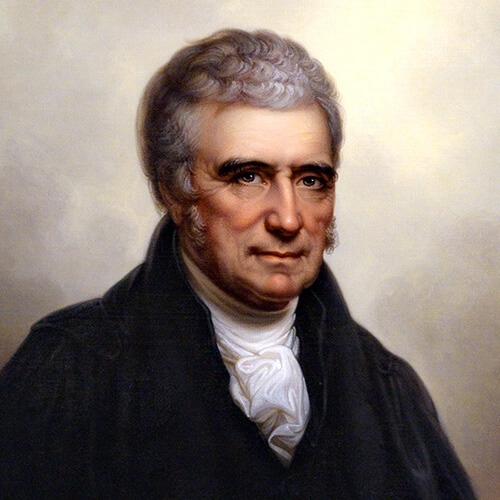
As chief justice of the Supreme Court for thirty-four years — a record that still stands — John Marshall impressed, charmed, and defied colleagues, skeptics, and enemies, transforming an institution to which the Founding Fathers had given relatively little thought into a pillar of the nation.
In 1801 when Marshall became chief justice, the job lacked “dignity,” as one contemporary put it, while the judiciary was, in the words of another, the “weakest” branch of the federal government. When Marshall died in 1835, he and the Court he led had rebuked two presidents, Congress, and a dozen states and laid down principles of law and politics that still apply.
In his rulings, Marshall he made the Supreme Court a definer of its own powers and a peer — sometimes, the superior — of Congress and the president. Now, when the Supreme Court makes the news every day it sits, and every time a new justice must be appointed, there is no question of its prominence. It owes that prominence, in the first instance, to Marshall, the man who made it.
But the most formative experiences of Marshall’s life came not in court but in battle. That was where he met George Washington, the man he called simply “the greatest Man on earth,” whose example would inspire and guide him for the rest of his life. The revolutionary army that Washington led drew patriotic young men like Marshall from every state who risked privation, injury, and death for their common country. The man who commanded them struck the enemy where he could and stood firm when he had to; he was judicious, brave, and a leader of men.
For the rest of his life, John Marshall saw Washington as his commander and himself as one of his troops. In 1787, Washington left his postwar retirement to preside over the Constitutional Convention in Philadelphia. Marshall, still in his early thirties, was not yet eminent enough to be sent as a delegate to that meeting, but in 1788, he served in the Virginia Ratifying Convention in Richmond, defending the Constitution that Washington had signed.
In 1798, Washington summoned his former junior officer to Mount Vernon and told him to run for Congress; Marshall obeyed. In 1799, after the great man died, it was Marshall who eulogized him, on the floor of the House, as “first in war, first in peace, and first in the hearts of his countrymen.”
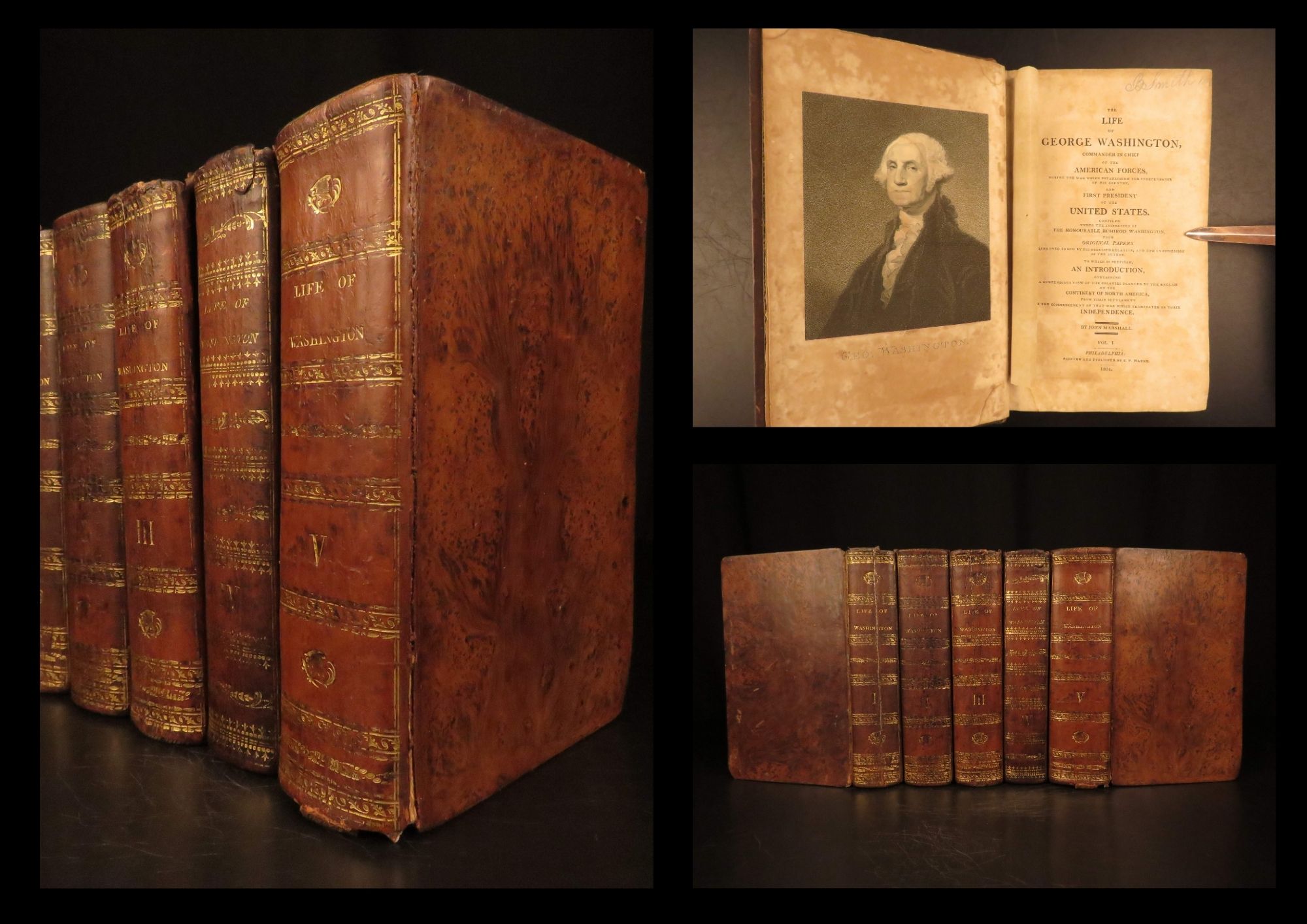
But Washington was more than a hero to Marshall. He was a man with principles and an agenda, who had learned from the privations of his army the need for a capable national government, and who then worked as a Constitution-maker and president to design and lead one. How could Marshall support Washington while he lived and defend his handiwork after he was gone?
The most obvious way was politics, and Marshall had an abiding interest in it. In the first national two-party system that emerged in the 1790s, the party Marshall joined was the Federalists. Their policies were Washington’s: a strong federal government that could pay its debts, foster commerce, and sustain a unified nation in a turbulent world. Marshall was friendly with every prominent Federalist — Washington, John Adams, Alexander Hamilton, Timothy Pickering — even when, as their party began to sink at the turn of the century, they turned on each other. The only man Marshall ever hated was Federalism’s enemy and destroyer (and his own cousin) — Thomas Jefferson.
Federalism withered and died, new parties emerged; Marshall kept tabs on them all. He was touted as a presidential candidate himself in one election season, and in another he attended America’s first national political convention, organized by America’s first third party (the Marshall campaign went nowhere, as did the third party).
See also Adams Appoints Marshall, by Gordon S. Wood
Yet although politics was a lifelong interest of Marshall’s, it was not his main one. He had a vocation, which was the law. His father, Thomas, had decided that his eldest child should be a lawyer; William Blackstone’s Commentaries on the Laws of England, then the most popular legal text in the English-speaking world, was part of John’s homeschooling. In 1780, while on a furlough from the army, he attended a course of lectures in the law at William and Mary — the only formal legal instruction he would ever receive, but since the course was given by George Wythe, one of the top legal minds in the country, it was first-rate.
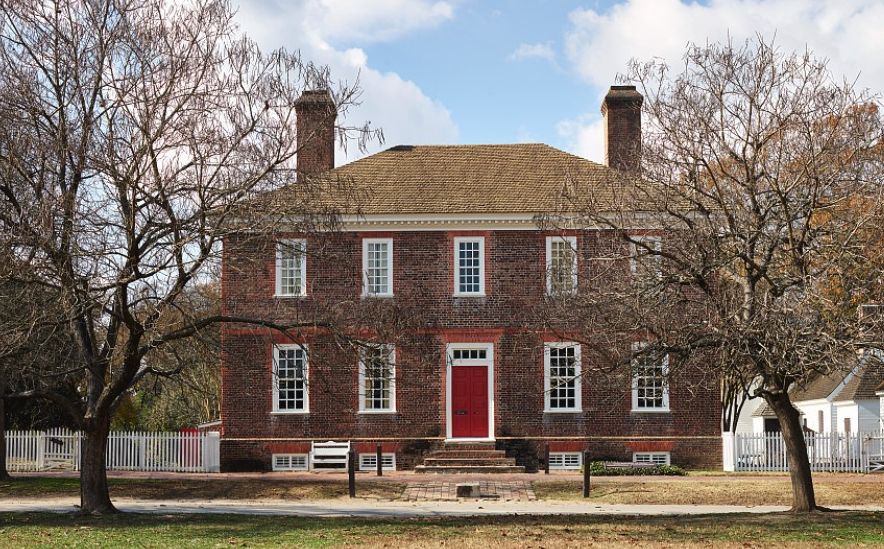
After the war, Marshall established a practice in Richmond, Virginia’s new capital, quickly joining the state’s legal elite. His practice was so engrossing that he refused several offers of national public office.
In 1801, however, after serving in Congress and as secretary of state, he agreed to become the nation’s chief justice.
The Supreme Court that Marshall led was the federal government’s fledgling, almost its orphan. In twelve years, it had traveled, with the nation’s capital, through three cities — New York, Philadelphia, and the brand-new site on the Potomac; between terms, justices were required to ride circuit over hundreds of miles of woeful roads. Partly because of these hardships, three men had already cycled through the post of chief justice before Marshall took the job.
The law that the Court administered was in no better shape. Americans were already famously litigious, but the legal arena in which they struggled was poorly marked. Colonial precedents had been upset by the Revolution; many Americans, from pioneers on the margins of settlement to wealthy grandees, simply broke whatever laws there were, old or new. Americans went to court to scramble for land and to exploit new technology; to defend their religious and political beliefs and to attack the beliefs of their neighbors. Black men and red men went to court — mostly, though not always, unsuccessfully — for relief from injustices committed by white men; white men went to court to gouge each other.
At the helm of the Supreme Court, Marshall brought order to this chaos. He did it by expressing and implementing the principles he had imbibed from Washington and from other Federalists such as Alexander Hamilton. In a series of landmark decisions, he defended contracts and corporations from meddlesome state laws and struck down state-sponsored monopolies, unblocking what Hamilton called “the veins of commerce”; he affirmed the constitutionality of a national bank, one of the keystones of Washington’s economic policy; he compelled state courts to acknowledge the supremacy of the federal judiciary (Hamilton had likened unchecked state courts to “a hydra in government”); and he tried, in vain, to sustain Washington’s Indian policy, whereby native peoples who signed and honored treaties with the United States could keep their tribal lands.
In 1801, Jefferson, who had been inaugurated president only five weeks after Marshall was confirmed as chief justice, complained that Federalism had “retired into the judiciary as a stronghold.” Marshall held his position as resolutely as Washington had at the battle of White Marsh.
More important than the substance of Marshall’s rulings was what they said about the power of the Supreme Court and the nature of the Constitution. He disclaimed any intention to judge matters that were strictly political, but he insisted that in defense of the Constitution’s text or of constitutionally protected rights, the Supreme Court could overturn a law passed by Congress or compel a president to testify in a courtroom. In so ruling, he made the Supreme Court a definer of its own powers and a peer — sometimes, the superior — of Congress and the president.
Marshall was, at the deepest level of his thought, a populist; he believed that the people had expressed their incontrovertible will when they debated and ratified the Constitution. But until they willed something new, they and their representatives — citizens, legislators, and chief executives alike — were bound by their first foundational act. And the Supreme Court was a guardian — a protector and an expounder — of that act.
In his conduct as chief justice, Marshall imitated his former commander in chief as much as a judge can imitate a president or a general. Marshall’s description of Washington in action outside Philadelphia described what he himself wished to be. Some of the phrases he used — “firmness of temper,” “steady firmness” — applied equally to himself. If his courtroom exhortations were not always as stern as Washington’s battlefield appeals — Marshall listened and persuaded as often as he commanded — they were as persistent and as successful.
In one respect, Marshall exceeded his idol. Washington’s combined service as commander in chief during the Revolution (1775–83) and first president (1789–97) made him the nation’s chief executive for sixteen and a half years. But Marshall’s tenure as chief justice was more than twice as long.
When he died, Marshall was eulogized as “a Federalist of the good old school of which Washington was the acknowledged head.”
What did john Marshall accomplish as chief justice? He gave the office what its first occupant, John Jay, had complained it lacked: dignity. Some of that dignity was imparted by mere staying power. Marshall served alongside six presidents, swearing in five of them in nine inaugurals.
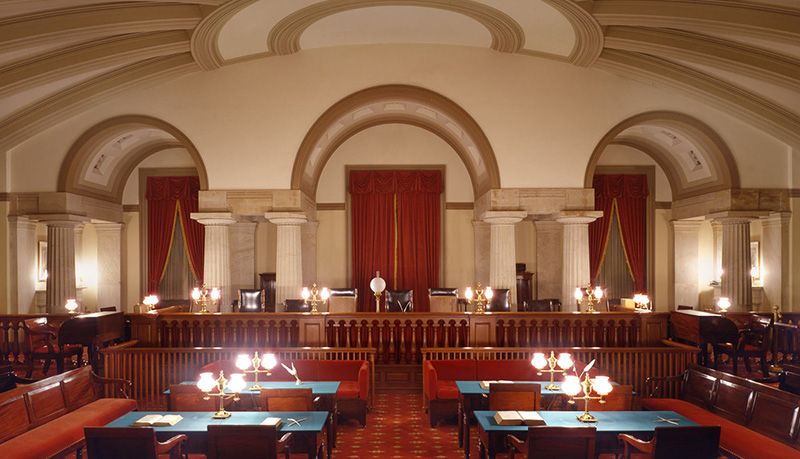
Marshall’s manner radiated dignity. Jefferson called him lax and lounging; friends spoke of him as simple. But once he mounted the bench, he was sober, focused, direct. His thoughts seemed well arranged and logical; his rhetoric typically had a quality that we, standing after and away from it, associate with the century in which he grew up-balanced, sometimes ringing, minus the flourishes and reaching for effect of romantic orators (Clay, Webster, Lincoln).
He instilled his dignity into his Court. Whatever backstage maneuvers he and his brother justices engaged in, the high number of unanimous decisions they issued gave them solidity and mass. Justices during his tenure still ran hither and yon on circuit duty (and several of Marshall’s most consequential decisions — in Stuart v. Laird and in the trial of Aaron Burr — were delivered in Richmond); when the justices met together in Washington, it was in ground-floor quarters in the Capitol, at worst squalid, at best modest. But when they decided, the nation listened. As much as possible, Marshall made them not six or seven men but one body. This was why McLean’s public spat with Thompson and Baldwin in Peters v. Wheaton, or Johnson’s indiscreet discussions of how a judicial sausage had been made in Ogden v. Saunders, were so wounding to Marshall’s project.
Justice Story called Marshall the advocate of George Washington’s principles, a description he repeated in a eulogy, in which he hailed Marshall as “a Federalist of the good old school of which Washington was the acknowledged head.” What principles had he upheld? To what school had he belonged?
In Marshall’s view, America’s earliest days of independence were a chaos of slipshod legislating and power grabs by interest groups, chiefly debtors. To cure the evil, he spoke for the validity of contracts, even contracts made by crooked politicians (Fletcher v. Peck) or George III (Dartmouth v. Woodward). In his only dissent on a constitutional question (Ogden v. Saunders) he wrote of contracts in almost sacred terms.
Twenty-five years after the fact, he inserted himself into one of the defining arguments of the Washington administration, declaring (in McCulloch v. Maryland) that the power to charter a Bank of the United States was constitutional (even if not explicitly enumerated) and, by implication, wise. Hamilton proposed a Bank, Washington approved it; the Republican Party resisted it, accepted it, killed it, then revived it. Marshall anchored it in the Constitution.
When states claimed the power to ignore this and other decisions and go their own legal way — breaking into bank vaults (Osborn v. Bank of the United States) or refusing to hear appeals from their wayward actions — fining lottery promoters (Cohens v. Virginia), overturning a land deal made by Marshall’s brother (Martin v. Hunter’s Lessee) — he, or Justice Story, called them to account. States had many powers reserved to them, but where a power was given to the federal government, Marshall and his Court defended it zealously.
Some of his principles were a shade less definite. He considered with sympathy the proposition that the United States was meant to be a single economic unit — E Pluribus Unum, as Daniel Webster romantically called it — though when he struck down a state-approved transportation monopoly, he did it on a smaller point (Gibbons v. Ogden).
In the early 1790s, the Washington administration had considered establishing free Indian nations within America’s borders. Marshall would not go so far; he defined Indian tribes as “domestic dependent nations” (Cherokee Nation v. Georgia) and denied them standing to sue in federal courts as foreign countries. But he recognized the sovereignty of these nations as defined by treaties with the federal government and defended it (Worcester v. Georgia) against state incursions and presidential hostility.
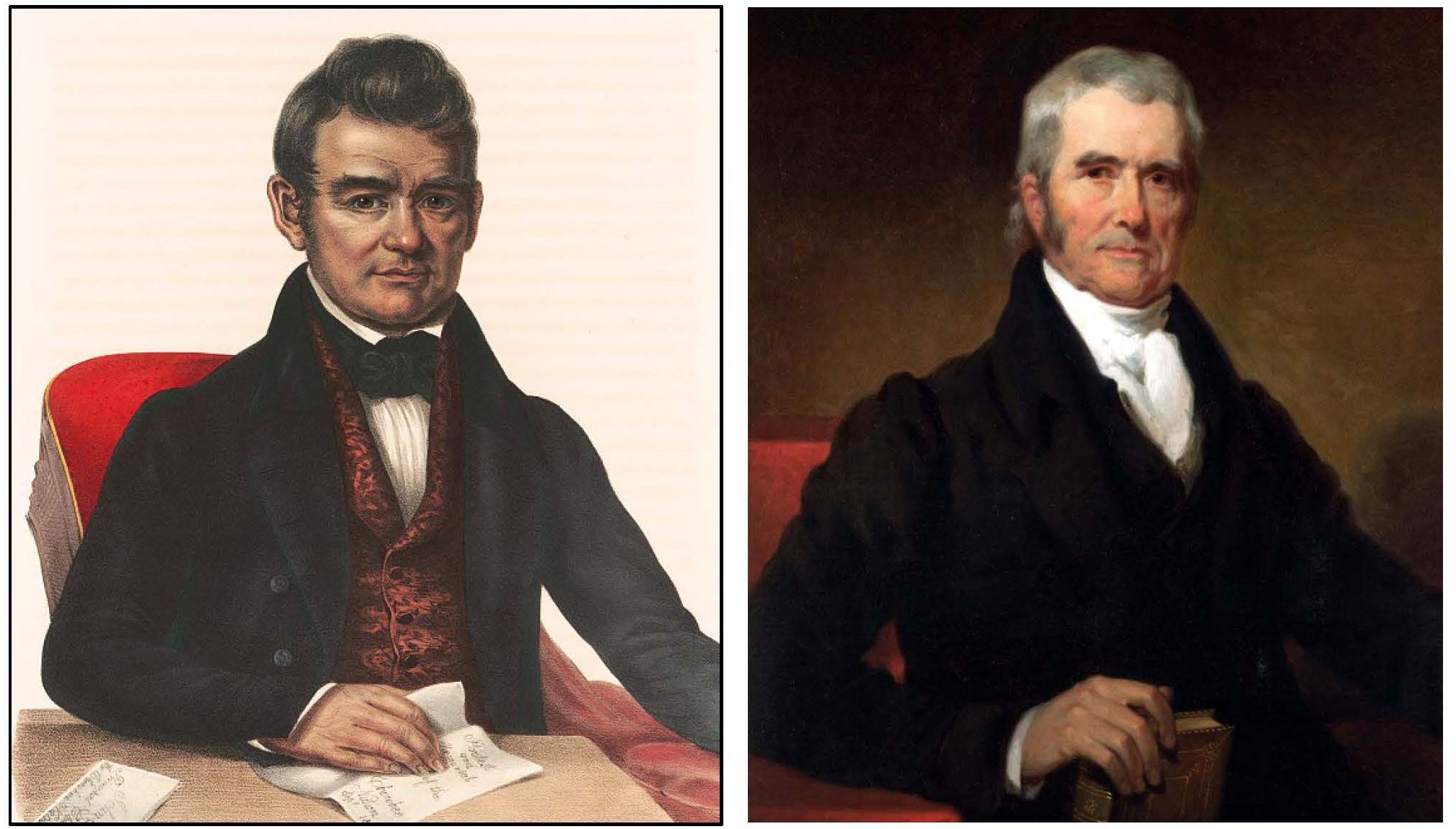
He rebuked the crooked dealings of some slave traders (Antelope), though he left the resolution of the problem of slavery to private charity and to the states, which is to say, in limbo.
These (with the partial exception of his views on slavery) were substantially the policies of Washington and his most trusted aide, Alexander Hamilton. Marshall served with both in the Revolution; they went on to politics and administration; he went on to the judiciary, where he defended their handiwork, using their arguments, sometimes (as in Cohens v. Virginia) their very words.
Marshall’s greatest accomplishment, though congruent with Washington’s and Hamilton’s way of thinking, was something elaborated by Marshall himself: defending the Constitution as the people’s supreme act. The Philadelphia Convention of 1787 had been a secret conclave, with no one besides the delegates admitted and no words of theirs escaping until the very end. But the ratification struggle of 1787-8 had been a yearlong, wide-open process, played out in newspapers, pamphlets (of which the Federalist was only one of many), and state ratifying conventions. The people had made a new government, giving it new powers, and binding it with new prohibitions.
It was, as Marshall wrote in McCulloch, a government of the people, emanating from them, its powers granted by them, to be exercised on them and for their benefit. Marshall devoted his decades as chief justice to explicating and upholding the people’s government against the attacks of men he deemed demagogues in Congress, in the states (including his own Virginia), and in the White House (including his own cousin).
In defending the Constitution, he used two weapons. Sometimes he relied, in almost Hebraic fashion, on its words (literalism). They had issued, as from a cloud, and should be read and pondered in splendid isolation. “The intention of the instrument must prevail,” as he wrote in his dissent in Ogden v. Saunders. “This intention must be collected from its words.”
Sometimes he relied, additionally or instead, on the historical context of its creation: the particular ills the framers and the American people had faced, the desires and the fears reflected in the remedies they had chosen. “The great revolution which established the constitution of the United States,” as he put it in Barron v. Baltimore, “is universally understood... is a part of the history of the day.”
Marshall’s key to that history was his own history: observing the ratification struggle as it unfolded nationwide, participating in the Richmond ratifying convention, following as always George Washington’s imperative lead.
Washington died, Hamilton died, the Federalist Party died. But for thirty-four years, Marshall held his ground on the Supreme Court, showing the steady firmness and vigorous performance of duty that he had witnessed in Washington at the battle White Marsh outside Philadelphia when he was twenty-two years old.
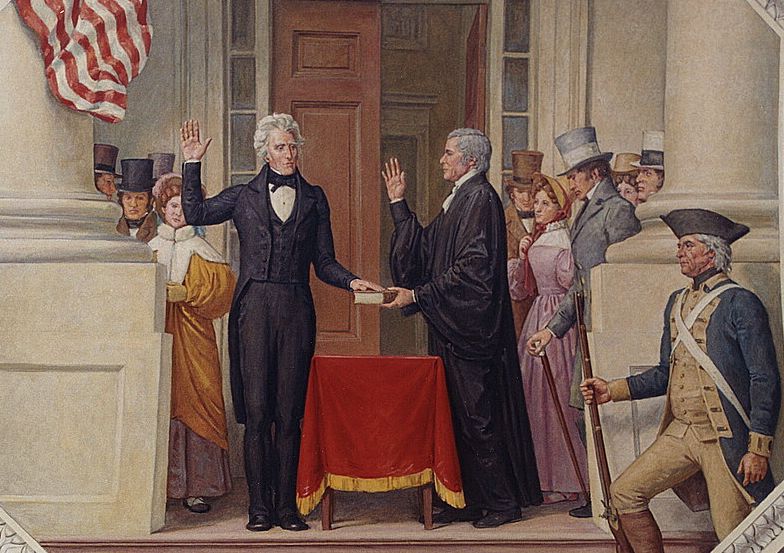
Marshall himself, at the end of his life, saw his accomplishments differently. He feared he had failed and that the Union might fail. After Thomas Jefferson’s retirement, the Court for a time no longer had to defend itself, and Marshall and his colleagues had reaped a harvest of decisions.
But in the mid-1820s, things began to come unstuck. Andrew Jackson was a much more resolute advocate of his own ideas than Jefferson had been; he neither schemed nor theorized, he acted. He destroyed the second Bank of the United States and articulated a principle of executive power that equally destroyed Marshall’s reasoning in McCulloch. He let Marshall’s last Cherokee decision fall stillborn. He quashed nullification, but was otherwise friendly to the prerogatives of states not dominated by John Calhoun.
In October 1834, nine months before his death, Marshall wrote a sober letter to Thomas Grimké, a South Carolina lawyer who was a supporter of the Union (and thus a lonely man). Is our Constitution, wrote Marshall, “a LEAGUE” or “A GOVERNMENT” (his capital letters)?
“This is the true and substantial dividing line between parties in the United States,” Marshall wrote. “One of more vital importance cannot be drawn. As the one opinion or the other prevails, will the union, as I firmly believe, be preserved or dissolved.” Dissolution and preservation would come some thirty years later.